


In thermal processing facilities, petrochemical refineries, and power generation boilers, static equipment flanges and moving furnace doors require flexible, high-temperature thermal barriers. Gaskets and packing seals must endure continuous temperatures from 650°C to 1100°C without embrittlement or structural disintegration. Specifying engineered ceramic fiber textiles manufactured from spun aluminosilicate yarns provides the definitive thermal insulation and sealing solution. At Topower Refractory, we manufacture and export comprehensive ceramic textile product lines-including woven cloth, twisted and braided ropes, and insulating tapes reinforced with glass filament or stainless steel wire-to provide durable thermal barrier solutions worldwide.
Key Technical Sourcing Facts
Primary Textile Formats: High-temp cloth (1.5 to 5.0 mm thickness, 1000 mm width), packing ropes (twisted, round braided, square braided in 6 to 50 mm diameters), and expansion joint tapes (25 to 100 mm widths).
Reinforcement Metallurgy: E-glass filament reinforcement for continuous service up to 650°C; heat-resistant nickel-chrome stainless steel wire reinforcement for severe duty up to 1050°C to 1100°C.
Density & Physical Characteristics: Bulk density 500 to 800 kg/m3; low thermal conductivity <= 0.12 to 0.18 W/m·K at 600°C; organic carrier burnout <= 15% during first firing.
Factory Direct Sourcing: Supplied in standard 30 m rolls or coiled cartons on export pallets. Standard export lead time 7 to 10 days FOB Qingdao / Tianjin.
What Are Ceramic Fiber Textiles?
Engineered ceramic fiber textiles are high-temperature industrial fabrics manufactured from premium blown or spun aluminosilicate refractory ceramic fibers (purity 45% to 48% Al2O3 and 51% to 53% SiO2). Because raw ceramic fibers lack natural surface cohesion for direct spinning, approximately 15% organic carrier fibers (such as cellulose or viscose) are blended with the refractory bulk during carding and yarn spinning.
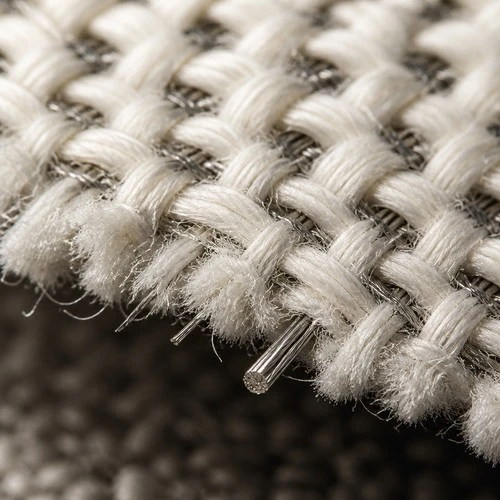
To impart high tensile strength across industrial thermal ranges, ceramic yarns are plied around internal reinforcement cores:
Glass Filament Core: Designed for non-conductive electrical insulation and moderate thermal sealing up to 650°C.
Stainless Steel Wire Core: Woven with fine 304 or 310S heat-resistant alloy wires, preserving mechanical integrity and tear resistance up to 1100°C.
During initial furnace heat-up between 200°C and 300°C, the organic processing carrier volatilizes with mild smoke, leaving behind a 100% pure, flexible, non-combustible inorganic refractory textile.
Technical Specifications: Glass Filament vs Stainless Steel Reinforcement
Selecting the appropriate textile reinforcement dictates temperature capability, tensile strength, and electrical properties. Below are verified inspection specifications from our production lines:
| Technical Property / Parameter | Glass Filament Reinforced (GF Series) | Stainless Steel Wire Reinforced (SS Series) | Bio-Soluble Fiber Textile | Test Standard |
|---|---|---|---|---|
| Classification Temperature (°C) | 1260 | 1260 | 1200 | ISO 10635 |
| Continuous Working Temp (°C) | 500 - 650 | 1000 - 1100 | 1000 - 1050 | In-House Standard |
| Reinforcement Material | E-Glass Filament Core | 304 / 310S Stainless Steel | SS Wire / Glass Filament | Visual / Metallurgy |
| Al2O3 Content (%) | 45.0 - 48.0 | 45.0 - 48.0 | / | ASTM C114 |
| SiO2 Content (%) | 51.0 - 53.0 | 51.0 - 53.0 | 55.0 - 65.0 | ASTM C114 |
| Alkaline Earth (CaO + MgO) (%) | / | / | 32.0 - 42.0 | ASTM C114 |
| Bulk Density (kg/m3) | 500 - 650 | 550 - 800 | 500 - 750 | ASTM C134 |
| Organic Content / Loss on Ignition | <= 15.0% | <= 15.0% | <= 15.0% | ASTM C612 |
| Moisture Content (%) | <= 1.0 | <= 1.0 | <= 1.0 | ASTM C612 |
| Tensile Strength (Warp / Weft) | >= 400 N / 50 mm | >= 800 N / 50 mm | >= 750 N / 50 mm | ASTM D5035 |
Note: For specialized smoke-free or cleanroom installations, Topower Refractory provides pre-heat-cleaned fabrics with organic carriers pre-burned under controlled factory conditions.
Product Format Selection: Cloth, Rope, and Tape
Ceramic fiber textiles are engineered into three primary industrial geometries tailored to specific mechanical mounting methods:
1. Ceramic Fiber Cloth
Woven fabrics supplied in standard 1.0 mm, 1.5 mm, 2.0 mm, 3.0 mm, and 5.0 mm thicknesses with a standard width of 1000 mm (length 30 m/roll). Widely specified for removable thermal insulation jackets, flexible flue expansion joints, personnel heat shields, and safety welding fire curtains.
2. Ceramic Fiber Ropes (Braided and Twisted)
High-density packing cords available in diameters from 6 mm to 50 mm across three distinct structural configurations:
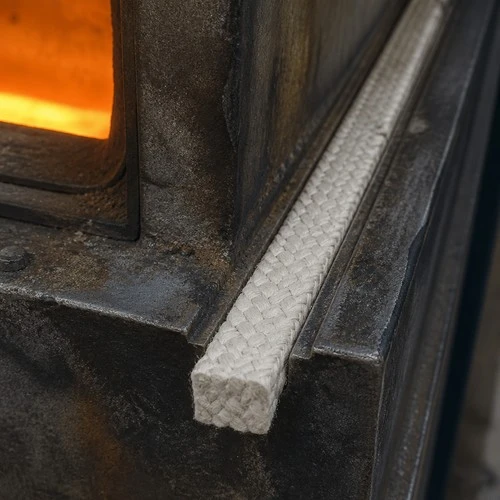
Round Braided Rope: High-density over-braided jacket over ceramic fiber cores, delivering excellent elasticity and compression recovery for kiln door jamb seals.
Square Braided Rope: Crisp rectangular cross-sections engineered for tight dimensional stuffing inside boiler door grooves and access hatch recesses.
Twisted Rope: Multiple plied strands loosely twisted for economical thermal caulking and pipe wrapping where deep compression is required.
3. Ceramic Fiber Tape
Narrow slit fabrics ranging from 25 mm to 100 mm in width (thickness 1.5 to 5.0 mm), available in plain flat weave or drop-warp "ladder tape" styles (with center warp yarns omitted to accommodate bolt holes on pipe flanges). Used extensively for wrapping exhaust manifolds, cable trays, and steam lines.
Thermal Sealing & Industrial Applications
Specifying ceramic fiber textiles improves thermal efficiency and prevents fugitive hot gas emissions across multiple industries:
1. Industrial Furnace and Kiln Door Seals
Furnace doors on heat-treatment furnaces, aluminum melting car-bottom kilns, and coke ovens cycle continuously. Square braided ceramic ropes provide a resilient gas-tight seal that absorbs door misalignment, preventing hot gas leakage that warps steel door frames.
2. Boiler Expansion Joints & Flexible Compensators
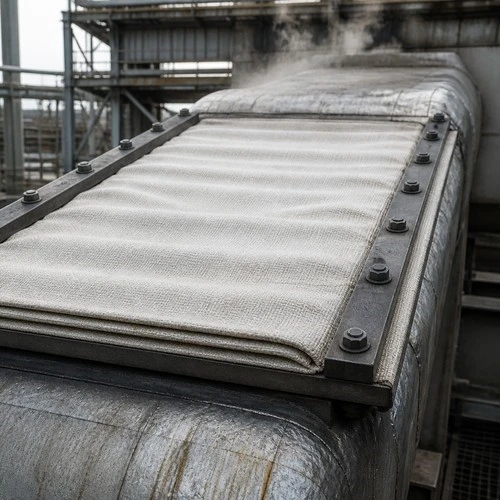
Power generation ductwork and petrochemical flue gas lines undergo severe axial thermal expansion. Multi-layer expansion joints incorporating stainless-steel-reinforced cloth withstand continuous vibration, acidic flue vapors, and mechanical turbulence when secured with heavy-duty stainless steel anchor systems and backed by a resilient ceramic fiber blanket.
3. Pipe & Exhaust Heat Insulation
High-temperature steam lines, engine exhaust manifolds, and turbine piping utilize ceramic tapes and cloth wrapping to lower outer skin temperatures, preventing personnel burns and reducing energy losses alongside rigid calcium silicate board installations.
4. Welding Blankets & Molten Splash Curtains
In metal fabrication and shipyards, heavy-gauge wire-reinforced ceramic cloth acts as an impenetrable shield against oxy-acetylene torch cutting sparks, molten weld spatter, and grinding slag.
Handling, Organic Burnout & Installation Protocol
Achieving maximum performance from refractory textile seals requires proper field installation discipline:
Understanding First-Fire Smoking: Inexperienced maintenance crews often mistake initial smoking for material failure. The 15% organic spinning carrier begins volatilizing between 200°C and 300°C, causing temporary discoloration and smoke. In closed workspaces, maintain local ventilation during initial firing; the fabric returns to natural white with full refractory strength once burnout completes.
Proper Compression Density in Grooves: When installing square or round braided packing ropes into door grooves, specify a rope diameter approximately 10% to 15% larger than the channel width. Compress evenly using wooden mallets without over-stretching the warp fibers.
Cutting and Edge Sealing: Always use heavy-duty industrial shears. To prevent frayed edges on cut cloth or tapes, technicians can apply high-temperature silicate adhesive or edge-wrap with refractory thread before bolting into clamping bars.
Packaging, Storage & Export Logistics
Topower Refractory ships industrial textile rolls and packing cartons configured for global container transit:
Export Roll Packing: Cloth and tape rolls are wrapped in protective polyethylene tubular bags, inserted into heavy-wall corrugated cartons, and unitized on heat-treated fumigated wooden pallets.
Rope Spool Packing: Braided ropes are coiled neatly inside reinforced export cartons or wound on sturdy plastic reels to prevent kinks during unrolling.
Warehouse Storage: Store cartons in dry, covered indoor facilities. While inorganic ceramic fibers do not rot or mildew, moisture saturation weakens the organic spinning carrier and impairs unwinding tension.
Transparent Sourcing: Pricing & How to Order
At Topower Refractory, we maintain continuous inventory of standard cloth, ropes, and tapes for immediate container dispatch:
Technical RFQ Checklist
To obtain an exact formal quotation within 4 hours, provide:
Product Format & Size: Cloth thickness/width, tape width/thickness, or rope diameter and cross-section (round, square, or twisted).
Reinforcement Type: Glass filament core (<= 650°C) or stainless steel wire core (<= 1100°C).
Order Quantity: Total linear meters or weight (Full container load FCL is 7 to 10 metric tons per 40HQ container due to volumetric cubic space).
Special Coatings Required: Vermiculite coated, graphite impregnated, silicone rubber coated, or aluminum foil laminated.
Destination Port: For instant FOB Qingdao/Tianjin or CIF pricing calculations.
Commercial Pricing Reference: Standard glass-reinforced ceramic cloth and tapes generally range from 1800 to 2600 USD per metric ton FOB China, while heavy-gauge stainless-steel wire-reinforced braided ropes range from 2400 to 3500 USD per metric ton based on diameter, braiding density, and alloy grade.
Direct Engineering Support: Contact our insulation sales engineering team directly at inquiry@topower.tech for batch datasheets or free sample swatches.
Frequently Asked Questions
Why does ceramic fiber cloth smoke and turn dark brown during initial heating?
The temporary smoke and brown discoloration occur because approximately 15% organic carrier fibers (such as rayon or cellulose), added to facilitate mechanical yarn spinning, volatilize between 200°C and 300°C. Once temperatures exceed 400°C, the organic matter burns out completely, leaving pure white refractory fibers that will not smoke again.
What is the primary difference between square braided rope and twisted rope?
Square braided rope is tightly interlaced on multi-spindle braiders to form clean 90-degree corners and high mechanical density, making it ideal for sealing recessed furnace door channels. Twisted rope consists of multiple strands plied together, resulting in a looser, highly compressible structure suitable for general pipe lagging and irregular expansion gaps.
How does stainless steel wire reinforcement improve textile performance?
Stainless steel wire reinforcement (such as 304 or 310S) provides a continuous metallic backbone that holds the ceramic fibers together even under mechanical vibration and gas turbulence up to 1100°C, preventing the fabric from tearing under dynamic stress.


