


An alumina bubble insulating brick is an advanced ultra-high-temperature lightweight refractory manufactured from electro-fused hollow alumina spheres and high-purity corundum micro-powders, delivering safe continuous operating capability up to 1800°C. Containing over 98% Al₂O₃ with an engineered bulk density between 1.20 and 1.65 g/cm³, this specialty brick provides cold crushing strength above 15 MPa while reducing thermal conductivity to less than one-third that of dense corundum bricks (0.95–1.35 W/m·K at 1000°C).
Unlike conventional insulating firebricks that soften or react with reducing atmospheres above 1400°C, alumina bubble bricks withstand direct flame impingement, intense reducing gases (pure H₂ and CO), and aggressive slag vapors. They serve as direct working linings and ultra-high-temperature backup courses in coal gasifiers, carbon black reactors, vacuum induction furnaces, and nuclear processing kilns. Below are the key metallurgical parameters, atmosphere resistance mechanisms, masonry practices, and factory procurement specifications.
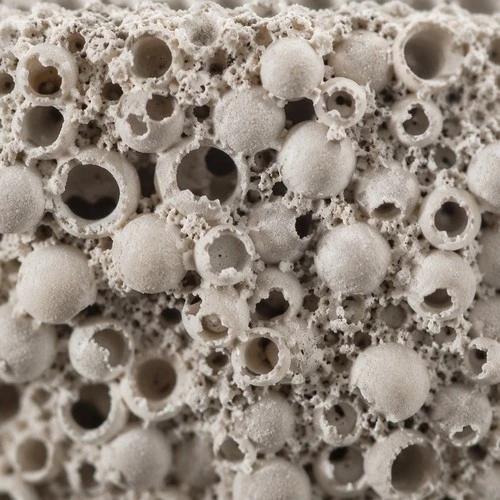
What Is an Alumina Bubble Brick? (The Hollow Sphere Microstructure)
The unique performance of an alumina bubble insulating brick stems from its microstructural architecture: hollow spherical corundum grains (alpha-Al₂O₃) bonded by a high-purity sub-micron sintered alumina matrix.
Electric Arc Fusion & Blowing Process
Electric Arc Melting: High-grade calcined industrial alumina is charged into a tilting electric arc furnace and fused at temperatures above 2200°C.
High-Pressure Air Atomization: As the molten corundum stream pours from the furnace spout, compressed air (0.6–0.8 MPa) is blown horizontally across the stream. The aerodynamic shear forces atomize the stream into liquid droplets. Surface tension pulls each droplet into a hollow sphere while internal air thermal expansion hollows the core before rapid chilling freezes the shell.
Screening & Classification: The solidified hollow spheres (0.2 mm to 5.0 mm in diameter with shell thicknesses of 0.05–0.2 mm) are classified into aggregate size fractions.
Hydraulic Pressing & Firing: Classified bubbles are blended with reactive alumina micro-powders and molded under hydraulic pressure (30–50 MPa) calibrated to compact the mix without crushing the spheres. The green bricks are fired in high-temperature shuttle kilns at 1700°C to 1750°C for over 48 hours, sintering the micro-powders directly onto the sphere walls to form a rigid corundum skeleton.
Technical Specifications Across Standard Density Classes
We produce three standard density classes to balance mechanical load-bearing capacity against thermal insulation efficiency:
1. Grade AB-12 (Lightweight Thermal Barrier)
Chemical Composition: Al₂O₃ ≥ 98.5%, SiO₂ ≤ 0.3%, Fe₂O₃ ≤ 0.2%, Na₂O + K₂O ≤ 0.3%
Bulk Density: 1.20–1.30 g/cm³
Cold Crushing Strength (CCS): ≥ 12.0 MPa (ASTM C133)
Refractoriness under Load (T0.6): ≥ 1680°C (ASTM C16, 0.1 MPa)
Apparent Porosity: 65–70%
Thermal Conductivity: 0.65 W/m·K at 400°C; 0.95 W/m·K at 1000°C; 1.25 W/m·K at 1400°C
Permanent Linear Change (1650°C, 3h): ±0.3%
2. Grade AB-14 (Standard Heavy-Duty Workhorse)
Chemical Composition: Al₂O₃ ≥ 98.5%, SiO₂ ≤ 0.4%, Fe₂O₃ ≤ 0.2%, Na₂O + K₂O ≤ 0.3%
Bulk Density: 1.35–1.45 g/cm³
Cold Crushing Strength (CCS): ≥ 18.0 MPa
Refractoriness under Load (T0.6): ≥ 1720°C
Apparent Porosity: 60–65%
Thermal Conductivity: 0.75 W/m·K at 400°C; 1.10 W/m·K at 1000°C; 1.45 W/m·K at 1400°C
Permanent Linear Change (1650°C, 3h): ±0.2%
3. Grade AB-16 (High-Strength Structural Grade)
Chemical Composition: Al₂O₃ ≥ 98.0%, SiO₂ ≤ 0.5%, Fe₂O₃ ≤ 0.25%, Na₂O + K₂O ≤ 0.35%
Bulk Density: 1.50–1.65 g/cm³
Cold Crushing Strength (CCS): ≥ 25.0 MPa
Refractoriness under Load (T0.6): ≥ 1750°C
Apparent Porosity: 55–60%
Thermal Conductivity: 0.85 W/m·K at 400°C; 1.30 W/m·K at 1000°C; 1.70 W/m·K at 1400°C
Permanent Linear Change (1650°C, 3h): ±0.2%

Heavy Corundum vs. Alumina Bubble vs. Mullite Insulation
Selecting the proper high-temperature brick requires understanding the distinct roles of these three materials:
Dense Sintered Corundum Bricks: Contain over 95% Al₂O₃ with high bulk density (3.00–3.25 g/cm³) and crushing strengths exceeding 100 MPa. While outstanding against liquid slag abrasion, heavy corundum brick conducts heat rapidly (3.8–4.5 W/m·K), causing high shell temperatures unless backed by insulation.
JM-30 Mullite Insulating Bricks: Lightweight (0.95–1.05 g/cm³) with low conductivity (0.42 W/m·K), but limited to continuous temperatures under 1550°C. Under pure hydrogen atmospheres above 1400°C, the silica phase decomposes into volatile gases, restricting their use to intermediate backup courses.
Alumina Bubble Bricks: Bridge the performance gap. They combine the chemical inertness and 1800°C temperature threshold of pure corundum with the low thermal conductivity and lightweight design of an insulating brick.
Hydrogen Atmosphere & Extreme Reducing Gas Resistance
In petrochemical synthesis (ammonia secondary reformers, gasifiers, and hydrogen annealing kilns), furnace atmospheres contain 75% to 100% dry H₂ at temperatures exceeding 1400°C.
The Mechanism of Silica Reduction
Silica (SiO₂) present in standard firebricks reacts with hydrogen at high temperatures: SiO2 (s)+H2 (g)→SiO (g)+H2O (g)SiO2 (s)+H2 (g)→SiO (g)+H2O (g) Volatile silicon monoxide gas leaves the brick, leaving behind unbonded, friable alumina dust that collapses under load. The vaporized SiO gas then condenses downstream in heat exchangers and catalyst beds, causing fouling.
The Alumina Bubble Solution
With SiO₂ strictly limited under 0.4% and Fe₂O₃ under 0.2%, high-purity alumina bubble bricks contain virtually zero reducible oxides. The alpha-Al₂O₃ crystal lattice remains chemically stable in pure hydrogen up to 1800°C, preserving dimensional accuracy and load-bearing strength across multi-year campaigns.
Industrial Applications & Multi-Layer Lining Design
1. Petrochemical Gasifiers and Secondary Reformers
Operating at 1350°C to 1650°C under 3.0 to 6.0 MPa with syngas containing CO and H₂.
Lining Structure: Heavy chrome-corundum bricks on the direct slag-contact hot face, backed by 150 mm of Grade AB-14 alumina bubble bricks, followed by an external course of high density calcium silicate board.
Benefit: Keeps pressure vessel shell temperatures below 180°C while preventing silica vapor migration into downstream catalyst units.
2. Carbon Black High-Temperature Reactors
In reactor choke sections where temperatures reach 1750°C to 1900°C with severe thermal shock from tangential oil-feed sprayers.
Benefit: The hollow spherical aggregate absorbs thermal shock strains without propagating through-body spalling cracks, outlasting solid refractory shapes.
3. Vacuum Induction Melting (VIM) Furnaces
In aerospace superalloy vacuum melting, linings operate under 0.001 mbar vacuum at 1600°C. Alumina bubble bricks exhibit zero volatile outgassing, ensuring alloy purity.
For multi-stage kilns transitioning from ultra-high heat to moderate zones, contractors coordinate these bricks with standard high temperature refractory bricks to optimize overall project cost.

Masonry Installation, Mortar Pairing & Expansion Joints
Mortar Compatibility: Never lay alumina bubble bricks with generic fireclay or calcium aluminate mortars. Always specify matched corundum-mullite air-setting mortar (Al₂O₃ ≥ 90%, SiO₂ ≤ 5%).
Thin Joint Control: Maintain joint thickness strictly between 1.0 mm and 1.5 mm. Dip each brick into mortar slurry and tap into position with a wooden or rubber mallet.
Expansion Clearances: With a linear expansion coefficient of 8.5 × 10⁻⁶ /°C, a 3-meter wall expands by roughly 35 mm to 40 mm at 1600°C. Incorporate 10 mm to 15 mm expansion joints every 1.5 to 2.0 meters, packed tightly with high-purity polycrystalline alumina fiber strips.
Moisture Protection: Alumina bubble bricks have high porosity (55–70%). Keep inventory dry on site; wet bricks heated rapidly can experience hydro-thermal spalling during initial firing.
Export Dimensions, Packaging & Factory Sourcing Guidelines
tprefractory precision-grinds all export-grade alumina bubble bricks after firing:
Standard Brick Shapes & Tolerances
Standard Straights: 230 × 114 × 65 mm (9" × 4.5" × 2.5") and 230 × 114 × 75 mm (9" × 4.5" × 3.0").
Radial Shapes: Standard ISO/ASTM side arch, end arch, and key brick shapes precision-pressed to fit cylindrical shells and circular arches.
Dimensional Tolerances: Dimensions ≤ 150 mm within ±1.0 mm; Dimensions > 150 mm within ±1.5 mm; Warpage under 0.5%.
Commercial Logistics
Minimum Order Quantity (MOQ): Standard straight shapes: 500 pieces (approx. 1.2 metric tons); Custom arch or key profiles: 1,000 pieces.
Packaging: Bricks are interleaved with foam sheets, shrink-wrapped, and crated in heavy-duty fumigated wooden crates (ISPM-15 compliant) with plywood corner reinforcement.
Lead Time: Standard straights dispatch in 10–14 days; custom pressed or machined shapes in 20–25 days.
Port of Loading: FOB Qingdao Port or CIF worldwide container shipping. Full MTC certificates verifying chemistry, density, and crushing strength accompany every container.
Technical Consultation & Commercial RFQ
To request official technical data sheets (TDS), customized brick quantity estimates, or a commercial quotation:
Email: inquiry@topower.tech (Direct engineer response within 4 hours)
Required Details: Operating temperature, furnace atmosphere (H₂, CO, air, vacuum), dimensional drawings, and required volume.


