


Calcium silicate board is a rigid, fiber-reinforced microporous thermal insulation slab manufactured from siliceous materials, quicklime, and reinforcing fibers via dynamic hydrothermal autoclaving (forming xonotlite and tobermorite crystal lattices). Delivering continuous service limits from 650°C to 1000°C with an engineered bulk density of 230 to 270 kg/m³, this asbestos-free refractory insulation combines low thermal conductivity (0.055–0.095 W/m·K) with high compressive strength exceeding 0.65 MPa, preventing lining compression failure under heavy brickwork.
Unlike soft ceramic fiber blankets that compress and settle under mechanical loading, rigid calcium silicate boards provide stable structural backing behind dense refractory bricks and castables in cement rotary kilns, petrochemical heaters, and aluminum melting furnaces. Below are the core technical differences between tobermorite (650°C) and xonotlite (1000°C) grades, compressive behavior, masonry installation practices, and factory-direct procurement parameters.
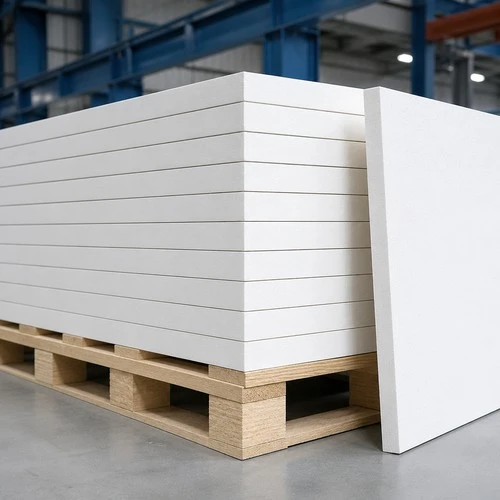
Crystal Mineralogy: Tobermorite (650°C) vs. Xonotlite (1000°C)
The maximum working temperature of a calcium silicate board is governed by its synthetic crystalline phase formed during high-pressure steam autoclaving:
650°C Medium-Temperature Grade (Tobermorite Lattice): Synthesized at autoclave pressures of 0.8 to 1.2 MPa. The primary mineral phase is 5CaO·6SiO₂·5H₂O (tobermorite). This grade is tailored for steam piping, power generation boilers, and district heating networks where continuous temperatures remain under 650°C. Above 700°C, tobermorite dehydrates rapidly, causing volumetric shrinkage and micro-cracking.
1000°C High-Temperature Grade (Xonotlite Lattice): Autoclaved at higher steam pressures (1.5 to 2.0 MPa) and controlled Ca/Si molar ratios. The resulting crystal structure is pure 6CaO·6SiO₂·H₂O (xonotlite). With chemically bound water locked tightly within needle-like interlocking crystals, xonotlite retains full volume stability and mechanical strength up to 1000°C without significant shrinkage.
Specifying certified products directly from a verified high density calcium silicate board factory ensures that 1000°C boards are 100% xonotlite-based, avoiding premature dehydration shrinkage behind furnace hot-face linings.
Technical Specifications: 650°C vs. 1000°C Density Classes
We manufacture two standard industrial classes engineered to balance mechanical load-bearing capacity with thermal insulation performance:
1. Standard 650°C Medium-Temp Grade
Classification Temperature: 650°C (Continuous service limit: 600°C)
Bulk Density: 220–240 kg/m³
Compressive Strength: ≥ 0.60 MPa (ASTM C165, 10% deformation)
Flexural (Bending) Strength: ≥ 0.35 MPa (ASTM C203)
Linear Shrinkage (16h at 650°C): ≤ 1.5% (ASTM C356)
Thermal Conductivity: 0.058 W/m·K at 200°C; 0.075 W/m·K at 400°C; 0.095 W/m·K at 600°C
Moisture Content: ≤ 7.5%
2. High-Density 1000°C High-Temp Grade
Classification Temperature: 1000°C (Continuous service limit: 950°C)
Bulk Density: 240–270 kg/m³
Compressive Strength: ≥ 0.70 MPa
Flexural (Bending) Strength: ≥ 0.45 MPa
Linear Shrinkage (16h at 1000°C): ≤ 1.8%
Thermal Conductivity: 0.065 W/m·K at 200°C; 0.082 W/m·K at 400°C; 0.105 W/m·K at 600°C; 0.125 W/m·K at 800°C
Moisture Content: ≤ 5.0%
Rigid Calcium Silicate vs. Ceramic Fiber Blanket: The Backup Selection
When engineering backup thermal insulation behind heavy working linings, plant managers often weigh rigid boards against flexible blankets:
Load-Bearing Capability: Under the hydrostatic and dead weight of heavy high temperature refractory bricks, flexible ceramic blankets compress by 30% to 50%, altering designed lining thickness and leading to hot spots. Calcium silicate boards support over 65 metric tons per square meter (0.65 MPa) with under 5% deformation, maintaining an unyielding structural backstop.
Handling & Machinability: Calcium silicate boards cut cleanly with standard woodworking hand saws or circular table saws without generating loose airborne respirable fibers. They can be pre-drilled, routed, and shaped on site with tight joint fitment.
Vibration & Gas Velocity Resistance: In high-vibration equipment such as cement preheater towers and rotary kiln hoods, soft fiber blankets can pack down or shred over time. Rigid boards stay mechanically secured against the furnace steel casing plate.
Thermal Application Limit: For furnace hot faces exceeding 1100°C without brick cladding, heavy ceramic fiber blanket for furnace lining or monolithic castables must be selected, with calcium silicate serving exclusively in the cooler backup zone.
Industrial Applications Across High-Temperature Plants
1. Cement Rotary Kiln Systems & Preheater Cyclones
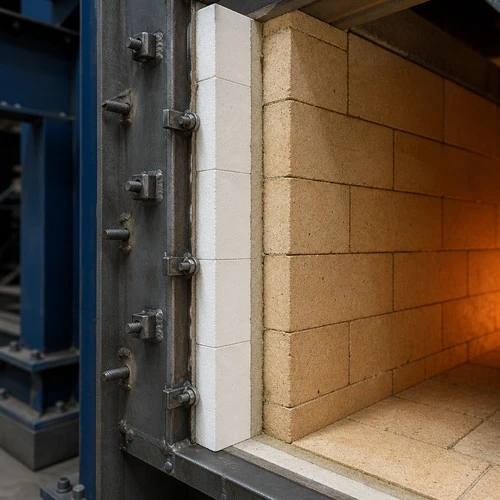
In cyclone preheaters, tertiary air ducts, and kiln smoke chambers, calcium silicate boards serve as the secondary insulation layer directly behind dense firebricks or castables.
Installation Setup: 50 mm or 100 mm 1000°C boards applied against the steel shell, followed by a working lining of high alumina castable refractory.
Benefit: Lowers kiln steel shell temperatures below 85°C, reducing radiative heat loss while protecting steel structural framing from thermal fatigue.
2. Petrochemical Reformers & Cracking Furnaces
High-density 1000°C boards insulate furnace sidewalls and radiant roofs behind lightweight insulating firebricks. High chemical neutrality (pH 9–10) prevents casing corrosion even if acidic flue gases condense near the dew point.
3. Non-Ferrous Aluminum Melting & Holding Furnaces
Molten aluminum at 750°C does not wet or penetrate xonotlite-based calcium silicate. High-density boards are employed as non-wetting backup layers behind silicon carbide or high-alumina hearth castables, protecting external casings during metal penetration accidents.
Installation, Cutting & Moisture Precautions
To achieve optimal campaign life and prevent structural spalling during initial firing:
Water Infiltration Protection: Calcium silicate boards possess open microporosity (over 80% total porosity). When pouring wet castables directly against the board face, always apply a waterproof plastic film or bitumen barrier over the board. If untreated, the dry board will pull gauging water out of the wet castable, preventing proper hydraulic hydration and weakening the castable bond.
Staggered Double-Layer Masonry: For insulation thicknesses of 100 mm or more, always specify two 50 mm layers installed with staggered horizontal and vertical joints. This design breaks straight thermal paths through joint seams, eliminating through-thickness heat bridging.
Mechanical Fastening: Fasten boards to furnace shell plates using stainless steel pin anchors with speed washers, or bond them using matched high-temperature silicate adhesive mortar. Ensure joint mortar is applied thinly (under 2 mm).
Export Dimensions, Packaging & Factory Sourcing Guidelines
As an ISO 9001:2015 certified manufacturer in China, tprefractory supplies calcium silicate boards in standard international dimensions with heavy export packaging:
Standard Dimensions & Thickness Availability
Standard Sheet Sizes: 1000 mm × 500 mm (most common European/Middle Eastern size), 600 mm × 300 mm, and 1000 mm × 600 mm.
Thickness Options: 25 mm, 30 mm, 40 mm, 50 mm, 65 mm, 75 mm, and 100 mm. Custom CNC-machined curved pipe covers and segmented radius blocks are available for curved vessel shells.
Dimensional Tolerances: Length and width controlled to ±2.0 mm; Thickness within ±1.0 mm.
Packaging & Commercial Logistics
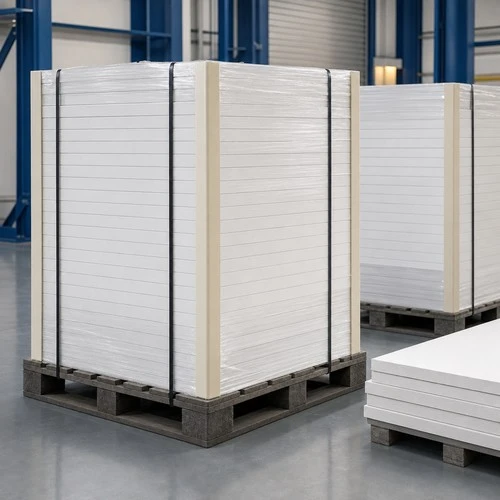
Moisture-Proof Palletizing: Sheets are packed on sturdy wooden export pallets (ISPM-15 heat-treated), protected by heavy cardboard edge protectors on all corners, shrink-wrapped with UV-resistant polyethylene film, and secured with steel or high-tensile PET strapping.
Minimum Order Quantity (MOQ): 10 cubic meters (approx. one partial container load); full container loads (20GP approx. 28–30 m³, 40HQ approx. 65–68 m³) recommended for optimal sea freight economy.
Factory Lead Time: Standard stock sizes dispatch in 7–10 days; custom thickness or radius fabrication in 14–20 days.
Port of Loading: FOB Qingdao Port or CIF worldwide container shipping. Mixed container loading with firebricks, mortars, and fiber blankets is supported.
Technical Consultation & Project RFQ
To request official technical data sheets (TDS), third-party lab thermal conductivity certificates, or a project quotation:
Email: inquiry@topower.tech (Direct engineer response within 4 hours)
Required RFQ Details: Application area, target service temperature, sheet dimensions, thickness, and total square meters.


