


A refractory precast block is an engineered, factory-cast monolithic shape formulated from low-cement or ultra-low cement castables, compacted via high-frequency vibration tables, and pre-fired at 350°C to 650°C under controlled kiln atmospheres. By transferring mixing, consolidation, and primary dehydration from the job site into a factory environment, precast shapes achieve cold crushing strengths exceeding 85 MPa85 MPa, eliminate on-site hydration defects, and reduce furnace relining downtime by up to 70%70% compared to field-poured refractories.
From high-velocity burner blocks and steel ladle purging well blocks to furnace door jambs and suspended roof arches, precision precast refractory shapes solve complex thermal shock and high-wear demands. This technical guide outlines core formulation classes, geometric design criteria, lifting hardware integration, expansion gap management, and factory procurement specifications.
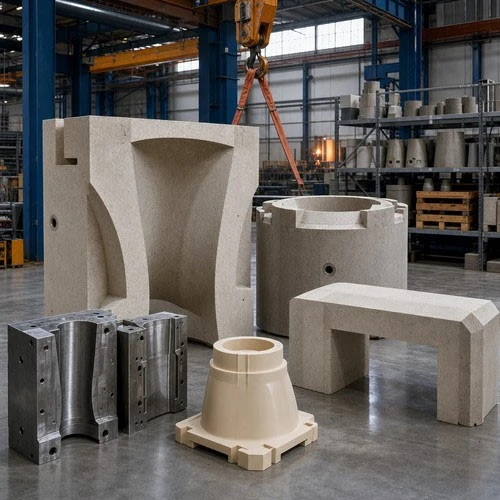
Why Precast Shapes Outperform Field-Poured Castables
While unshaped refractory castables offer lower material purchase costs, in-situ casting inside industrial furnaces introduces unpredictable variables that frequently trigger early lining failure:
Precision Water Control: Job site crews often add 2–3%2–3% excess water to force material through tight formwork, creating high open porosity that reduces crushing strength by 30–50%30–50%. In our precast plant, water additions are dosed gravimetrically to within ±0.1%±0.1%.
High-Frequency Vibration Compaction: Handheld pokers cannot de-air heavy aggregates effectively. Factory precast facilities use synchronized multi-axis vibrating tables operating at 3,000–6,000 rpm3,000–6,000 rpm (0.5–1.0mm0.5–1.0mm amplitude), completely releasing trapped air and achieving bulk densities above 2.90 g/cm32.90 g/cm3 for corundum formulations.
Temperature-Regulated Hydration: Field castables hydrate under ambient seasonal temperatures, often forming unstable calcium aluminate hydrate phases. Precast blocks cure inside climate-controlled chambers (20–25∘C,≥90% RH20–25∘C,≥90% RH) for 24 hours prior to demolding.
Complete Elimination of Explosion Risks: In-situ linings require slow, multi-day heat-up schedules with high risks of steam explosion if heated too quickly. Factory precast blocks arrive pre-fired at 350–600∘C350–600∘C, safely driving off all chemically combined water before shipment.
For plants requiring both custom precast assemblies and monolithic field jointing, engineers pair these shapes with compatible high alumina castable refractory for field tie-ins.
Material Formulations Tailored by Furnace Zone
Selecting the appropriate refractory precast block depends on matching raw material chemistry to the mechanical, chemical, and thermal stresses of the target zone:
1. Dense High-Alumina Shapes (Al2O3 70–80%Al2O3 70–80%)
Key Properties: Bulk density 2.55–2.75 g/cm32.55–2.75 g/cm3; Cold crushing strength ≥75 MPa≥75 MPa; Maximum continuous service 1550°C.
Typical Applications: Reheating furnace hearth skids, walking beam piers, furnace door jambs, and flue collection duct linings.
2. Corundum-Mullite Formulations (Al2O3 85–92%Al2O3 85–92%)
Key Properties: Bulk density 2.85–3.05 g/cm32.85–3.05 g/cm3; Cold crushing strength ≥95 MPa≥95 MPa; Maximum continuous service 1700°C.
Typical Applications: High-velocity burner quarls, electric arc furnace (EAF) roof delta sections, and waste incinerator choke rings exposed to thermal cycling and high gas velocities.
3. Silicon Carbide Composite Shapes (SiC 60–85%SiC 60–85%)
Key Properties: Bulk density 2.65–2.85 g/cm32.65–2.85 g/cm3; Cold crushing strength ≥110 MPa≥110 MPa; High thermal conductivity (>12 W/m⋅K>12 W/m⋅K).
Typical Applications: Hazardous waste incinerator slag tap chutes, aluminum dross ramps, and boiler cyclone target walls subject to severe mechanical erosion.
4. Alumina-Spinel Formulations (Al2O3 85–90%,MgO 5–10%Al2O3 85–90%,MgO 5–10%)
Key Properties: Bulk density 2.95–3.15 g/cm32.95–3.15 g/cm3; Cold crushing strength ≥90 MPa≥90 MPa; Outstanding resistance to basic metallurgical slag.
Typical Applications: Steel ladle bottom well blocks, argon porous plug seat assemblies, and molten steel impact pads.
Engineering Design: Draft Angles, Expansion Gaps & Lifting Anchors
Precast refractory blocks are structural engineering components. Designing long-lasting components requires attention to three fundamental rules:
Mold Draft Angles for Clean Release
Complex shapes with internal tapers, burner ports, or interlocking keys must incorporate proper draft angles:
External Faces: Minimum 1.0∘ to 1.5∘1.0∘ to 1.5∘ taper per side.
Internal Cores (Burner Throats): Minimum 2.0∘ to 3.0∘2.0∘ to 3.0∘ taper.
Tooling Execution: Precision CNC-machined steel or laminated high-density polymer molds maintain dimensional tolerances within ±1.0mm±1.0mm across dimensions up to 1,000mm1,000mm.
Thermal Expansion Gaps & Fiber Cushioning
Dense corundum-mullite castables expand by 0.6–0.8%0.6–0.8% linearly at 1400°C. In a continuous run of large precast blocks (500mm500mm each), each unit expands by 3–4mm3–4mm.
Joint Clearance: Design planned expansion joints of 3–5mm3–5mm between adjacent precast blocks.
Cushioning Material: Cushion all expansion gaps with compressible strips of ceramic fiber paper. Never lock precast blocks tightly with rigid mortar without expansion relief, or corner pinching and thermal spalling will occur during initial firing.
Lifting Hardware Integration
Safe rigging hardware must be designed into every block weighing over 25 kg:
Removable Threaded Sockets: Flush-mounted stainless steel (SS304/SS310) sockets cast into the cold face. Certified swivel hoist rings screw in for crane hoisting, then are removed and plugged with refractory mastic.
Recessed Lifting Loops: Heavy rebar loops cast into recessed pockets on the cold face. After the block is aligned, the loop is bent down or cut off to allow a flat fit against the furnace steel casing plate.
Critical Application Shapes: Burners, Well Blocks & Roof Skews
1. Burner Quarls for High-Velocity Combustion
Burner blocks endure direct flame radiation, turbulent air scour (30–60 m/s30–60 m/s), and severe thermal shock during burner cycling.
Design Feature: Diverging conical throats CNC-cast with smooth internal profiles to minimize flow turbulence and carbon deposition.
Alloy Needle Reinforcement: We blend 2.0–2.5%2.0–2.5% melt-extracted 310-grade stainless steel needles into the mix to bridge micro-cracks and arrest spalling.
2. Porous Plug Seat Blocks & Well Blocks for Ladles
In secondary steelmaking ladles, well blocks must survive intense ferrostatic pressure and basic slag erosion around the argon gas purging element.
Performance Life: High-density tabular alumina-spinel blocks, pre-fired at 1000°C, match the campaign life of adjacent working linings, maintaining gas-tight seals without erosion channeling.
3. Suspended Roof Skews & Door Jamb Assemblies
Furnace door jambs experience repeated mechanical shock from scrap charging machines. Precast jambs replace dozens of loose firebrick joints with a single rigid lintel block, backed by calcium silicate board to minimize shell heat loss.
Transport, Rigging & Rapid On-Site Installation Checklist
To ensure fast crane installation and prevent job site damage:
Unloading & Inspection: Inspect every crate upon delivery. Minor surface chips (<15mm<15mm) can be filled using matched chemical-setting refractory putty; blocks with structural through-cracks must not be placed into high-stress thermal zones.
Level Substructure: Ensure the furnace shell plate or backup safety lining is level within ±2mm±2mm. High spots create concentrated point loads that can crack large blocks under thermal loading.
Rigging Practice: Always use two-leg or four-leg synthetic web slings connected to rated swivel hoist rings. Never choke bare wire ropes directly across unpadded refractory edges.
Thin-Joint Mortaring: Apply a thin bedding layer (1.5–2.5mm1.5–2.5mm) of high-alumina air-setting refractory mortar. Position blocks gently using a rubber dead-blow mallet-never strike precast blocks directly with steel sledgehammers.
Verify Expansion Spacers: Ensure that ceramic fiber expansion strips are inserted at all designated relief joints before moving to the next block.
Factory Customization, Shop Drawings & Export Specifications
Our precast engineering facility delivers turnkey manufacturing support from CAD modeling through ocean container dispatch:
Engineering & Manufacturing Workflow
CAD/BOM Optimization: Send your furnace shell drawings in DWG, DXF, or 3D STEP formats. Our engineering team partitions the lining into optimal weight segments (50–2,500 kg/block50–2,500 kg/block), calculates draft angles, details lifting points, and provides assembly placement maps.
Precision Tooling: In-house CNC pattern shop fabricates steel, aluminum, or composite molds to exact project dimensions.
Quality Assurance Testing: Companion test cylinders are cast from every production batch to verify bulk density, cold crushing strength (CCS), and permanent linear change (PLC). Mill Test Certificates (MTC) accompany shipping documents.
Packaging & Commercial Terms
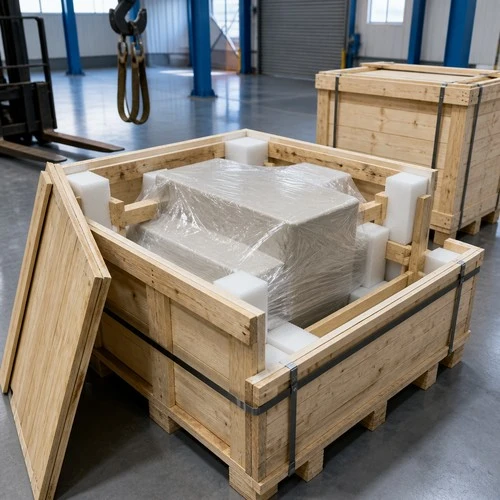
Protective Packaging: Blocks are wrapped in heavy polyethylene film, padded with high-density EPS foam cushions, and anchored inside heavy-duty solid-timber export crates (ISPM 15 fumigation certified).
Minimum Order Quantity (MOQ): Custom engineered shapes: 5 pieces (or 1 metric ton equivalent); Standard burner quarls: 2 pieces.
Manufacturing Lead Time: Mold fabrication and first-piece casting: 10–14 days; Batch vibration casting, controlled 600°C pre-firing, and crating: 15–20 days.
Shipping Logistics: FOB Qingdao Port or CIF worldwide container delivery. Precast orders can be consolidated with dense firebricks, mortars, and ceramic blankets to maximize container loading efficiency.
Technical Consultation & Project RFQ
To submit 2D/3D component drawings for engineering review, obtain material recommendations, or receive an official quotation:
Email:inquiry@topower.tech (Direct engineer response within 4 hours)
Required RFQ Information: Operating temperature, furnace atmosphere, mechanical impact conditions, and CAD drawings with target quantities.
Emergency Turnaround Support: Accelerated mold fabrication and rapid curing schedules are available for emergency plant shutdown repairs.


