


High alumina castable is the workhorse of industrial furnace construction. It pours, it vibrates, and it sets into a dense, load-bearing lining - no brick joints, no skilled mason required for simple shapes. But "high alumina castable" is not a single product. The gap between a 70% Al₂O₃ general-purpose castable and a 90% Al₂O₃ corundum-based castable is significant in both performance and price.
This guide gives you the actual numbers by grade, explains what each parameter on a datasheet really means, and walks through the mixing and installation steps that determine whether your lining lasts 12 months or 3.
What Defines "High Alumina" in Castable Refractories?
In the refractory industry, "high alumina" means Al₂O₃ content above 45%. That's the starting point. For castables used in serious industrial furnaces, the practical range is 70–90% Al₂O₃ - below 70% you're in fire clay territory, above 90% you're moving into corundum or tabular alumina castable, which carries a different price bracket.
What does the Al₂O₃ do? Three things:
Load-bearing at temperature. Higher alumina means a higher RUL (Refractoriness Under Load) temperature - the point at which the brick starts to deform under pressure. At 70% Al₂O₃, RUL T₀.₅ is around 1380°C. At 90%, it climbs past 1580°C.
Chemical resistance. High-alumina phases resist alkali attack and slag penetration better than fire clay. For applications like rotary kiln inlets or cement preheater linings, this matters more than thermal conductivity.
Thermal shock tolerance. Paradoxically, pure corundum castable (99% Al₂O₃) has lower thermal shock resistance than 70–80% grades because corundum lacks the microcrack network that absorbs stress. If your furnace cycles daily, 80% may outperform 90% in real-world campaign life.
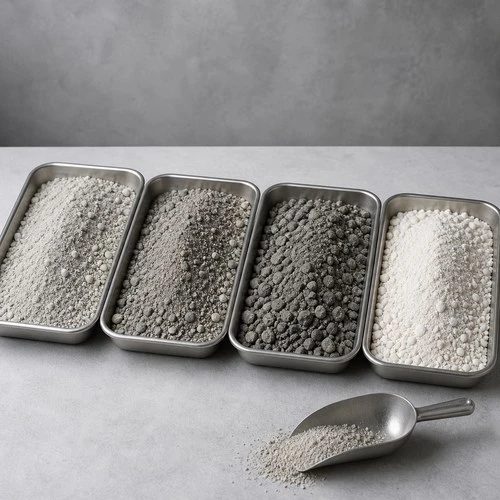
Grade Specs at a Glance - 70%, 80%, 90% Al₂O₃ Data Table
| Property | 70% Al₂O₃ | 80% Al₂O₃ | 90% Al₂O₃ |
|---|---|---|---|
| Al₂O₃ content (%) | 70–72 | 78–82 | 88–92 |
| SiO₂ content (%) | 20–25 | 12–18 | 5–8 |
| Bulk density after firing (g/cm³) | 2.50–2.65 | 2.70–2.85 | 2.90–3.05 |
| Apparent porosity (%) | 14–18 | 12–16 | 10–14 |
| CCS @ 110°C (MPa) | 60–80 | 80–110 | 100–140 |
| CCS @ 1000°C (MPa) | 75–100 | 90–130 | 120–160 |
| RUL T₀.₅ (°C) | 1350–1400 | 1450–1500 | 1550–1600 |
| PLC @ 1500°C × 3h (%) | −0.3 to +0.3 | −0.3 to +0.2 | −0.2 to +0.2 |
| Max service temperature (°C) | 1550 | 1650 | 1750 |
| Thermal conductivity @ 1000°C (W/m·K) | 1.8–2.2 | 2.0–2.5 | 2.2–2.8 |
Source: In-house QC data, 200-batch average. ASTM C401 classification standard.
Cost index (relative, FOB Qingdao basis): 70% = 1.0× | 80% = 1.4× | 90% = 2.0–2.5×
For most cement kiln backup and heat-treatment furnace applications, 80% Al₂O₃ hits the sweet spot between cost and performance. We see a lot of over-specifying on 90% when 80% would do the job at 40% lower material cost.
How to Read a Castable Datasheet: CCS, RUL, PLC Explained
Datasheets are not all honest. Here's how to read the numbers critically:
CCS (Cold Crushing Strength). Most suppliers report CCS after 110°C drying. That's easy to achieve. Ask for CCS after 1000°C firing - it tells you how much strength survives the first heat cycle. Values below 60 MPa at 1000°C are a red flag for any structural lining.
RUL (Refractoriness Under Load). The T₀.₅ value is the temperature at which the sample has compressed 0.5% under a 0.2 MPa load. T₀.₅ of 1450°C means: under furnace weight, this castable starts to creep above 1450°C. Always compare RUL to your actual peak furnace temperature - the gap is your safety margin.
PLC (Permanent Linear Change). This tells you if the castable shrinks or expands after service at high temperature. Values outside ±0.5% indicate dimensional instability. Excessive shrinkage = joint opening and lining cracking. Excessive expansion = spalling and delamination.
Apparent porosity. Lower is better for chemical resistance. Above 18% means the lining is porous enough for molten slag to infiltrate the microstructure over time.
One thing many buyers miss: water addition rate on the TDS is given as a percentage of dry weight (usually 5–8%). Adding more water "for flowability" dramatically cuts CCS - we've seen field linings fail at 30–40% of the rated CCS simply because the contractor added 2% extra water.
Mixing and Installation - Water Ratio, Vibration, Curing
Mixing
Use a forced-action mixer (pan or drum). Free-fall concrete mixers give inconsistent results.
Water-to-powder ratio by grade:
| Grade | Vibration casting | Free-flow / self-leveling |
|---|---|---|
| 70% Al₂O₃ | 5.5–6.5% | N/A (dense grade) |
| 80% Al₂O₃ | 5.0–6.0% | 6.5–7.5% (LCC variant) |
| 90% Al₂O₃ | 4.5–5.5% | 6.0–7.0% (self-flow) |
Mix for 3–5 minutes until homogeneous. Do not add water incrementally to improve flow - use a plasticizer if you need better workability.
Formwork and Vibration
Cast in lifts of 300–400mm maximum. Vibrate each lift for 30–60 seconds at 50 Hz. Over-vibration causes aggregate segregation. Check: castable should flow around reinforcement and fill formwork corners without voids.
Curing and Dry-Out
After casting, cure for minimum 24 hours at 15–25°C before any heat application. Then follow the dry-out curve:
| Stage | Temperature Range | Heating Rate | Hold |
|---|---|---|---|
| 1 | Ambient → 110°C | 15°C/hr | 8 hrs |
| 2 | 110°C → 350°C | 20°C/hr | 4 hrs |
| 3 | 350°C → 600°C | 25°C/hr | 2 hrs |
| 4 | 600°C → Operating | 30–50°C/hr | Per process |
The 110°C hold is non-negotiable - this is where chemically bound water leaves. Rushing past it causes steam pressure buildup and explosive spalling.
Common Failure Causes and How to Avoid Them
1. Excess water during mixing. Already mentioned - the most common cause of premature failure. Stick to the TDS water ratio. Use a superplasticizer if the contractor complains about workability.
2. Insufficient curing time before heat-up. 24 hours minimum at ambient temperature. In cold climates (below 10°C), extend to 48 hours.
3. Thermal shock from rapid first heat-up. The dry-out curve is not optional. A 4-hour furnace brought to 1000°C in 2 hours will crack. We've replaced linings that failed on Day 1 because the site supervisor "needed the furnace online."
4. Wrong grade for the application. 70% Al₂O₃ in a ladle slag zone. 80% Al₂O₃ where alkali attack is severe. These substitutions happen. Know your lining position before ordering.
5. Contaminated aggregate or cement. High-alumina castable is sensitive to calcium silicate contamination from low-grade refractory cement. Always specify cement source and ask for COA before production.
Sourcing Checklist - What to Demand Before You Order
Before placing a bulk order:
TDS with CCS values atboth 110°C and 1000°C(not just 110°C)
RUL T₀.₅ data (tested per ASTM C113 or ISO 1893)
PLC data at your service temperature + 50°C
Batch COA from the same production run (Al₂O₃ %, Fe₂O₃ %, grain size distribution)
Water-to-powder ratio confirmed for your application type (vibration vs. self-flow)
ISO 9001:2015 certificate with valid date
Sample available before bulk order (50–100 kg)
We test every production batch for the above parameters. QC records are kept for 36 months - traceable by lot number on the bag.
Frequently Asked Questions
What is high alumina castable refractory used for?
High alumina castable refractory is used for lining industrial furnaces and kilns operating between 1400°C and 1750°C. Common applications include cement rotary kiln inlets and outlets, steel ladle backup linings, heat-treatment furnace linings, cracking furnaces in petrochemical plants, and electric arc furnace roof repairs. The 70% grade is used for general backup and structural linings; 80–90% grades are used for direct hot-face contact where slag resistance and load-bearing strength are required.
What is the difference between high alumina castable and low cement castable (LCC)?
High alumina castable refers to the Al₂O₃ content (≥70%). Low cement castable (LCC) refers to the calcium aluminate cement content (≤4%). These two classifications can overlap - a low cement castable can also be a high alumina castable. LCC has lower CaO content, which reduces slag infiltration and improves high-temperature strength. For demanding applications above 1500°C, we recommend combining both: high alumina + low cement formulation.
How long does high alumina castable take to cure before firing?
A minimum of 24 hours at ambient temperature (15–25°C) is required before the dry-out heat cycle begins. The critical first stage is a slow heat-up to 110°C with an 8-hour hold to remove free water. Skipping or shortening this hold is the most common cause of explosive spalling in new linings.
Can high alumina castable be repaired without full replacement?
Yes, for localized damage up to 30% of the lining area. Use a compatible gunning castable of the same Al₂O₃ grade for hot patching. For larger failures or structural damage, full replacement is more cost-effective than repeated patch repairs. We supply both vibration-cast and gunning-grade formulations of our high alumina castable.


