


As North American automotive manufacturers, industrial furnace builders, and green energy developers accelerate decarbonization and thermal safety initiatives, the global demand for precision refractory insulation has surged. High-temperature gaskets, thermal barriers in electric vehicle (EV) battery packs, and expansion seals in steelmaking transfer ladles increasingly rely on engineered aluminosilicate papers. Navigating the evolving ceramic fiber paper market in 2026 requires procurement managers to balance strict environmental compliance, rising raw material costs, and maritime freight volatility against factory-direct pricing. At Topower Refractory, we supply premium refractory ceramic fiber paper and bio-soluble papers engineered to meet ASTM and ISO standards for demanding industrial buyers across the United States, Canada, and global export destinations.

Key Technical Sourcing Facts
Standard Industrial Product Line: Topower DK series, including DK-1260 (Standard aluminosilicate, 1000°C continuous), DK-1350 (High-alumina grade, 1100°C), and DK-1430 (Zirconia stabilized, 1300°C).
Bio-Soluble Paper Expansion: Alkaline earth silicate (AES) soluble paper formulated with CaO and MgO for low biopersistence and full OSHA / EU regulatory compliance.
Density & Physical Tolerances: Uniform bulk density of 200 kg/m3; low organic binder fraction <= 8.0%; high tensile strength >= 0.4 MPa for high-speed die-cutting and clean gasket stamping.
Standard Roll Dimensions: Thicknesses from 0.5 mm to 10.0 mm; standard roll widths of 610 mm and 1220 mm; roll lengths from 6 m to 100 m. Full container load (40HQ) capacity reaches 7 to 9 metric tons. Export dispatch within 7 to 10 days FOB Qingdao / Tianjin.
Ceramic Fiber Paper Market Drivers in North America (2026)
The North American ceramic fiber paper landscape has entered a rapid transformation phase driven by three major industrial catalysts:
1. Electric Vehicle Battery Fire Barriers & Automotive Heat Shields
Automotive tier-1 suppliers specify thin (1.0 mm to 3.0 mm) ceramic paper as an impenetrable thermal runaway barrier between lithium-ion battery cells. Ceramic paper prevents adjacent cell ignition during battery thermal runaway events up to 1200°C, outperforming traditional mica or polymer insulation.
2. Petrochemical, Power Generation & Industrial Kiln Flanges
Industrial furnace manufacturers are phasing out thick, rigid asbestos alternatives in favor of flexible, die-cut ceramic paper gaskets. These lightweight sheets act as non-conductive electrical insulation and expansion joints, frequently specified alongside ceramic fiber blanket layers and rigid calcium silicate board backings.
3. Shift Toward Factory-Direct Sourcing from China
High inflation and domestic distributor markup in North America (often exceeding 150% over factory FOB costs) have prompted major OEMs and refractory contractors to establish direct container-load supply agreements with verified Chinese manufacturers.

Technical Specifications: Topower DK Series & Bio-Soluble Paper
A comprehensive understanding of grade chemistry ensures proper gasket performance without thermal degradation:
| Technical Parameter / Property | DK-1260 (Standard Grade) | DK-1350 (High-Alumina) | DK-1430 (Zirconia Grade) | Bio-Soluble Paper (AES) | Test Standard |
|---|---|---|---|---|---|
| Classification Temperature (°C) | 1260 | 1350 | 1430 | 1260 | ISO 10635 |
| Continuous Working Temp (°C) | 1000 | 1100 | 1300 | 1000 | In-House Standard |
| Al2O3 Content (%) | 46.0 - 48.0 | >= 48.0 | >= 35.0 | / | ASTM C114 |
| SiO2 Content (%) | 51.0 - 53.0 | 50.0 - 52.0 | / | 55.0 - 65.0 | ASTM C114 |
| ZrO2 Content (%) | / | / | 13.0 - 15.0 | / | XRF Analysis |
| Alkaline Earth (CaO+MgO) (%) | / | / | / | 32.0 - 42.0 | ASTM C114 |
| Bulk Density (kg/m3) | 200 (+/- 15) | 200 (+/- 15) | 200 (+/- 15) | 200 (+/- 15) | ASTM C134 |
| Tensile Strength (MPa) | >= 0.35 | >= 0.40 | >= 0.40 | >= 0.35 | ASTM D828 |
| Organic Binder Content (%) | <= 8.0 | <= 8.0 | <= 8.0 | <= 8.0 | Loss on Ignition |
| Moisture Content (%) | <= 1.0 | <= 1.0 | <= 1.0 | <= 1.0 | ASTM C612 |
Note: All rolls are manufactured via automated wet-laid fourdrinier paper machines, ensuring isotropic fiber dispersion, smooth calendered surfaces, and minimal thickness variation (+/- 0.1 mm).
Standard vs Bio-Soluble Paper: Regulatory Evolution
Industrial buyers in the United States and Canada face increasing regulatory scrutiny regarding respirable refractory ceramic fibers (RCF). Understanding the chemical distinction is crucial for worker safety compliance:
Traditional RCF Papers (DK-1260, DK-1430):
Chemical Composition: Pure vitreous aluminosilicate fibers.
Thermal Performance: Superior high-temperature shrinkage stability (< 3.0% at 1100°C) and resistance to chemical attack.
Workplace Regulations: Requires standard personal protective equipment (PPE) and controlled dust extraction during cutting and handling.
Bio-Soluble AES Papers:
Chemical Composition: Alkaline earth silicate fibers enriched with calcium and magnesium oxides.
Biopersistence Advantage: Inhaled fibers dissolve rapidly in human lung fluids, exempting the material from carcinogen classifications under EU REACH regulations and OSHA health surveillance mandates.
Market Uptake: The bio-soluble ceramic fiber paper market share in North American consumer appliances (stoves, fireplaces, water heaters) has expanded by over 25% year-on-year.
Die-Cutting and Fabrication Advantages
Because ceramic fiber paper is soft, ductile, and uniform, it provides distinct processing advantages over heavier refractory textiles or boards:
Precision Stamping & Gasket Die-Cutting: The low organic binder matrix allows rotary and flatbed die-cutters to stamp intricate gasket profiles with crisp edge retention without delaminating.
Smooth Non-Wetting Contact: In non-ferrous foundry operations, ceramic paper prevents molten aluminum and brass from adhering to casting launders and ladles, acting as a disposable release barrier.
Multi-Layer Thermal Laminates: Paper can be laminated with aluminum foil, graphite foil, or high-temperature ceramic fiber textiles to create composite expansion joint seals.
Sourcing Costs, Packaging & Container Economics
Understanding cost structures in the global ceramic fiber paper market enables procurement teams to maximize landed savings:
1. Cost Drivers: Density, Binder, and Chemistry
Raw Fiber Grade: Standard 1260°C paper serves as the cost baseline. Zirconia-stabilized grades (1430°C) carry a 25% to 35% premium due to high-purity ZrO2 feedstock costs.
Thickness Economics: Very thin papers (0.5 mm and 1.0 mm) incur higher production machine time per square meter, whereas heavier sheets (4.0 mm to 10.0 mm) carry higher fiber mass per roll.
2. Freight Optimization for North American Shipments
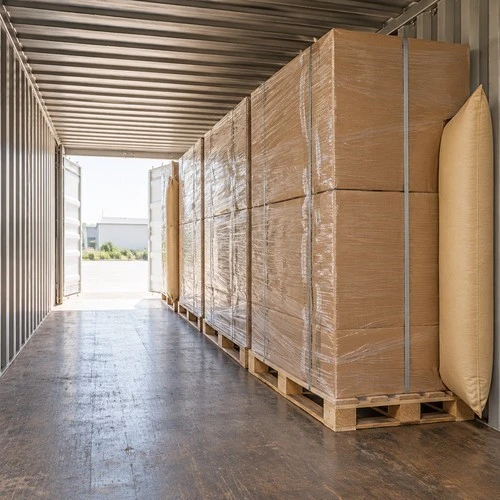
Ceramic fiber paper is a volume-restricted cargo rather than a weight-restricted commodity. A standard 40HQ container accommodates approximately 1200 to 1400 rolls (7000 to 9000 kg depending on roll width and diameter).
Moisture Barrier Packaging: Each master roll is sealed in a heavy-gauge polyethylene tube, packed in reinforced corrugated export cartons, and secured vertically or horizontally on fumigated solid timber pallets.
Damage Prevention: High-impact corner protectors and vacuum stretch hoods prevent roll edge crushing during multi-modal ocean rail transit to inland Midwest or East Coast distribution hubs.
Transparent Sourcing: Pricing & How to Order
Topower Refractory supplies certified ceramic paper rolls and custom-stamped gasket sheets directly to North American distributors, OEMs, and industrial kiln contractors:
Technical RFQ Checklist
To obtain an engineered proposal and formal quote within 4 hours, provide:
Paper Grade: Standard DK-1260, high-temp DK-1430, or bio-soluble AES paper.
Dimensions Required: Thickness (0.5 mm to 10.0 mm), roll width (610 mm or 1220 mm), and roll length.
Order Volume: Full container load (FCL 40HQ) or partial pallet quantities (LCL minimum order 1 pallet / 250 kg).
Custom Requirements: Die-cut drawing files (DXF/PDF), pre-fired organic-free paper, or adhesive backing (PSA).
Destination Port / Facility: For direct CIF Long Beach, Houston, New York, or Montreal logistics calculations.
Commercial Pricing Reference: Standard DK-1260 ceramic paper typically ranges from 1950 to 2800 USD per metric ton FOB China for container volumes, while specialized zirconia-stabilized and bio-soluble grades range from 2600 to 3600 USD per metric ton depending on thickness and custom slitting specifications.
Direct Engineering Support: Contact our technical sales team at inquiry@topower.tech to request material safety datasheets (MSDS) or free sample roll swatches.
Frequently Asked Questions
What role does the 8% organic binder play in ceramic fiber paper?
The organic binder (typically latex or polyvinyl alcohol) provides green tensile strength and handling flexibility, allowing the paper to be wound into tight rolls and die-cut cleanly without tearing. Upon initial heating above 250°C, the binder volatilizes harmlessly, leaving behind a 100% pure inorganic ceramic barrier.
Why is bio-soluble paper gaining rapid market share across North America?
Bio-soluble paper features low physiological biopersistence, meaning inhaled airborne fibers dissolve rapidly in human body fluids. This eliminates regulatory classification as a hazardous carcinogen, reducing workplace liability and permitting easier disposal in consumer appliances.
Can ceramic fiber paper withstand direct flame contact?
Yes. Both standard aluminosilicate and zirconia-stabilized papers resist direct flame impingement up to their rated classification temperatures. However, high-velocity gas burner turbulence should be minimized unless the paper is mechanically clamped or shielded.


