


When high alumina brick tops out, corundum brick starts. The boundary is roughly 1650°C continuous service - above that temperature, high alumina brick starts to deform under load, and Al₂O₃ content of 90%+ becomes the minimum requirement.
Corundum brick is not a single material. There are fused corundum bricks with Al₂O₃ approaching 99%, sintered corundum bricks in the 92–96% range, and corundum-mullite composites that trade some purity for better thermal shock resistance. Picking the wrong type in a glass furnace or EAF application means a relining job measured in months, not years.
This page covers all three types, the specs that matter, where each type works, and how to source correctly.
Corundum Brick vs. High Alumina Brick - Where the Line Is
High alumina brick: 45–90% Al₂O₃. Corundum brick: 90–99% Al₂O₃. The chemical dividing line is 90% Al₂O₃.
The functional difference is temperature. High alumina brick with 85% Al₂O₃ has an RUL T₀.₅ around 1550°C. At 1650°C continuous service, it will creep. Corundum brick at 95% Al₂O₃ has RUL T₀.₅ above 1700°C - it holds its shape under load at temperatures that destroy standard high alumina.
Cost difference is significant: corundum brick typically costs 3–5× the price of 80% high alumina brick on a per-piece basis. For most applications below 1600°C, that premium isn't justified. For glass furnace crowns, EAF upper zones, and ceramic kiln roofs above 1650°C, it's the only option that delivers acceptable campaign life.
Three Types of Corundum Brick Explained
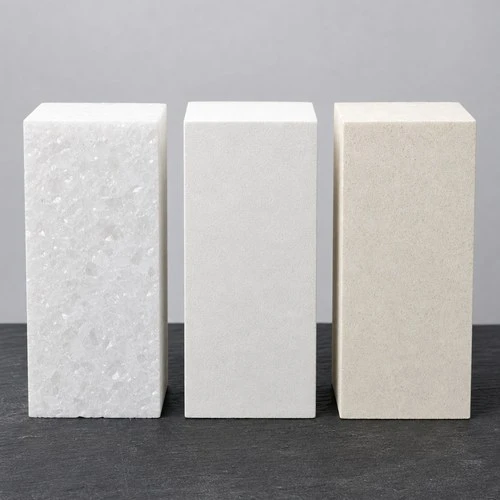
Fused Corundum Brick (Fused Cast / White Fused Alumina)
Made from white fused alumina (WFA) - Al₂O₃ ≥99% - as the primary raw material, with aluminum titanate or glass-phase binders. Produced by either fusion casting or high-pressure sintering.
Properties: highest density (3.4–3.5 g/cm³), lowest porosity (8–12%), highest chemical resistance. Best for direct molten glass contact and slag line zones in glass furnaces.
Limitation: lowest thermal shock resistance of the three types. Not recommended for applications with rapid thermal cycling.
Sintered Corundum Brick
Produced from sintered Al₂O₃ aggregate (92–96% Al₂O₃) with a small addition of TiO₂ or MgO as sintering aids. Fired at 1700–1750°C.
Properties: bulk density 3.0–3.3 g/cm³, apparent porosity 12–16%, good balance of strength and thermal shock resistance. The most commonly specified corundum brick for general high-temperature applications.
Best for: EAF upper shell, cement kiln main zone at elevated Al₂O₃ requirement, high-temperature chemical reactor linings.
Corundum-Mullite Brick
Contains 70–85% Al₂O₃ with the balance as mullite (3Al₂O₃·2SiO₂). The mullite phase acts as a thermal shock buffer - it distributes micro-cracks under thermal stress, preventing catastrophic spalling.
Properties: bulk density 2.75–2.95 g/cm³, apparent porosity 15–20%, RUL T₀.₅ 1600–1650°C. Lower chemical purity than pure corundum but significantly better thermal shock resistance.
Best for: glass furnace upper structure, ceramic kiln structural components, applications with daily thermal cycling above 1500°C.
Full Specification Comparison Table
| Property | Fused Corundum | Sintered Corundum | Corundum-Mullite |
|---|---|---|---|
| Al₂O₃ (%) | 98–99 | 92–96 | 70–85 |
| SiO₂ (%) | <0.5 | 1–3 | 12–22 |
| Bulk density (g/cm³) | 3.40–3.55 | 3.00–3.30 | 2.75–2.95 |
| Apparent porosity (%) | 8–12 | 12–16 | 15–20 |
| CCS (MPa) | 150–200 | 100–160 | 80–130 |
| RUL T₀.₅ (°C) | 1750+ | 1680–1720 | 1600–1650 |
| Max service temp (°C) | 1800+ | 1750 | 1700 |
| Thermal shock resistance | Low | Medium | High |
| Slag resistance | Excellent | Very good | Good |
| Relative cost index | 5× | 3–4× | 2.5–3× |
Reference base: 80% Al₂O₃ high alumina brick = 1×. Source: in-house production data.
Glass Furnace Applications - Where Corundum Earns Its Cost
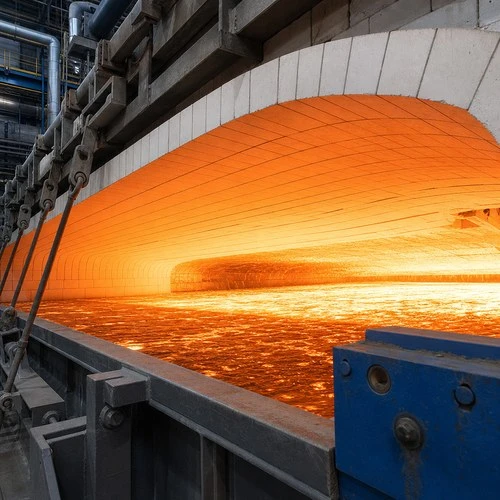
Glass furnaces are the primary market for corundum brick. The melting zone operates at 1550–1650°C with direct contact between molten glass and the lining. Standard high alumina brick dissolves in glass melt within months. Corundum brick with ≥99% Al₂O₃ is the only practical choice for direct glass contact.
Crown: Fused corundum or sintered corundum, 230mm standard thickness. Crown temperature: 1550–1600°C. Campaign target: 8–12 years in a well-maintained float glass furnace.
Melting zone sidewall and bottom: Fused corundum or AZS (alumina-zirconia-silica) brick. Below the glass line, AZS is standard. Above the glass line in contact with corrosive vapor, corundum performs better.
Upper structure and regenerator: Corundum-mullite brick for thermal shock tolerance. The regenerator sees cycling from ambient to 1400°C during valve reversal - mullite phase absorbs this stress.
A float glass plant in the Middle East replaced their 90% Al₂O₃ high alumina crown with our 95% sintered corundum brick in 2023. Previous crown lasted 6 years. Current installation has reached year 3 with no measurable thinning at the last cold inspection.
EAF and Petrochemical Applications
Electric Arc Furnace (EAF) Upper Zone
EAF refractory operating temperatures reach 1600–1700°C at the upper shell. MgO-C brick handles the slag line, but the upper shell above the slag line benefits from corundum brick's combination of high temperature resistance and resistance to iron oxide dust penetration.
Sintered corundum brick (93–95% Al₂O₃) is the standard specification for EAF upper shell applications. CCS requirement: minimum 100 MPa. Apparent porosity: maximum 16%.
Petrochemical Cracking Furnace
Steam cracking furnaces run at 1000–1250°C in the radiant section, but the hot gas ducts and cyclone separators can reach 1400–1600°C. Corundum-mullite brick (75–85% Al₂O₃) handles these zones well, with the mullite phase providing thermal shock resistance during process upsets.
Critical spec: Fe₂O₃ < 0.8% for hydrocarbon cracking applications - iron acts as a coking catalyst and reduces furnace run length.
High-Temperature Ceramic Kilns
Special ceramics kilns firing at 1650–1750°C use sintered corundum brick for kiln floor and setter supports. The requirement: dimensional stability under the weight of the ceramic load at operating temperature.
Reading a Corundum Brick COA - 5 Numbers That Matter
Every corundum brick shipment should come with a Certificate of Analysis. Here's what to check:
1. Al₂O₃ content. Verify it's within 2% of the specified grade. A "99% Al₂O₃" brick at 96.5% on the COA is not what you ordered.
2. SiO₂ content. For fused corundum, SiO₂ should be <0.5%. Higher SiO₂ indicates impure raw material or mullite contamination.
3. Fe₂O₃ content. Target <0.5% for glass furnace applications, <0.8% for petrochemical. Iron causes glass discoloration and promotes coking.
4. Bulk density. For fused corundum, anything below 3.35 g/cm³ suggests incomplete fusion or high porosity - both reduce chemical resistance and mechanical strength.
5. CCS. Ask for post-firing CCS (after 1600°C firing), not just after drying at 110°C. A high CCS at 110°C can drop significantly after service temperature.
We provide all five parameters on every batch COA. Traceability: lot number → production date → raw material source.
Factory Direct Sourcing: MOQ, Lead Time & Sample Policy
Reference Pricing (2025, FOB Qingdao)
| Type | Price per piece (USD, standard 230×114×65mm) | Per metric ton (USD) |
|---|---|---|
| Corundum-mullite (75% Al₂O₃) | 3.50–5.00 | 850–1,100 |
| Sintered corundum (93–95% Al₂O₃) | 5.00–8.00 | 1,200–1,800 |
| Fused corundum (98–99% Al₂O₃) | 8.00–14.00 | 2,000–3,200 |
MOQ:
Standard straight bricks: 50 pieces (sample) / 500 pieces (production order)
Custom shapes (wedge, arch, special cuts): minimum 200 pieces per shape
Project orders with multiple shapes: per drawing confirmation
Lead time:
Corundum-mullite: 15–20 days
Sintered corundum standard sizes: 20–25 days
Fused corundum (cast production): 30–45 days
Custom shapes add 10–15 days
Free sample policy: 2–5 pieces per grade for qualified buyers with a specific project. Provide equipment type, lining position, and service temperature when requesting samples.
Frequently Asked Questions
What is the difference between corundum brick and high alumina brick?
Corundum brick has Al₂O₃ content of 90–99%, compared to 45–90% for high alumina brick. The higher alumina content gives corundum brick a higher RUL (refractoriness under load) - typically 1680–1750°C vs. 1400–1600°C for high alumina. Corundum brick is used in furnaces operating above 1600°C where high alumina brick would deform or dissolve. It costs 3–5× more per piece.
Which corundum brick type is best for glass furnaces?
For direct glass contact zones (melting tank bottom and below-glass-line sidewall), fused corundum (99% Al₂O₃) or AZS brick provides the best chemical resistance against glass corrosion. For the furnace crown and upper structure, sintered corundum (93–95% Al₂O₃) offers a better balance of temperature resistance and cost. For regenerator zones with thermal cycling, corundum-mullite provides better thermal shock resistance.
Can corundum brick withstand thermal shock?
Fused corundum brick has low thermal shock resistance and is not suitable for applications with rapid temperature cycling (more than 200°C/hour). Sintered corundum has moderate thermal shock resistance. Corundum-mullite brick has the best thermal shock resistance of the three types and is recommended when daily cycling or process upsets are frequent. For severe thermal cycling applications, ceramic fiber modules or castable refractories may be more appropriate.
What is the minimum order quantity for corundum brick?
For standard straight brick (230×114×65mm): 50 pieces for sample orders, 500 pieces for production orders. Custom shapes require a minimum of 200 pieces per shape. Full project orders involving multiple shapes are quoted on a per-drawing basis.


