


An EAF runs at higher thermal intensity than almost any other industrial furnace. The electric arc generates temperatures above 3000°C at the electrode tip. The steel bath averages 1600–1650°C. The combination of molten metal, liquid slag, thermal cycling, arc radiation, and physical impact from charge material makes EAF refractory selection one of the most demanding problems in steelmaking.
The mistake most buyers make: treating the EAF as a single zone and specifying one material throughout. That's how you get a lining that fails first in the slag zone within 8 weeks while the bottom is still perfectly serviceable.
This guide maps each EAF zone, explains the failure mechanism in that zone, and gives the material specification that addresses it. For a comprehensive overview of the basic refractory family used throughout primary steelmaking, see our guide on magnesia refractory materials.
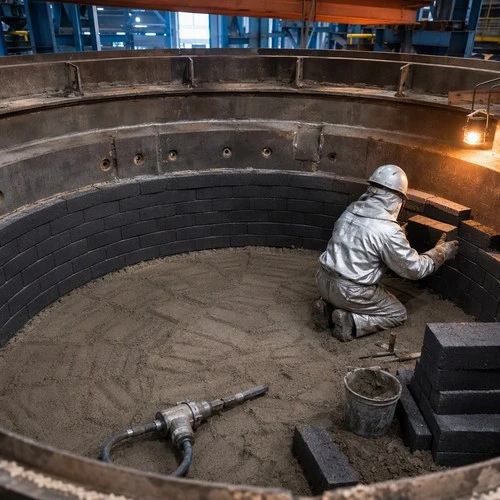
EAF Refractory Challenges - Why EAF Environments Are Unique
An EAF operating at 150 MW heat input generates conditions that would destroy most industrial furnace linings in days:
Thermal intensity: Arc temperatures of 3000°C+ with direct radiation to the roof and upper sidewall. Temperature gradients from the electrode zone to the steel bath: 1000°C within 500mm of lining thickness.
Chemical attack: Basicity of 3–4 (CaO/SiO₂ ratio). FeO content in EAF slag reaches 15–25%, significantly higher than BOF slag. FeO is particularly aggressive toward MgO-C brick - it oxidizes the carbon phase, creating porosity that accelerates slag penetration.
Thermal cycling: Each heat is a full cycle from cold startup to 1700°C and back. For a melt shop running 30 heats per day, the lining experiences 30 full thermal cycles per day. Thermal shock is the primary failure mode for roof bricks and upper sidewall sections.
Mechanical impact: Scrap charging with large steel pieces causes direct physical impact to the sidewall. This is why the impact zone (where scrap falls) receives the thickest, highest-CCS lining.
An EAF in Southeast Asia was replacing their sidewall lining every 3 months (approximately 250 heats). After we redesigned their zone specification - specifically switching from 10% C to 15% C MgO-C in the slag zone and adding a gunning maintenance program - they extended campaign life to 550+ heats before full relining.
EAF Zone Map - Failure Modes by Position
| Zone | Temperature | Primary Failure Mode | Recommended Material |
|---|---|---|---|
| Bottom (under steel bath) | 1600–1700°C | Erosion from molten steel + thermal fatigue | Rammed MgO + MgO-C safety lining |
| Slag line | 1600–1750°C | FeO slag attack + carbon oxidation | MgO-C brick, 14–18% C, FM-97 grain |
| Lower sidewall | 1500–1650°C | Slag attack + scrap impact | MgO-C brick, 12–15% C |
| Upper sidewall | 1400–1600°C | Arc radiation + thermal cycling | High alumina brick or alumina-chrome |
| Roof | 1400–1600°C | Arc radiation + gas attack + thermal shock | High alumina (90%) or water-cooled panels |
| Tap hole area | 1600–1700°C | Molten steel erosion + thermal shock | Alumina-MgO castable or special bricks |
Bottom and Hearth: Rammed MgO vs. Castable
The EAF bottom is typically constructed in two layers:
Safety/backup lining: MgO-C brick (8–10% C) or dense fired MgO brick. This layer remains in place for multiple campaigns - it's not replaced every heat. Thickness: 200–300mm.
Working layer: Sintered MgO rammed mass or MgO-based castable, applied on top of the safety lining. The rammed mass is replaced or replenished more frequently.
Why rammed mass for the hearth? The bottom surface is not a flat plane - it has irregular curvature from previous heats and erosion patterns. Rammed mass conforms to the surface and fills irregularities. Brick courses don't adapt as well to this geometry.
MgO content for hearth rammed mass: Minimum 90% MgO, grain size distribution to achieve maximum packing density. Coarse/medium/fine ratio: 40/30/30% by weight.
Application: Apply in 50–80mm lifts, tamp each lift manually or with pneumatic rammer. Target density ≥ 2.95 g/cm³ after tamping. Critical: the first heat after a hearth repair must follow a controlled heat-up schedule to sinter the rammed mass in place.
Material compatibility warning: High alumina castable can serve as the permanent backup/safety layer, but never as the working lining in direct steel contact. At 1650°C, high alumina releases SiO₂ into the bath, causing silicon pickup and degrading basic slag compatibility. Sintered MgO rammed mass remains non-negotiable for clean steel production.
Slag Zone (Lower Sidewall): Why MgO-C Grade Matters
The slag zone - roughly the 400–600mm band where the slag layer contacts the sidewall - is the fastest-wearing zone in any EAF. The combination of high-FeO slag, arc turbulence, and thermal cycling creates a perfect erosion environment, where premium magnesia carbon brick serves as the primary defense.
Carbon content selection:
14–18% C: Maximum carbon content, maximum thermal conductivity, maximum frozen slag layer protection. Used for high-FeO slag environments (scrap-based EAF with 15–20% FeO in slag). The frozen slag layer at the brick face effectively armor-plates the lining between taps.
12–14% C: For DRI (direct reduced iron) charges where FeO is lower and carbon pickup in ultra-low-carbon steel grades must be minimized.
10–12% C: For stainless steel EAF where carbon contamination is critical.
Raw material quality: FM-97 grain is the specification for slag zone brick. Using DBM-95 to reduce cost in the slag zone is a false economy - the lower bulk density and smaller crystal size of DBM allows faster FeO penetration.
Antioxidant addition: All our slag zone MgO-C bricks include Al or Al-Mg alloy antioxidant (2–4% addition) to retard carbon oxidation. This is standard practice - any MgO-C brick without antioxidant is inadequate for EAF slag line service.
Upper Sidewall: High Alumina vs. Alumina-Chrome Options
The upper sidewall operates above the slag line. The temperature is lower (1400–1550°C) but the environment is different: hot gas circulation, arc radiation, and dust/fume condensation rather than direct slag contact.
High alumina brick (85–90% Al₂O₃): Standard choice for upper sidewall. Adequate for moderate-intensity EAF operation. CCS ≥80 MPa, RUL T₀.₅ ≥1550°C. Cost-effective (review our technical breakdown of high alumina brick properties).
Alumina-chrome brick (70–80% Al₂O₃, 8–15% Cr₂O₃): Premium choice for high-intensity EAF with aggressive process chemistry. Cr₂O₃ addition significantly improves resistance to iron oxide fume condensation and alkali vapor attack. Campaign life typically 30–50% longer than standard high alumina in upper sidewall positions.
Environmental note on Cr₂O₃: Used brick from alumina-chrome linings contains hexavalent chromium (Cr⁶) after service - requires special disposal per local regulations. Confirm local waste disposal requirements before specifying.
Thickness: Upper sidewall typically 150–200mm. For high-duty operations, 230mm with hot face spray-on gunning maintenance.
Roof: Material Selection for Arc Radiation and Gas Attack
EAF roofs take the most punishment from arc radiation. Two main design approaches:
Delta roof (brick construction): Uses high alumina brick (90%+ Al₂O₃) or magnesia-chrome brick arranged in a suspended arch. Maximum service temperature: 1650°C. Requires periodic inspection and replacement of hot spots (directly below electrode positions).
Water-cooled panel roof (partial or full): Modern high-power EAF designs often use water-cooled copper or steel panels for most of the roof area, with only the electrode delta remaining as refractory brick. This dramatically extends the roof campaign life but increases water cooling energy consumption.
For brick roofs, specify:
High alumina brick, 92–95% Al₂O₃, minimum CCS 120 MPa
Apparent porosity < 15% (dense brick resists fume penetration)
Proper brick geometry for the arch design - consult us with roof diameter and delta dimensions
Gunning and Patching - Extending Campaign Life
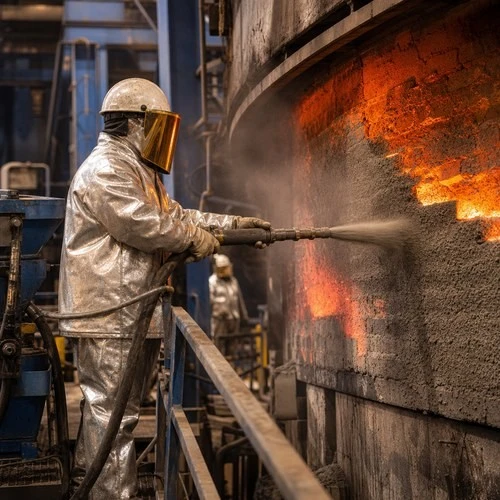
A well-run gunning maintenance program is the difference between 300-heat and 600-heat campaigns.
Gunning material: MgO-based dense gunning castable, 85–90% MgO, particle size optimized for pneumatic application.
When to gun: After each heat or every 2–3 heats, inspect the slag zone and impact zone. Gun any area where wear exceeds 20mm from the reference profile. Target: keep the lining within 30–50mm of original profile throughout the campaign.
Application method:
Wet gunning (preferred): pre-mixed with water, applied at 5–8m gun distance
Dry gunning: powder + water at nozzle; requires precise water control for adhesion
Adhesion key: The furnace shell must be at 600–900°C when gunning. Below 600°C, the gunning material doesn't sinter and falls off. Above 1000°C, it dries too fast before penetrating into existing cracks.
Our dense gunning castable: MgO ≥88%, Fe₂O₃ < 1.2%, CCS after 1400°C firing ≥ 45 MPa. Compatible with both our MgO-C brick and competitor brands - gunning compatibility depends on chemistry, not brand.
Campaign Life Benchmarks and Optimization
Typical EAF campaign lives by design:
| EAF Type | Bottom Life | Sidewall Life (without gunning) | With Gunning Program |
|---|---|---|---|
| AC EAF, conventional scrap | 300–500 heats | 250–350 heats | 500–700 heats |
| DC EAF | 400–600 heats | 300–400 heats | 600–800 heats |
| DRI-fed EAF | 200–350 heats | 200–300 heats | 400–600 heats |
Three variables that most influence campaign life:
MgO-C carbon content (higher C in high-FeO slag = longer life)
FM vs. DBM grain quality (FM-97 consistently outperforms in slag zone)
Gunning program consistency (patching within 24 hours of detecting wear > 20mm)
Component replacement intervals across campaigns:
Sidewalls: 250–400 heats unmaintained; 500–800 heats with daily hot gunning maintenance.
Hearth bottom: Typically survives 2–3 complete sidewall campaigns (1,200–2,000 heats) before requiring full breakout and re-ramming.
Tap hole sleeve bricks: Scheduled changeouts every 50–100 heats to prevent tap stream flare and steel leakage.
AC vs. DC furnace considerations: DC EAF bottom designs incorporate conductive MgO or graphite-MgO pin bricks around the bottom return electrode, demanding specialized thermal expansion monitoring during startup.
Technical Consultation & Project RFQ
MgO-C brick for EAF slag zone - 14% C and 12% C grades in stock.
Provide your furnace type (AC/DC), tap weight, steel grade, and current campaign life. Our engineering team will specify the zone-matched refractory package and provide a complete technical proposal.
Email: inquiry@topower.tech - we reply within 4 business hours.
TDS, COA, and batch test reports from recent production lots available on request.


