


Why Sintering Temperature Matters for High-Alumina Bricks
Sintering temperature is one of the most important production factors affecting the quality of High Alumina Brick. For international buyers, the appearance of a refractory brick is often the first thing they notice. A light yellow or yellowish-white surface may look clean and attractive, while a darker brick may appear less visually appealing. However, in refractory applications, appearance should never be the only standard for judging quality.
The sintering process directly affects the internal structure, density, strength, volume stability and service life of high-alumina bricks. A properly fired brick can perform reliably in high-temperature furnaces, kilns and thermal equipment. An under-fired brick may look smooth on the surface, but it can develop serious problems during operation, especially under dynamic temperature changes.
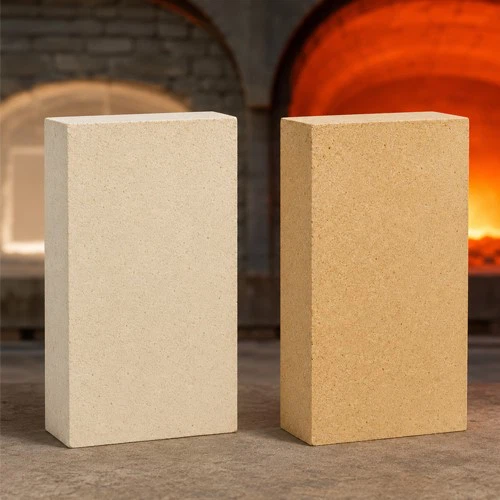
Low-Temperature Sintering: Better Appearance but Lower Stability
When the sintering temperature is relatively low, high-alumina bricks often show a lighter color and smoother surface. From a visual point of view, these bricks may look more attractive. Their edges may appear neat, and the surface may seem cleaner compared with bricks fired at higher temperatures.
However, low-temperature sintering usually means the raw materials have not fully reacted. The internal structure may not be dense enough, and the bonding between particles may remain weak. As a result, the brick may have lower mechanical strength, poorer wear resistance and reduced resistance to spalling.
For some static furnace wall areas, where there is limited mechanical stress and no severe thermal shock, a lower-fired brick may still be usable if its technical data meets the requirement. But for demanding furnace zones, appearance alone cannot guarantee reliable performance.
High-Temperature Sintering: Darker Color but Stronger Performance
At a suitable higher sintering temperature, the raw materials inside high-alumina bricks react more completely. The brick structure becomes denser and more stable. This improves cold crushing strength, refractoriness under load, wear resistance and resistance to volume change during service.
High-temperature sintered bricks may appear darker yellow or deep yellowish-white. Their surface color may not be as bright as low-temperature fired products, but this darker appearance is often linked with better internal sintering. For buyers who need bricks for high-temperature and high-load working areas, this performance advantage is far more important than color.
A well-sintered Refractory Brick can better withstand thermal cycling, chemical attack and long-term furnace operation. This is especially important in industries such as cement, steel, lime, ceramics and non-ferrous metallurgy.
Secondary Expansion Risk in Under-Fired Bricks
One major problem caused by insufficient sintering is secondary expansion. High-alumina bricks are usually made from bauxite and other alumina-rich raw materials. These raw materials naturally experience phase transformation and volume changes during heating.
If the brick is not fully sintered during production, part of this transformation may continue after the brick is installed in the furnace. During actual use, the brick may expand again when exposed to high temperature. This secondary expansion can create stress between bricks or between the brick lining and the furnace shell.
In severe cases, the kiln lining may crack, loosen, peel off or collapse. The result can be shortened service life, more frequent repairs and even unplanned shutdowns. For buyers, the real cost of a low-quality brick is not only the purchase price, but also the maintenance cost and production loss caused by lining failure.
Why Rotary Kilns Require Fully Sintered Bricks
Rotary kilns place much higher demands on high-alumina bricks than many static furnace linings. During operation, the kiln body rotates continuously and experiences thermal expansion, mechanical stress and material impact. The refractory lining must remain stable under both high temperature and movement.
If under-fired bricks are used in a rotary kiln, secondary expansion can be especially dangerous. The kiln shell expands during operation, while the bricks may also expand because of incomplete sintering. This can generate abnormal stress inside the lining. Once the stress exceeds the brick's resistance, spalling or lining damage may occur.
Therefore, Rotary Kiln Refractory Bricks should have sufficient sintering, stable volume, good strength and reliable thermal shock resistance. In this application, buyers should pay more attention to actual performance data than to surface color.
How Manufacturers Determine the Correct Sintering Temperature
A professional manufacturer does not set the sintering temperature randomly. The correct firing process must be determined according to the characteristics of the raw materials. Different bauxite sources may have different mineral composition, impurity levels, particle size distribution and sintering behavior.
Before mass production, manufacturers usually conduct raw material testing, trial firing and performance verification. Trial firing helps determine whether the selected temperature can achieve good density, proper shrinkage, stable color, qualified strength and acceptable dimensional accuracy.
If the temperature is too low, the brick may be under-fired. If the temperature is too high, the brick may deform, over-burn or lose dimensional accuracy. The best process is not simply the highest temperature, but the most suitable temperature for the specific raw material and product grade.
How Buyers Should Evaluate High-Alumina Bricks
When purchasing high-alumina bricks, buyers should not only ask for photos or judge the product by color. Technical data is much more important. Key indicators include Al2O3 content, bulk density, apparent porosity, cold crushing strength, refractoriness under load, thermal shock resistance and linear change after reheating.
For general furnace wall construction, buyers may focus on dimension accuracy, appearance and basic strength. For working linings, rotary kilns, hot zones and high-wear areas, buyers should require more stable physical and chemical properties.
It is also helpful to tell the supplier the furnace type, working temperature, fuel type, lining position, atmosphere and whether there is mechanical impact or chemical corrosion. This allows the supplier to recommend a suitable grade instead of only offering a general brick
Sintering temperature has a direct influence on the appearance, structure and service performance of high-alumina bricks. Low-temperature sintered bricks may look cleaner and lighter in color, but they can have incomplete internal bonding and higher risk of secondary expansion. Proper high-temperature sintering may make the brick color darker, but it improves density, stability and service life.
For industrial buyers, the best high-alumina brick is not always the one with the most attractive appearance. It is the brick that matches the furnace working condition and performs reliably during long-term operation. A balanced evaluation of appearance, technical data and application requirements is the best way to select the right refractory material.


