


What Is Calcium Aluminate Cement?
Calcium aluminate cement, also called CAC or high alumina cement, is a hydraulic binder widely used in refractory castables, repair materials and special construction products. Unlike ordinary Portland cement, calcium aluminate cement contains calcium aluminates as the main mineral phase, giving it faster strength development and better high-temperature performance.
In refractory materials, calcium aluminate cement helps bind aggregates and powders before ceramic bonding develops at high temperature. It is one of the most common binders for castable refractories.
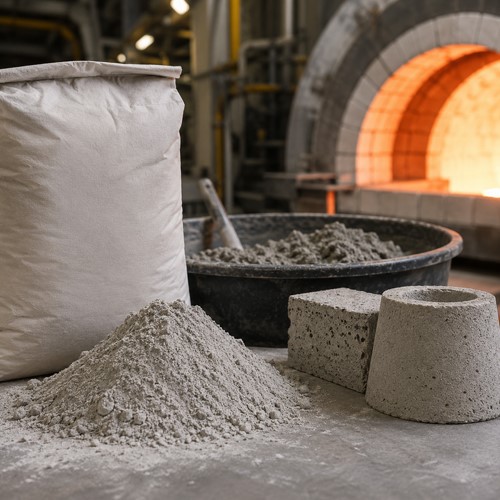
Common Calcium Aluminate Cement Grades
Calcium aluminate cement is often classified by alumina content. Common refractory grades include CA50, CA60, CA70 and CA80. The higher the alumina content, the better the high-temperature performance generally becomes, but the cost also increases.
CA50 is widely used in general refractory castables and construction applications. CA60 and CA70 are suitable for higher temperature castables. CA80 is used in more demanding refractory formulations where higher purity and lower lime content are needed.
The correct grade depends on the castable design, service temperature, slag environment and required strength.
Setting Time and Strength Development
One important reason buyers choose calcium aluminate cement is its setting and hardening behavior. It can develop strength faster than ordinary cement, especially under suitable curing conditions. However, setting time can be affected by temperature, water addition, additives and storage condition.
If the setting time is too fast, construction may become difficult. If it is too slow, demolding and repair schedules may be delayed. For refractory castables, the supplier should balance workability, setting time and early strength according to the installation method.
Use in Refractory Castables
Calcium aluminate cement is used in dense castables, low cement castables, insulating castables, repair castables and gunning materials. It helps the castable form a stable structure after mixing with water.
In high alumina castables, CAC provides bonding before firing. In low cement castables, the amount of cement is reduced to improve high-temperature strength and corrosion resistance. In insulating castables, it helps bond lightweight aggregates while keeping the material easy to install.
How Buyers Should Choose CAC
When selecting calcium aluminate cement, buyers should consider Al2O3 content, CaO content, setting time, strength, fineness and compatibility with refractory aggregates. The final castable performance depends not only on cement quality but also on the whole formulation.
For export purchasing, packaging is also important. Calcium aluminate cement should be protected from moisture because hydration before use can reduce performance. Buyers should check shelf life, bag condition and storage instructions.
Common Application Areas
Calcium aluminate cement is widely used in industrial furnace lining, boiler repair, kiln maintenance, ladle lining, incinerator lining and petrochemical furnace insulation. It is also used in refractory precast shapes and special repair materials where fast installation is required.
For emergency repair projects, fast setting and early strength are very valuable. For long-service furnace lining, high-temperature stability and compatibility with aggregates become more important.
Calcium aluminate cement is a key binder for refractory castables. Buyers should select the correct grade according to alumina content, setting time, service temperature and castable formulation. A suitable CAC grade can improve workability, early strength and high-temperature lining performance.


