


Refractory failure is the premature physical or chemical degradation of a high-temperature industrial furnace lining, resulting in loss of structural load-bearing capacity, loss of thermal insulation containment, or molten liquid breakout. Governed primarily by three distinct failure modes-thermal shock spalling from cyclic temperature swings, chemical slag infiltration creating destructive altered layers, and mechanical anchor fatigue-refractory lining breakdown forces unscheduled plant downtime that costs heavy processing industries millions of dollars per day.
While refractory materials are rated by maximum service limits exceeding 1700°C, commercial linings rarely fail from pure over-temperature melting. Instead, catastrophic failure occurs when mechanical stresses exceed material tensile thresholds, when basic and acidic chemical species react at grain boundaries to form low-melting eutectic phases, or when improper curing schedules convert internal moisture into explosive steam pockets. Understanding root causes and aligning material thermomechanical properties with operational furnace stresses extends lining campaign life by 30% to 50%. This engineering guide diagnoses common refractory failure mechanisms and outlines actionable prevention protocols.
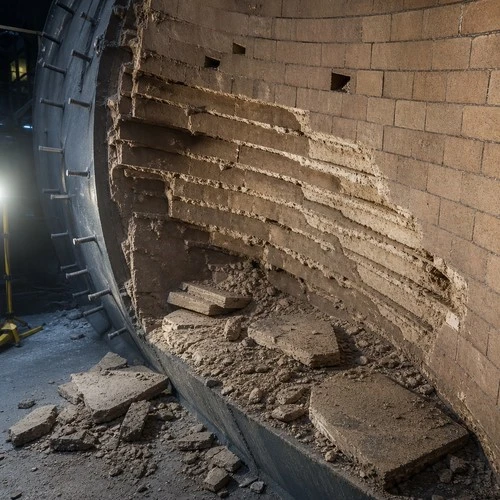
The Three Primary Modes of Refractory Failure
Field autopsy investigations of failed furnace linings categorize degradation into three root-cause mechanisms:
1. Thermal Shock Spalling (Mechanical Stress Exceeding Tensile Limits)
Thermal spalling occurs when sudden heating or cooling generates steep temperature gradients across the thickness of a refractory brick or monolithic castable:
Shear Stress Generation: The hot-face skin expands rapidly while the colder backing material restrains movement. This mechanical constraint creates severe compressive shear stress parallel to the hot face.
Crack Propagation: Once thermal stresses exceed the material hot modulus of rupture (HMOR), horizontal tensile cracks initiate 15 to 40 mm behind the working face. During subsequent temperature fluctuations, these microcracks join into a continuous shear plane, causing thick monolithic slabs to break loose and spall into the furnace bath.
Typical Plant Environments: Steel teeming ladles between tapping cycles, rotary kiln emergency flame shutdowns, and batch heat-treatment furnaces.
2. Structural Spalling via Chemical Slag Infiltration
Unlike pure thermal spalling, structural spalling is driven by chemical contamination:
Capillary Infiltration: Molten metallurgical slags containing iron oxide (FeO), calcium oxide (CaO), and silica (SiO2) penetrate open refractory pores via capillary suction.
Formation of Altered Dense Layer: The infiltrating flux reacts with matrix minerals, altering the chemical composition, density, and thermal expansion coefficient of the front 10 to 30 mm zone.
Differential Expansion Rupture: When the furnace cools, the newly formed vitrified slag zone contracts at a significantly different rate than the unaltered parent brick behind it. The localized shear strain along the boundary plane causes the densified face to peel away in sheets.
3. Mechanical Anchor Fatigue & Shell Distortion
Monolithic castables and ceramic fiber linings depend on metallic or ceramic anchors welded to the steel shell. Failure occurs when:
Anchor Thermal Creep: Low-grade stainless anchors (such as standard SUS304 used above 850°C) suffer catastrophic creep deformation and oxidation scaling, losing grip on the lining.
Inadequate Expansion Clearance: If plastic expansion caps are omitted from anchor tips during casting, expanding steel anchors exert immense outward pressure, fracturing the surrounding cured refractory from within.
When premature degradation occurs, forensic analysis of refractory failure must isolate chemical corrosion from initial installation errors.
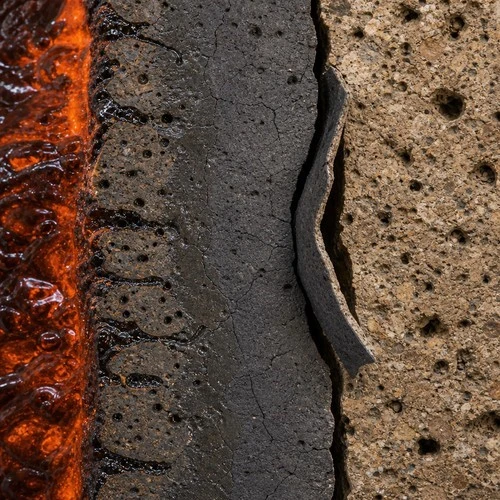
Chemical Infiltration Mechanics: Acidic vs. Basic Slag Attack
Chemical corrosion is governed by acid-base metallurgical thermodynamics:
1. Acidic Slag Attack (Silica-Rich Chemistry: CaO/SiO2 < 1.0)
Vulnerable Materials: High-alumina bricks, basic magnesia refractories, and fireclay castables.
Reaction Mechanism: Acidic silica flux and iron oxide attack alumina-silica refractories to form low-melting fayalite (2FeO·SiO2, melting point 1205°C) and anorthite. In basic magnesia linings, silica dissolves periclase grains into low-melting monticellite (CaO·MgO·SiO2, melting point 1490°C), liquefying the grain-boundary bond.
2. Basic Slag Attack (Lime-Rich Chemistry: CaO/SiO2 > 2.0)
Vulnerable Materials: Alumina-silica refractories and silica bricks.
Reaction Mechanism: Free lime (CaO) aggressively dissolves alumina, forming low-melting calcium aluminate compounds (such as 12CaO·7Al2O3, melting point 1415°C) that wash away in turbulent molten steel.
Engineering Solution: Basic operational environments require dense magnesia-carbon bricks or microcrack-toughened magnesia alumina spinel bricks that resist basic slag wash and alkali salt infiltration.
3. Carbon Monoxide (CO) Disintegration
In petrochemical cracking units, blast furnace stacks, and gasifiers operating in reducing atmospheres between 400°C and 600°C:
The chemical reaction 2CO -> C + CO2 is catalytically accelerated by free iron oxide (Fe2O3) impurities present in the refractory.
Solid carbon soot precipitates inside brick micropores, generating massive localized internal crystal pressure that reduces hard refractory bricks into loose powder within weeks. Refractory specifications for reducing atmospheres strictly limit Fe2O3 to <= 0.8% to 1.0%.

Construction & Commissioning Pitfalls: Why Brand-New Linings Collapse
Over 40% of refractory lining failures originate during installation and initial curing rather than operational wear:
Excessive Mixing Water in Monolithic Castables: Adding just 1% to 2% extra mixing water beyond the technical data sheet (TDS) recommendation elevates dry porosity by 15% to 25%, slashing cold crushing strength by half and exponentially accelerating slag infiltration rates. Always utilize planetary pan mixers and vibrating compaction to place zero-slump high alumina castable refractory formulations.
Explosive Steam Spalling During First Firing: Hydraulic cements (such as Secar 71 or CA-50) chemically bind high volumes of crystalline water. If the initial heating ramp exceeds 10°C to 15°C per hour through the critical dehydration zone (110°C to 350°C), trapped moisture turns to steam faster than it can escape through micropores. Internal steam pressure exceeding 5.0 MPa instantly shatters the newly installed lining. Polypropylene anti-explosion fibers must be incorporated to melt at 160°C, creating micro-channels for vapor release.
Missing Thermal Expansion Allowances: Dense refractory bricks expand 0.5% to 1.4% upon heating. Failing to incorporate expansion relief gaps (typically 10 to 14 mm per linear meter packed with combustible spacers or ceramic fiber paper) results in extreme compressive pinch spalling around door frames, arches, and kiln rings.
Engineering Prevention: Diagnostics & Lining Design
Extending industrial lining campaign life requires proactive design and predictive monitoring:
Composite Backup Insulation: Backing dense hot-face working refractories with high-efficiency rigid calcium silicate board maintains a steep thermal gradient. This forces the freezing isotherm of infiltrating liquid slag to solidify within the first 10 mm of the brick face, stopping deep structural contamination.
Thermomechanical Matching: Specify refractories with high thermal shock parameters: lower thermal expansion coefficients, higher thermal conductivity to dissipate localized hot spots, and aggregate matrices engineered with microcrack toughening.
Non-Destructive Thermal Imaging: Deploy continuous infrared thermography scanning across exterior steel shells. Detecting a localized temperature spike from 220°C to 380°C pinpoints early refractory thinning or internal anchor failure weeks before a catastrophic molten metal breakout occurs.
Technical Audits, Failure Analysis & Commercial Support
Our engineering team provides comprehensive forensic laboratory audits for industrial plants experiencing premature refractory failure:
Laboratory Testing Services: Post-mortem analysis includes XRF chemical profiling, X-ray diffraction (XRD) mineral phase mapping of altered slag zones, and SEM microstructural scanning.
Customized Lining Engineering: We calculate heat-transfer profiles, optimize anchor metallurgy (SUS310S, Inconel 601), and formulate tailored castable and brick linings engineered for specific plant slag chemistry.
To submit failed refractory photographs, request an on-site technical inspection, or review specialized high-durability formulations, contact our metallurgical team at inquiry@topower.tech.


