


Industrial silica brick is an acidic shaped refractory manufactured from high-purity quartzite containing SiO2 >= 96%, engineered to deliver exceptional structural load resistance at temperatures exceeding 1600°C with refractoriness under load (RUL T0.6) reaching 1650°C to 1680°C and near-zero creep. Characterized by a true density strictly controlled below 2.34 g/cm3 and residual quartz under 1.0%, premium silica brick serves as the critical engineering material for spanning self-supporting crowns in float glass melting furnaces and lining heating flues in metallurgical by-product coke ovens.
While basic bricks and alumina-silica refractories soften and deform under structural compression at 1550°C, high-grade silica brick retains rigid mechanical geometry up to within 50°C of its ultimate melting point (1710°C to 1730°C). However, because quartz minerals undergo sharp, non-linear crystalline inversions between 100°C and 300°C, furnace designers and plant operators must understand thermal expansion kinetics, phase transformation control, and precise mortar pairing. This technical guide outlines chemical specifications, temperature inversion management, glass crown integrity, and export quality verification when sourcing from China.
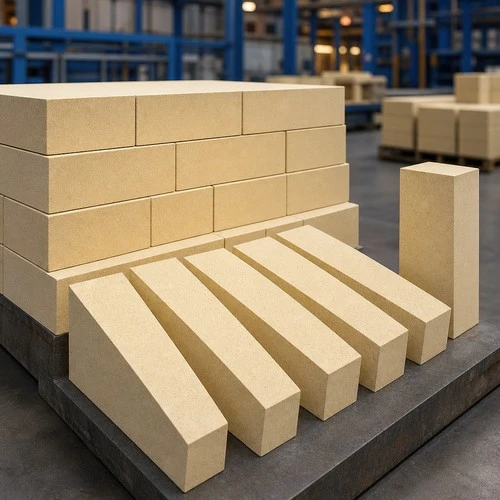
What Is High-Performance Silica Brick?
Natural raw quartzite undergoes irreversible allotropic crystalline phase changes when fired in industrial tunnel kilns at 1400°C to 1430°C for over 100 hours. The service life of a furnace lining depends directly on the proportion of converted mineral phases:
Tridymite (Target: 55% to 65%): The primary and most desirable crystal phase for glass furnace crowns. Tridymite has a stable monoclinic-to-hexagonal lattice that exhibits minimal thermal expansion above 600°C, providing the highest volume stability under continuous operating loads.
Cristobalite (Target: 25% to 35%): Formed during intermediate firing stages. Cristobalite delivers high refractoriness under structural load and strong resistance to acidic fluxing vapors.
Residual Quartz (Target: <= 1.0% for glass grade, <= 1.5% for coke oven grade): Unconverted quartz particles that remain after kiln firing. High residual quartz is dangerous because it continues to invert and expand inside industrial furnaces, creating late-stage arch lifting, pinch spalling, or brick fracture.
Glassy Matrix (Target: 5% to 8%): Formed by mineralizers such as calcium oxide (CaO) and iron oxide (Fe2O3) added during wet blending to accelerate quartz liquid-phase conversion.
The True Density Quality Indicator
Raw quartzite rock has a natural true density of 2.65 g/cm3. As high-temperature firing converts dense quartz into tridymite (true density 2.26 g/cm3) and cristobalite (true density 2.32 g/cm3), the overall density drops. Therefore, true density is the universal benchmark of firing completeness: a lower true density confirms that quartz has thoroughly converted into stable phases.
Export batches of silica brick in china specify a true density of <= 2.33 to 2.34 g/cm3 for glass melting furnaces and <= 2.35 g/cm3 for by-product coke ovens.
Technical Specifications: Glass Crown vs. Coke Oven Grades
Industrial silica bricks are manufactured into distinct metallurgical formulations tailored to specific furnace atmospheres and mechanical stresses.
1. Premium Glass Furnace Crown Grade
SiO2 Purity: >= 96.0% (XRF analysis)
Al2O3 Content: <= 0.4% (Crucial purity threshold)
Fe2O3 Content: <= 0.6%
Refractoriness under Load (RUL T0.6): >= 1680°C (ASTM C16)
True Density: <= 2.33 g/cm3 (ASTM C135)
Residual Quartz: <= 1.0% (XRD Quantitative Analysis)
Bulk Density: 1.88 to 1.95 g/cm3
Apparent Porosity: <= 18.0%
Cold Crushing Strength (CCS): >= 45.0 MPa
The Critical Low-Alumina Rule for Glass: Notice that Al2O3 in glass crown silica brick is restricted to <= 0.4%. Alumina acts as a destructive flux in the presence of volatile alkali vapors (Na2O) inside glass tanks. Exceeding 0.5% Al2O3 lowers the eutectic liquidus temperature drastically, causing refractory dripping into the molten glass bath and producing visual ribbon defects or stone inclusions.
2. Standard Coke Oven Battery & Hot Blast Stove Grade
SiO2 Purity: >= 95.0%
Al2O3 Content: <= 1.3%
Fe2O3 Content: <= 1.0%
Refractoriness under Load (RUL T0.6): >= 1640°C to 1650°C
True Density: <= 2.35 g/cm3
Residual Quartz: <= 1.5% to 2.0%
Apparent Porosity: <= 22.0%
Cold Crushing Strength (CCS): >= 35.0 to 40.0 MPa
Thermal Expansion Behavior: The 100°C to 300°C Inversion Zone
Unlike alumina-silica bricks that expand linearly with rising temperature, silica brick exhibits a sharp, non-linear thermal expansion profile governed by mineral inversions:
The Dangerous Low-Temperature Inversion Zone (100°C to 300°C):
Between 117°C and 163°C, alpha-tridymite rapidly inverts into beta-tridymite with a sharp volumetric expansion of approximately 0.2%.
Between 200°C and 270°C, alpha-cristobalite converts into beta-cristobalite, triggering a massive, instantaneous volume jump of nearly 1.0%.
Over 70% of the lifetime thermal expansion of a silica brick occurs before the lining reaches 300°C.
The Safe Operating Zone (Above 600°C):
Once furnace temperatures exceed 600°C, the expansion curve levels off completely.
Between 600°C and 1600°C, thermal expansion is negligible (less than 0.1%). This makes silica brick one of the most dimensionally rigid structural materials in high-temperature engineering.
Kiln Heat-Up Schedule Rules
To prevent catastrophic thermal stress cracking during initial heat-up:
Ambient to 150°C: Heating rate must not exceed 5°C per hour.
150°C to 350°C: Heating rate strictly restricted to 2°C to 3°C per hour, with 24-hour soaking holds at 160°C and 260°C.
Tie-Rod Tension Management: As furnace crowns rise during heating, engineers must systematically loosen spring tie-rods on external steel buckstays to accommodate expansion without crushing brick edges.
Primary Industrial Applications
1. Float Glass Furnace Crowns
Modern float glass lines operate continuously for 12 to 15 years without hot repair. Spanning widths of 10 to 14 meters directly above molten soda-lime glass at 1580°C to 1620°C, silica crowns resist vaporized sodium alkali attack. Volatile alkali reacts with silica to form a high-viscosity liquid sodium silicate surface glaze that adheres to the brick without dripping. In contrast, basic refractories like magnesia refractory materials creep under self-weight at these temperatures. External crown insulation typically combines lightweight silica brick and backing calcium silicate board to keep interface temperatures safely above 1200°C, preventing acid gas condensation.
2. By-Product Coke Oven Battery Walls
In metallurgical coke ovens, silica bricks construct the vertical heating flues and carbonization chamber dividing walls. The bricks withstand intense mechanical abrasion during coal charging and red-hot coke pushing. With thermal conductivity reaching 1.8 to 2.2 W/(m·K) above 800°C, tridymite-rich walls transfer heat efficiently, accelerating carbonization cycles. Furthermore, with Fe2O3 controlled under 1.0%, silica bricks remain chemically inert against carbon monoxide (CO) gas, eliminating iron-catalyzed carbon deposition that causes internal disintegration in fireclay refractories.
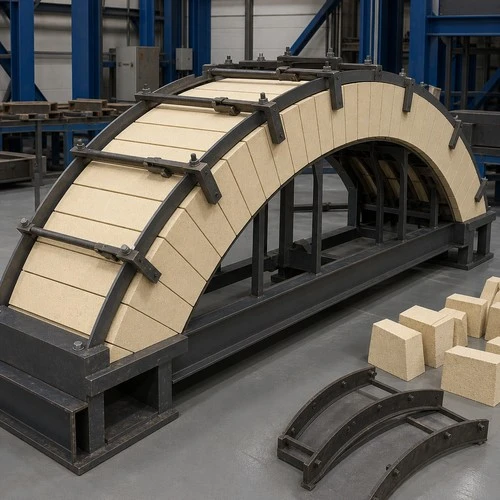
Masonry Installation, Silica Mortar Pairing & Joint Sizing
Strict Silica Mortar Matching: Silica bricks must never be laid with high-alumina or fireclay bonding mortars. Always pair them with specialized refractory silica mortar containing SiO2 >= 94% and Al2O3 <= 1.5%. Clay-based mortars form low-melting eutectic compounds that liquefy and bleed out of joints above 1500°C.
Tight Joint Tolerances: Glass furnace crowns mandate joints <= 1.5 mm. Every brick is dry-checked for dimensional tolerances before applying a thin wet slurry.
Expansion Joint Allowances: A longitudinal expansion allowance of 12 to 14 mm per linear meter must be built into furnace framework. Relief gaps are packed with combustible cardboard spacers or ceramic fiber paper that burn out cleanly above 300°C.
When designing furnace transitions between silica crowns and sidewall sections built from high temperature refractory bricks, flexible expansion joints prevent compressive shear failure.

Factory Direct Inspection, Sourcing & Export Logistics
Direct procurement from certified manufacturers in China requires strict verification of conversion completeness and packaging protection:
Factory Inspection Protocols: Every 50 metric tons of production undergoes pycnometer true density testing per ASTM C135. Batches exceeding 2.34 g/cm3 are rejected. Quantitative X-ray diffraction (XRD) confirms residual quartz remains under 1.0%.
Moisture-Protected Export Packaging: Because silica brick can hydrate or absorb moisture that degrades thermal shock resistance during rapid heat-up, pallets are sealed in double-layer polyethylene shrink film, protected by rigid plastic corner protectors, strapped with heavy PET banding, and secured on fumigated solid wood pallets complying with ISPM 15 standards.
Commercial Terms & Lead Times: Standard 230x114x65 mm straights require a minimum order quantity (MOQ) of 10 metric tons. Custom tapered arch wedges, skewbacks, and tongue-and-groove coke oven shapes carry a 20-ton MOQ. Standard orders dispatch in 10 to 14 days, with custom mold pressings shipping within 20 to 25 days FOB Qingdao.
For material test certificates (MTC), XRD mineralogical reports, or commercial inquiries on glass crown and coke oven silica shapes, contact our technical team at inquiry@topower.tech.


