


Ceramic fiber paper is a precision-engineered, flexible high-temperature insulation sheet manufactured from high-purity spun aluminosilicate ceramic fibers via an automated wet-laid fourdrinier papermaking process. Providing continuous thermal resistance from 1260°C to 1430°C with an engineered bulk density of 180 to 220 kg/m³ and standard thicknesses spanning 0.5 mm to 10 mm, ceramic fiber paper delivers tensile strength exceeding 0.40 MPa, shot content below 8.0%, and excellent dielectric breakdown resistance (>1.2 kV/mm).
Across the international ceramic fiber paper market, this versatile material has largely superseded mineral wool blankets, asbestos paper, and high-temperature mica sheets in applications requiring thin-cross-section thermal barriers. From die-cut furnace flange gaskets and burner throat expansion wraps to non-ferrous molten metal parting barriers, ceramic fiber paper provides a lightweight thermal seal. Below are the key classification grades, compression recovery metrics, dielectric performance, and factory procurement specifications.
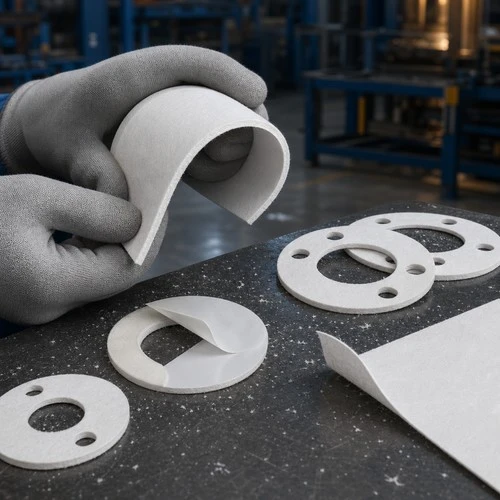
What Is Refractory Ceramic Fiber (RCF) Paper? (The Wet-Laid Process)
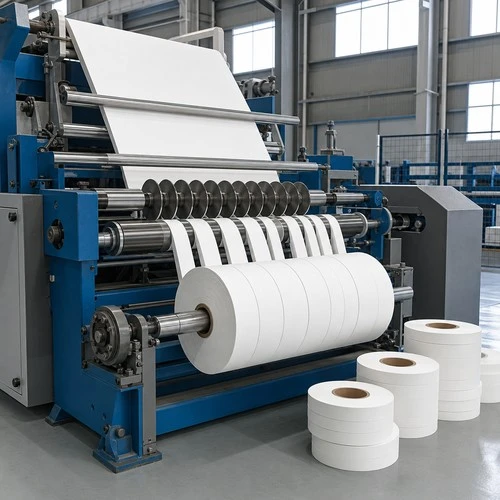
Unlike needle-punched ceramic fiber blankets, which rely on mechanical fiber inter-tangling, ceramic fiber paper is formed through a specialized industrial papermaking process that guarantees uniform thickness, smooth surface finish, and isotropic mechanical properties:
Fiber Slurrying & Washing: Spun aluminosilicate bulk fibers (Al₂O₃ 45–50%, SiO₂ 50–55%) are dispersed in water. Heavy, unfiberized spherical glass particles (known as "shot") are cyclonically separated and discarded, lowering shot content to <8% (and <5% in premium grades).
Binder Metering: A proprietary organic latex binder (6.0–8.5% by weight) is metered into the aqueous fiber slurry. This binder coats the individual fibers, providing cohesive green strength, elongation flexibility, and rollability.
Fourdrinier Wire Drainage: The slurry flows continuously onto a moving fourdrinier wire screen where vacuum boxes rapidly dewater the fiber mat, orienting fibers in a uniform multidirectional plane.
Calendering & Hot Air Curing: The wet sheet passes through heated compaction rollers (calenders) that consolidate thickness to precise tolerances (±0.1 mm) before entering a multi-zone convection tunnel to cure the organic polymer.
Precision Slitting & Winding: The finished continuous roll is edge-trimmed and wound onto heavy-duty cardboard cores in standard widths of 610 mm, 1000 mm, or 1220 mm.
Technical Specifications: Standard, High-Purity & Zirconia Grades
Selecting the proper grade in the global ceramic paper market requires matching operating temperatures, chemical atmospheres, and mechanical requirements:
1. Standard 1260°C Grade (General Industrial Insulation)
Classification Temperature: 1260°C (Continuous service: ≤ 1050°C)
Chemical Analysis: Al₂O₃ 45–47%, SiO₂ 51–53%, Fe₂O₃ ≤ 0.8%
Bulk Density: 180–210 kg/m³
Tensile Strength: Longitudinal ≥ 0.40 MPa; Transverse ≥ 0.30 MPa (ASTM D828)
Shot Content (>45 μm): ≤ 8.5% (ASTM C612)
Loss on Ignition (LOI): ≤ 8.0%
Thermal Conductivity: 0.075 W/m·K at 400°C; 0.145 W/m·K at 800°C; 0.210 W/m·K at 1100°C
2. High-Purity 1350°C Grade (Clean Firing & Low Impurity)
Classification Temperature: 1350°C (Continuous service: ≤ 1150°C)
Chemical Analysis: Al₂O₃ 47–49%, SiO₂ 50–52%, Total Alkalis (Na₂O + K₂O) ≤ 0.2%
Bulk Density: 190–220 kg/m³
Tensile Strength: Longitudinal ≥ 0.45 MPa; Transverse ≥ 0.35 MPa
Shot Content (>45 μm): ≤ 6.0%
Loss on Ignition (LOI): ≤ 7.0%
Thermal Conductivity: 0.070 W/m·K at 400°C; 0.138 W/m·K at 800°C; 0.195 W/m·K at 1100°C
3. Zirconia 1430°C Grade (Severe Thermal Service)
Classification Temperature: 1430°C (Continuous service: ≤ 1300°C)
Chemical Analysis: Al₂O₃ 35–39%, SiO₂ 44–48%, ZrO₂ 15–18%
Bulk Density: 200–230 kg/m³
Tensile Strength: Longitudinal ≥ 0.50 MPa; Transverse ≥ 0.40 MPa
Shot Content (>45 μm): ≤ 5.0%
Loss on Ignition (LOI): ≤ 6.5%
Thermal Conductivity: 0.068 W/m·K at 400°C; 0.132 W/m·K at 800°C; 0.180 W/m·K at 1100°C
Zirconia Advantage: The addition of 15–18% ZrO₂ inhibits mullite crystal coarsening and vitreous silica devitrification above 1150°C, drastically lowering post-firing shrinkage.
Thermal Expansion Gasket Design: Compressibility & Recovery
When designing high-temperature flange gaskets or burner seal rings, mechanical compressibility and recovery dictate whether a joint remains leak-free:
Compressibility Mechanics: Under an initial bolt seating stress of 0.1 MPa, standard 3 mm ceramic fiber paper compresses by 25% to 32%, reducing thickness to roughly 2.1 mm. This elastic compression forces soft aluminosilicate fibers into surface irregularities, tooling marks, and distortion gaps on non-machined steel or cast-iron flanges. Under 0.5 MPa bolt load, compression reaches 45% to 55%.
Elastic Recovery Resilience: Unlike graphite or elastomeric sheets, ceramic fiber paper exhibits a mechanical recovery rate of 18% to 25% upon load release. In cyclic batch furnaces where casings expand and contract dynamically, this residual fiber resilience prevents the creation of micro-gaps that permit combustible gas or fume bypass.
High-Temperature Electrical & Dielectric Insulation
A frequently overlooked capability of ceramic fiber paper is its electrical breakdown strength at elevated temperatures:
Dielectric Breakdown Strength: Measured per ASTM D149, dry ceramic fiber paper delivers an electrical breakdown strength of >1.2 to 1.5 kV/mm at room temperature, maintaining >0.8 kV/mm even after heating past 800°C.
Surface Resistivity: Greater than 10¹² Ω·cm under dry conditions, preventing electrical arcing between high-voltage heating elements and grounded furnace shells. Used widely as phase separators and busbar wraps in induction melting units and industrial heat tracing lines.
Industrial Applications & Multi-Material Coordination
1. Petrochemical & Industrial Kiln Flange Gaskets
In refinery cracking heaters and ceramic tunnel kilns lined with high temperature refractory bricks, sight glasses, burner blocks, and exhaust damper flanges require rapid gasket replacement during shutdowns.
Benefit: Non-stick behavior against metal casings; easily scraped clean during annual turnarounds without damaging flange sealing faces.
2. Molten Aluminum Transfer & Launders
In aluminum smelting and casting, molten metal (700°C to 850°C) will not wet or react with aluminosilicate fibers. Ceramic fiber paper serves as a sacrificial release liner inside launders, pouring spouts, and casting nozzles, protecting underlying high density calcium silicate board.
3. Glass Annealing Lehrs & Precision Ceramic Firing
Direct contact with hard refractory bricks can scratch high-value architectural glass sheets or cause edge-chipping on technical ceramic substrates. Sheets of 1 mm or 2 mm ceramic fiber paper laid across kiln car hearths provide a friction-free, non-scratching thermal cushion during cooling.
For heavy furnace linings requiring continuous insulation blankets rather than thin gasket sheets, contractors pair these papers with ceramic fiber blanket for furnace lining to achieve complete thermal enclosure.
Precision Converting: Slitting, PSA Backing & Die-Cutting
tprefractory provides extensive custom converting capabilities directly from our manufacturing plant:
Custom Roll Width Slitting: High-speed score-slitting down to custom widths as narrow as 20 mm for spiral pipe-wrapping applications.
Pressure-Sensitive Adhesive (PSA) Backing: For vertical installation (e.g., sticking gaskets to vertical furnace door frames prior to bolting), we apply a high-tack peel-and-stick adhesive transfer film to one side. The adhesive burns off cleanly upon initial heating above 250°C.
Die-Cut Gasket Fabrication: Fully automated die presses fabricate complex burner gaskets, oval manway rings, and continuous tape rolls with bolt hole patterns to customer CAD specifications.
Export Dimensions, Packaging & Factory Sourcing Guidelines
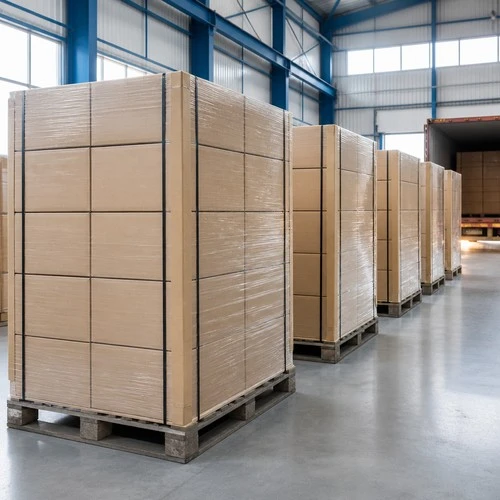
As a verified manufacturer in China, tprefractory ships all export rolls in moisture-protected packaging built for multi-week container shipping.
Standard Roll Configurations
0.5 mm Thickness: Widths 610 / 1000 / 1220 mm | Roll Length: 60 m (36.6 to 73.2 m²)
1.0 mm Thickness: Widths 610 / 1000 / 1220 mm | Roll Length: 40 m (24.4 to 48.8 m²)
2.0 mm Thickness: Widths 610 / 1000 / 1220 mm | Roll Length: 20 m (12.2 to 24.4 m²)
3.0 mm Thickness: Widths 610 / 1000 / 1220 mm | Roll Length: 15 m (9.15 to 18.3 m²)
5.0 mm Thickness: Widths 610 / 1000 / 1220 mm | Roll Length: 10 m (6.10 to 12.2 m²)
6.0 mm Thickness: Widths 610 / 1000 / 1220 mm | Roll Length: 8 m (4.88 to 9.76 m²)
10.0 mm Thickness: Widths 610 / 1000 mm | Roll Length: 5 m (3.05 to 5.0 m²)
Commercial Terms & Quality Assurance
Minimum Order Quantity (MOQ): 20 standard stock rolls; 1,000 pieces for custom die-cut gaskets.
Factory Lead Time: Standard stock thicknesses dispatch within 5–7 working days; custom die-cut gaskets take 10–14 working days.
Quality Verification: Every export lot is tested for bulk density, loss on ignition (LOI), and tensile strength. Full Mill Test Certificates (MTC) accompany shipping manifests.
Logistics: FOB Qingdao Port or CIF delivery worldwide. Consolidated container shipments with firebricks, castables, and ceramic fiber blankets are supported to optimize freight costs.
Technical Support & RFQ Requests
To request technical data sheets (TDS), material test reports, or a quotation for master rolls and custom gaskets:
Email: inquiry@topower.tech (Direct engineer response within 4 hours)
Details Needed for Gasket Quotes: Operating temperature, flange bolt pressure, and 2D drawings (PDF/DWG) with dimensions and tolerances.


