


Silicon carbide brick is a high temperature refractory material with excellent refractory performance and chemical stability. However, under certain circumstances, silicon carbide bricks may undergo active oxidation and erosion, resulting in changes in their properties.
Since the continuity of the final oxidation product is the continuity of the SiO2 reaction depends on the stability of the product SiO2 layer, that is, during high oxygen pressure, it is easy to form a stable and dense SiO2 protective layer, thereby restricting the continuation of the oxidation reaction. Conversely, when the oxygen division is low, it is difficult to form this anti -oxidant SiO2 dense layer. The former is usually called non -active oxidation or protective oxidation, and the latter is called active oxidation or continuous oxidation.
It can be seen that when the external oxygen is divided into PO2. The gas phase pressure PS 10 formed than the oxidation reaction. At the time, Si or SiC will occur non -active oxidation, which will form a dense SiO2 protective layer on the surface of its particles. As a result, it will prevent the internal particles from continuing to oxidize and play an effective protective role. Conversely, the vital activity oxidation cannot form a stable SiO2 protective layer. Through the volatilization of SiO, the surface of the new Si or SiC particles is constantly exposed to the oxygen atmosphere. Therefore, in high temperature and long period of time, the weak oxygen in the atmosphere may also cause the erosion of SIC material due to the recurrence of the oxidation effect. Essence
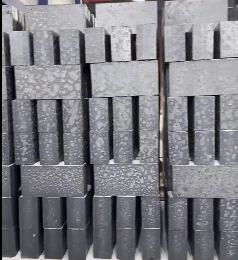
In addition, the alkaline metal K2O and Na2O have a great impact on the stability of carbonized silicon bricks. As long as the SiO2 gaseous or melting alkaline metal metal appears in the working surface of the carbide brick brick, it may be combined with it to form K2O · SIO2 (melting point 976 ° C), K2O · 2SiO2 (Following point 1045 ° C) such as low melting point compounds. These compounds will reduce the fire resistance and abrasion resistance of carbonized silicon bricks. Under the friction of airflow and furnace, the erosion or peeling or melting will turn the carbonized silicon brick to the non -active oxidation under normal conditions into the active oxidation of the erosion conditions. In addition It is found that potassium silicate is found. At the same time, it should also be noted that Fe2O3 and alkaline -eclipsed potassium silicate and potassium siliconate to form KFeSi3O8 iron potassium silicate. The generation of this compound may cause carbonized silicon bricks "Direct cause of corrosion. Therefore, controlling the impurities in silicon tiles, especially iron -containing impurities, is extremely important.


