


Glass tank furnaces represent one of the most demanding thermal environments in modern manufacturing, operating continuously for 8 to 12 years at temperatures exceeding 1580°C. In this aggressive setting, molten alkali-silicate glass relentlessly corrodes and erodes furnace refractory walls. Selecting the proper fused cast azs block grade is the single most critical engineering decision for glassmakers to prevent catastrophic sidewall washouts and costly glass defect contamination. At Topower Refractory, we manufacture and pre-assemble high-density electrofused alumina-zirconia-silica (AZS) refractory blocks engineered to deliver maximum corrosion resistance across float, container, and specialty glass melting furnaces worldwide.
Key Technical Sourcing Facts
Standard Commercial Grades: AZS-33# (ZrO2 >= 32.0%), AZS-36# (ZrO2 >= 35.0%), and AZS-41# (ZrO2 >= 40.0%), produced via electric arc furnace melting at 1800°C to 1900°C.
Casting Methods & Void Control: Regular Cast (RC), Tilted Cast (TC), Semi-Void Free (RA), and Void Free (VF / WS) for critical slag lines and throat blocks.
Exceptional Physical Properties: Bulk density up to 4.00 g/cm3 (VF grade); cold crushing strength >= 350 MPa; refractoriness under load (0.2 MPa) >= 1700°C; apparent porosity <= 1.3% to 2.0%.
Pre-Assembly Service: Full 1:1 factory dry pre-assembly inspection in our workshop with tight dimensional tolerance (+/- 0.5 to 1.0 mm) before ocean dispatch.
What Is a Fused Cast AZS Block?
A fused cast azs block, historically termed electrocast AZS or electrofused zircon-corundum refractory, is manufactured by fusing high-purity calcined alumina and premium zircon sand (or desiliconized zirconia) in an electric arc furnace at approximately 1900°C. The homogenous molten melt is subsequently poured into engineered graphite or bonded-sand molds, followed by controlled slow cooling in insulating kieselguhr bins over several weeks.
Mineralogically, solidified AZS refractories comprise three distinct phases:
Baddeleyite (Monoclinic ZrO2): Primary crystalline phase offering superior chemical inertia against corrosive molten glass.
Corundum (alpha-Al2O3): Interlocking dendritic skeleton providing exceptional structural hot load-bearing strength.
Glassy Matrix Phase: High-silica vitreous phase (13% to 16%) that fills the crystalline skeleton boundaries, accommodating thermal expansion stresses during furnace heat-up.
Technical Comparison: AZS-33#, AZS-36#, and AZS-41#
The corrosion resistance, thermal shock performance, and glass phase exudation temperature of AZS blocks depend directly on the zirconia (ZrO2) content. Below are the verified technical parameters from our factory production standards:
| Technical Property / Parameter | AZS-33# (Standard Grade) | AZS-36# (High Corrosion Grade) | AZS-41# (Ultra Corrosion Grade) | Test Standard |
|---|---|---|---|---|
| ZrO2 Content (%) | >= 32.0 | >= 35.0 | >= 40.0 | XRF / Chemical |
| Al2O3 Content (%) | 48.0 - 51.0 | 46.0 - 48.5 | 44.0 - 46.0 | ASTM C114 |
| SiO2 Content (%) | 15.0 - 16.0 | 13.5 - 14.5 | 12.5 - 13.5 | ASTM C114 |
| Na2O Content (%) | <= 1.5 | <= 1.4 | <= 1.3 | ASTM C114 |
| Fe2O3 Content (%) | <= 0.10 | <= 0.10 | <= 0.10 | ASTM C114 |
| TiO2 Content (%) | <= 0.05 | <= 0.05 | <= 0.05 | ASTM C114 |
| Cold Crushing Strength (MPa) | >= 350.0 | >= 350.0 | >= 350.0 | ISO 10059 |
| Bulk Density - Regular Cast (g/cm3) | 3.40 | 3.45 | 3.55 | ASTM C134 |
| Bulk Density - Void Free (g/cm3) | 3.70 | 3.78 | 4.00 | ASTM C134 |
| Apparent Porosity (%) | <= 2.0 | <= 1.5 | <= 1.3 | ASTM C20 |
| Refractoriness Under Load 0.2MPa (°C) | >= 1700 | >= 1700 | >= 1700 | ISO 1893 |
| Thermal Expansion @ 1000°C (%) | 0.80 | 0.80 | 0.80 | ASTM C832 |
| Glass Phase Exudation Temp (°C) | >= 1400 | >= 1420 | >= 1450 | Optical Dilatometry |
Note: All AZS products undergo ultrasonic flaw detection and 100% diamond grinding on joint faces to guarantee seamless glass tank installation.
Casting Void Technologies: RC, TC, RA, and VF Explained
During electrofusion solidification, liquid contraction generates shrinkage voids (shrinkage cavity). Specifying the appropriate casting cavity orientation determines service life:
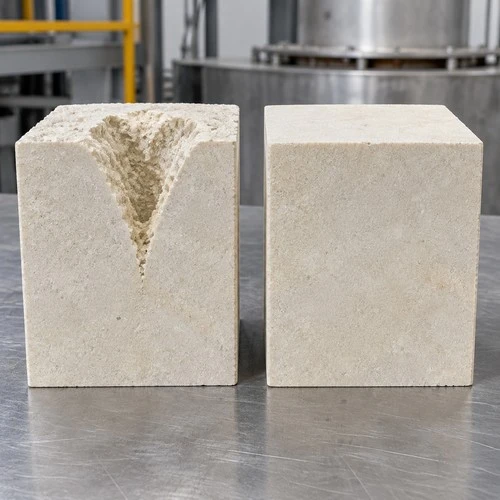
Regular Cast (RC): The shrinkage cavity is located in the upper central volume of the block. Used exclusively in low-wear zones, such as bottom paving under dense sub-layers or upper tuckstones.
Tilted Cast (TC): The mold is tilted during pouring, shifting the shrinkage cavity to one end of the block. Installed with the solid bottom facing molten glass.
Semi-Void Free (RA): Features a reduced shrinkage void located near the outer top surface, providing dense body mass for superstructure sidewalls.
Void Free (VF / WS): The casting header is oversized and fully sawn off after cooling using diamond wire saws. The resulting block is 100% solid with zero interior voids, mandatory for glass tank sidewall flux lines, electrode blocks, and throat facings.
Glass Tank Zoning & Material Selection
Matching specific AZS grades and casting techniques to distinct furnace zones maximizes tank campaign longevity while optimizing refractory capital investment:
1. Melting Tank Sidewall & Flux Line
The glass-level line (flux line) experiences intense thermal convection, mechanical surface waves, and concentrated chemical corrosion. Here, AZS-41# Void Free (VF) blocks are mandatory. The 40% zirconia concentration builds dense baddeleyite crystalline chains that withstand convective glass wash, preventing premature three-phase boundary undercut.
2. Throat and Submerged Passages
The throat connects the melting tank to the working end, handling high-velocity molten glass flow. This critical zone demands AZS-41# Void Free (VF) with diamond-ground mating surfaces to eliminate joint erosion and vortex drilling.
3. Paving and Bottom Construction
For tank bottom paving, AZS-33# or AZS-36# (TC or VF) blocks are installed over multi-layer clay flux sub-hearths or high alumina brick foundations, frequently backed by calcium aluminate cement castable sealing layers.
4. Superstructure, Crown Tuckstones & Breastwalls
Breastwalls, port necks, and tuckstones face volatile alkali vapors (Na2O, K2O) and batch dust carryover rather than direct liquid glass contact. AZS-33# (Regular or RA) provides excellent alkali vapor resistance and thermal spalling durability without the premium cost of higher zirconia grades.
Glass Phase Exudation & Defect Prevention
One of the most vital technical considerations for glass engineers is glass phase exudation:
1. The Exudation Mechanism
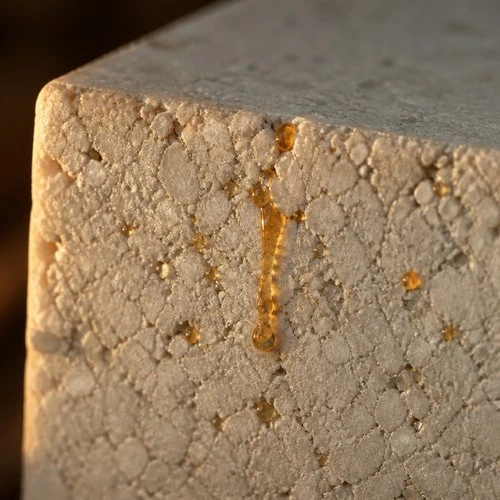
Between 1300°C and 1500°C, the high-silica vitreous phase residing between baddeleyite and corundum grains expands and sweats out to the block surface under capillary pressure. If this exuded liquid contains dissolved gas or impurities, it detaches into the glass melt, forming refractory knot defects, cat-scratches, and seed bubbles.
2. Manufacturing Quality Measures
At Topower Refractory, we maintain strict control over alkali (Na2O <= 1.3%) and iron oxide (Fe2O3 <= 0.10%) raw material limits. Lowering flux impurities increases the viscosity of the interstitial glass phase, raising the exudation starting temperature above 1420°C to 1450°C. This ensures clean, defect-free glass melting during initial furnace commissioning.
Pre-Assembly, Diamond Machining & Sourcing
Because glass tank construction permits joint gaps no wider than 0.5 mm, precise refractory processing is essential:
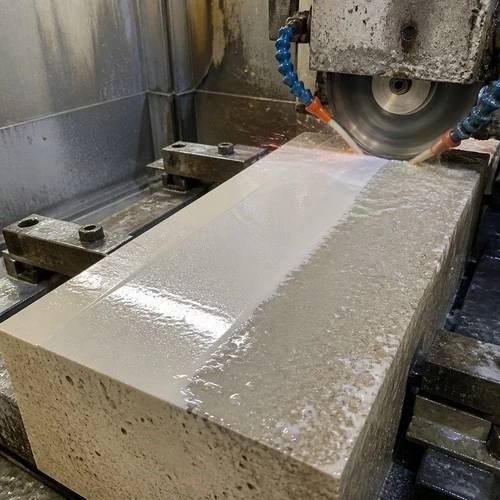
Diamond Machining: All molten-contact block faces undergo precision CNC diamond planers and surface grinders to ensure absolute flatness and right-angle accuracy.
1:1 Factory Dry Pre-Assembly: Before container stuffing, our technicians assemble entire tank sidewalls, throats, and doghouse arches on level inspection floors in our factory. Every block is numbered, documented with layout drawings, and approved by customer inspectors.
Export Packaging: Each machined block is wrapped in moisture-proof foam, secured with steel banding, and packed inside custom-built reinforced fumigated wooden crates.
Transparent Sourcing: Pricing & How to Order
Topower Refractory provides comprehensive engineering support for new furnace builds, cold repairs, and hot-spot emergency replacements:
Technical RFQ Checklist
To receive an itemized quotation and layout proposal within 24 hours, provide:
Target Grades & Quantities: AZS-33#, AZS-36#, or AZS-41# with specified block dimensions (Length x Width x Height in mm).
Casting Method Required: Regular Cast (RC), Tilted Cast (TC), or Void Free (VF / WS).
Furnace Section: Melting tank sidewalls, throat, paving blocks, or superstructure breastwalls.
Machining Requirements: Face grinding requirements, beveling, or thermocouple hole drilling.
Destination Port: For instant FOB Qingdao/Tianjin or CIF pricing calculations.
Commercial Pricing Reference: Fused cast AZS pricing varies primarily by zirconia percentage and casting method. Standard AZS-33# typically ranges from 1200 to 1800 USD per metric ton FOB China, while ultra-dense AZS-41# Void Free blocks range from 2200 to 3500 USD per metric ton due to extensive diamond wire sawing and raw zirconia costs.
Engineering Inquiries: Contact our glass refractory division directly at inquiry@topower.tech to submit furnace design drawings or schedule factory pre-assembly audits.
Frequently Asked Questions
Why is AZS-41# preferred for glass melting tank sidewalls over AZS-33#?
AZS-41# contains over 40% ZrO2, forming a continuous network of corrosion-resistant baddeleyite crystals. In the upper sidewall flux line where convective glass currents and chemical dissolution are highest, AZS-41# provides up to 40% longer service life than AZS-33#, preventing premature tank failure.
What causes blister and stone defects from AZS refractory blocks?
Blister and stone defects typically stem from premature glass phase exudation or coarse corundum grain wash-out. When high-iron or high-alkali blocks sweat out their vitreous phase at lower temperatures, the viscous liquid forms bubbles and unmolten refractory knots in the glass ribbon. Topower holds Fe2O3 under 0.10% to eliminate this risk.
Can fused cast AZS blocks be cut or drilled on-site during installation?
Due to high baddeleyite crystal hardness (Mohs 8.5 to 9), on-site dry cutting is nearly impossible and risks thermal shock cracking. All block trimming, beveling, and hole drilling (such as bubbler or electrode openings) must be completed at our factory using industrial diamond-tipped machine tools with continuous water cooling.


