


An alumina silica brick is a dense shaped refractory composed primarily of aluminum oxide (Al2O3) and silicon dioxide (SiO2) in varying proportions, engineered to resist operating temperatures from 1300°C to 1790°C under heavy mechanical compression, thermal cycling, and chemical slag corrosion. Spanning the spectrum from standard fireclay bricks (30% to 45% Al2O3) to premium high-alumina grades (48% to over 80% Al2O3), alumina-silica refractories represent over 60% of all shaped lining installations worldwide across blast furnaces, hot blast stoves, cement kilns, steel ladles, and ceramic tunnel kilns.
While both fireclay and high-alumina refractories belong to the Al2O3-SiO2 binary system, their mineralogical phase compositions differ dramatically. As alumina content rises, low-melting glassy silica phases are replaced by highly stable crystalline mullite (3Al2O3·2SiO2) and corundum (alpha-Al2O3), driving refractoriness under load (RUL T0.6) from 1350°C up to 1550°C. However, choosing the wrong grade frequently leads to premature lining spalling or unnecessary procurement cost. This technical guide outlines chemical classifications, ASTM standard grades, thermomechanical performance metrics, and factory sourcing standards when procuring directly from China.
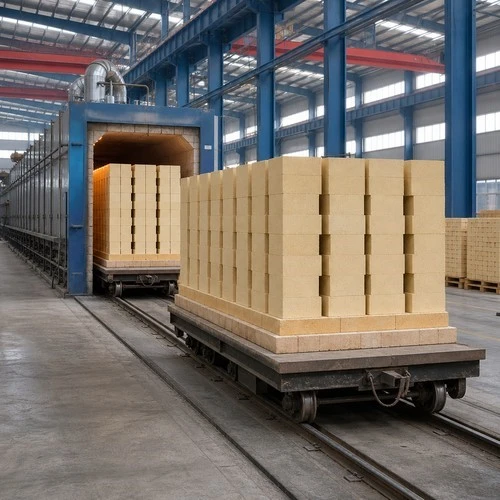
Classification of Alumina Silica Refractories
Industrial alumina-silica refractories are categorized by their alumina mass percentage, which dictates the dominant mineral crystals formed during high-temperature tunnel kiln firing:
1. Fireclay Bricks (Al2O3 30% to 45%)
Manufactured from refractory flint clays and calcined grog bonded with plastic kaolinite.
Mineral Phases: Corundum and mullite crystals embedded within a siliceous glassy matrix.
Operating Limit: Continuous service up to 1300°C to 1350°C.
Key Advantage: Exceptional thermal shock resistance and moderate cost, making them the standard choice for general boiler furnaces, kiln backing layers, and low-temperature flues.
2. Semi-Silica Bricks (Al2O3 15% to 30%, SiO2 > 65%)
Engineered for applications requiring volume expansion stability. Because residual quartz expands slightly upon initial heating, it counteracts the natural shrinkage of clay minerals, resulting in tight joints with near-zero post-heating shrinkage up to 1250°C.
3. High-Alumina Bricks (Al2O3 48% to 85%+)
Manufactured from premium calcined bauxite, sillimanite-group minerals, or fused alumina aggregates.
Mineral Phases: Interlocking needle-like mullite crystals and hexagonal tabular corundum.
Operating Limit: Continuous service from 1450°C to 1750°C.
Key Advantage: Extreme mechanical load-bearing capacity at high temperatures, high bulk density, and superior resistance to acidic and neutral metallurgical slags.
Direct procurement through certified alumino silicate bricks manufacturers provides tailored formulations according to specific thermal and mechanical stresses.
Technical Specifications: Grade-by-Grade Comparison
Refractory engineers rely on standard grades to specify performance thresholds across mechanical strength, porosity, and high-temperature volume stability:
1. Standard Fireclay Grade (SK-32 & SK-34)
Al2O3 Content: 36% to 42%
Refractoriness: 1710°C to 1750°C (Pyrometric Cone Equivalent SK-32 / SK-34)
Refractoriness under Load (RUL T0.6): >= 1320°C to 1350°C
Bulk Density: 2.10 to 2.18 g/cm3
Apparent Porosity: <= 22.0%
Cold Crushing Strength (CCS): >= 25.0 to 30.0 MPa
2. Third-Grade High-Alumina Brick (LZ-48)
Al2O3 Content: 48% to 54%
Refractoriness: >= 1750°C
Refractoriness under Load (RUL T0.6): >= 1420°C
Bulk Density: 2.25 to 2.30 g/cm3
Apparent Porosity: <= 23.0%
Cold Crushing Strength (CCS): >= 40.0 MPa
3. Second-Grade High-Alumina Brick (LZ-65)
Al2O3 Content: 65% to 70%
Refractoriness: >= 1790°C
Refractoriness under Load (RUL T0.6): >= 1460°C to 1480°C
Bulk Density: 2.45 to 2.55 g/cm3
Apparent Porosity: <= 22.0%
Cold Crushing Strength (CCS): >= 50.0 MPa
4. First-Grade & Super-Duty High-Alumina Brick (LZ-75 & LZ-80)
Al2O3 Content: 75% to 82%
Refractoriness: >= 1790°C
Refractoriness under Load (RUL T0.6): >= 1520°C to 1550°C
Bulk Density: 2.65 to 2.80 g/cm3
Apparent Porosity: <= 20.0%
Cold Crushing Strength (CCS): >= 60.0 to 75.0 MPa

Critical Engineering Metrics: RUL, Creep & Slag Attack
When evaluating an alumina silica brick, relying solely on room-temperature compressive strength (CCS) is a dangerous shortcut. Industrial performance hinges on three high-temperature parameters:
Refractoriness under Load (RUL T0.6): Standard refractoriness indicates when an unloaded cone melts. However, RUL measures the exact temperature at which a 50 mm cylindrical sample compresses 0.6% under a continuous load of 0.2 MPa. In fireclay, the glassy matrix softens early, causing deformation as low as 1320°C. In 75% alumina bricks, the dense interlocking network of mullite and corundum maintains structural geometry above 1520°C.
High-Temperature Creep Rate: In hot blast stove checker chambers and reheat furnace roofs, bricks sustain static compression for 10 to 15 years. Premium low-creep high-alumina bricks incorporate andalusite or fused corundum, maintaining creep rates below 0.2% during a 50-hour hold at 1400°C under 0.2 MPa load.
Slag Attack & Chemical Corrosion: Alumina-silica refractories are amphoteric to mildly acidic. At higher Al2O3 concentrations (>70%), they exhibit robust resistance to acidic metallurgical slags, iron oxides, and coal combustion ash. However, in strongly basic environments containing high free CaO, high-alumina bricks react to form low-melting calcium aluminate compounds; in such zones, basic refractories or specialized high temperature refractory bricks must be specified.
Industrial Applications & Lining Design
1. Blast Furnaces & Hot Blast Stoves
Blast furnace stacks and stoves utilize multi-zoned alumina-silica linings. The high-temperature combustion chamber and upper checkerwork require 70% to 75% low-creep high-alumina bricks to withstand cyclic thermal blasts up to 1400°C. Lower checker zones transition to economical second grade high alumina brick and fireclay bricks where mechanical strength at 800°C to 1000°C is the sole requirement.
2. Cement Rotary Kilns
In preheating and secondary calcining zones operating between 1000°C and 1250°C, high-alumina bricks (such as anti-stripping 70% alumina grades with added ZrO2) form stable protective coating layers. Backing insulation typically pairs with rigid calcium silicate board to lower shell heat losses below 250 W/m2.
3. Steel Ladles & Tundishes
Secondary refining ladles utilize 75% to 80% alumina bricks in safety lining courses and slag-free sidewall sections. Their dense texture (apparent porosity <= 18%) resists liquid steel penetration and turbulent washing during stirring.
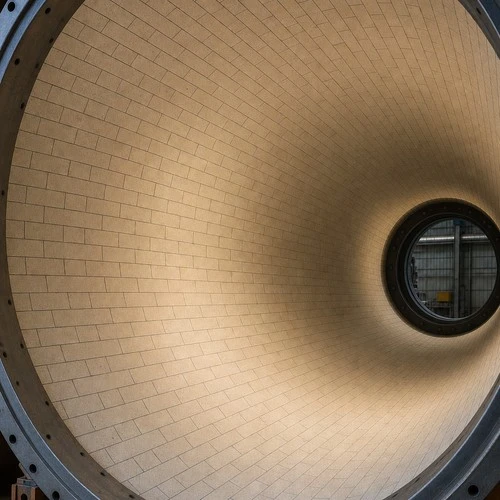
Factory Direct Sourcing, Packaging & Commercial Terms
Procuring alumina-silica refractory bricks directly from ISO 9001 certified Chinese manufacturers ensures certified chemical consistency and tight dimensional tolerances:
Dimensional Tolerances: High-pressure hydraulic and friction presses (630 to 1600 metric tons) hold dimensional accuracy within +/- 1.0 mm for standard straight series (230x114x65 mm, T-3) and tapered wedge bricks (arch, wedge, and key shapes), ensuring tight masonry joints <= 2.0 mm.
Factory Quality Inspection: Every 50 metric tons undergoes XRF chemical assay, true density testing, and cold crushing strength verification. Full mill test certificates (MTC) accompany every export container.
Export Packaging & Protection: Bricks are stacked on fumigated solid timber pallets (ISPM 15 compliant), interleaved with corrugated paper sheets to prevent corner chipping, wrapped in dual-layer waterproof polyethylene stretch film, and secured with high-tensile PET strapping.
Pricing & MOQ: Commercial alumina bricks price varies by alumina purity, shape complexity, and raw bauxite market trends. Standard straight series require a minimum order quantity (MOQ) of 10 metric tons, while custom mold shapes carry a 20-ton MOQ. Standard production lead time is 10 to 15 working days FOB Qingdao.
For official product data sheets (TDS), customized furnace lining drawings, or a commercial quotation, contact our technical sales team at inquiry@topower.tech.


