


A ceramic fiber module is a prefabricated refractory insulation block manufactured by folding and continuously compressing spun needle-punched ceramic fiber blankets to a bulk density of 200 to 240 kg/m³, engineered with embedded heat-resistant alloy anchors to line industrial furnaces operating from 1050°C to 1430°C. Specifically designed to eliminate thermal shrinkage gaps through lateral blanket decompression once binding straps are cut, factory-compressed modules replace traditional multi-layer brick and castable construction, reducing furnace wall weight by over 70% and accelerating installation speeds up to three times.
While raw fiber blankets are vulnerable to hot gas velocity erosion and require complex labor-intensive pin-and-washer hanging, prefabricated modules provide a monolithic, joint-free hot-face insulation layer. However, thermal efficiency and lining longevity depend strictly on selecting the correct operating temperature classification, matching anchor alloy metallurgy to shell interface temperatures, and optimizing compression density. This engineering guide outlines classification chemistry, anchor system mechanics, parquet versus soldier layouts, and direct sourcing specifications from our factory in China.
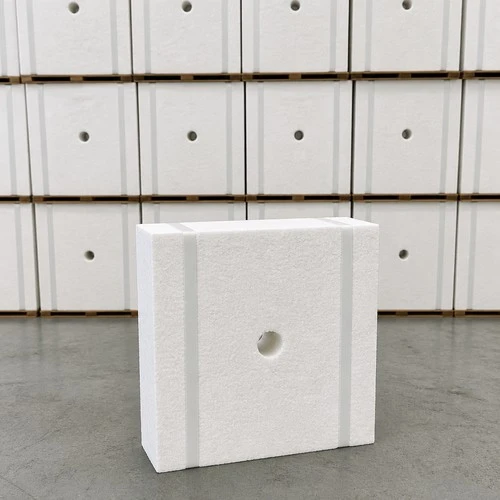
Anatomy of a Factory-Engineered Ceramic Fiber Module
Manufacturing industrial-grade modules requires precision pre-compression to offset natural fiber shrinkage at elevated temperatures:
Continuous Pre-Compression Mechanism: During automated assembly, continuous ceramic fiber blankets are folded in accordion fashion into standard dimensions (typically 300x300 mm or 600x300 mm with thicknesses of 150 to 300 mm). The block is hydraulically compressed in the direction of the folds by 15% to 20% before being secured with temporary plastic strapping or cardboard side panels. Once installed against the furnace shell and the bands are cut, the compressed fibers expand laterally, creating a tight, spring-loaded seal against adjacent modules that seals joint gaps during thermal cycling.
Integrated Structural Anchoring: Unlike external stud systems exposed to open fire, modular anchors remain embedded deep within the cold-face half of the fiber block, shielded from direct radiant heat. Depending on mechanical requirements, our ceramic fiber module factory supplies central butterfly clips, side-sliding guide tubes, or corner angle brackets that lock directly onto pre-welded studs on the steel shell.
Temperature Grades & Chemical Formulations
Ceramic fiber modules are classified according to their maximum continuous service limits and chemical purity:
1. Standard Grade (STD) & High-Purity Grade (HP) - 1260°C Rating
Chemical Composition: Al2O3 44% to 46%, SiO2 51% to 53%, Fe2O3 <= 1.0% (STD) or <= 0.2% (HP)
Continuous Operating Temperature: Up to 1050°C
Permanent Linear Shrinkage (24h soak at 1000°C): <= 2.5%
Typical Industrial Applications: Heat treatment furnaces, ceramic shuttle kiln walls, forging furnace covers, and petrochemical heater convection sections.
2. High-Alumina Grade (HA) - 1360°C Rating
Chemical Composition: Al2O3 52% to 55%, SiO2 44% to 47%, Fe2O3 <= 0.2%
Continuous Operating Temperature: Up to 1200°C
Permanent Linear Shrinkage (24h soak at 1100°C): <= 3.0%
Typical Industrial Applications: Steel rolling mill reheating furnace roofs, tunnel kiln firing zones, and high-temperature incinerator flue ducts.
3. Zirconia-Stabilized Grade (HZ) - 1430°C Rating
Chemical Composition: ZrO2 15% to 17%, Al2O3 35% to 40%, SiO2 48% to 50%
Continuous Operating Temperature: Up to 1350°C
Permanent Linear Shrinkage (24h soak at 1350°C): <= 3.0%
Typical Industrial Applications: High-temperature petrochemical cracking furnaces, forging soak pits, and atmospheres containing reducing or mildly corrosive flue gases.
Density Selection: 200 vs. 220 vs. 240 kg/m³
Choosing the correct module density balances thermal conductivity against mechanical resistance to furnace gas erosion:
200 kg/m³ (Lightweight Thermal Efficiency): Delivers the lowest thermal conductivity at moderate temperatures (0.12 W/(m·K) at 400°C; 0.20 W/(m·K) at 800°C). Best suited for static furnace sidewalls and low-velocity holding ovens where fuel reduction is the primary priority.
220 kg/m³ (Industry Standard Workhorse): The most widely specified density across metallurgical and petrochemical furnaces. Provides robust structural resilience, excellent thermal shock resistance, and handles flue gas velocities up to 15 m/s.
240 kg/m³ (High Velocity & Heavy Roofs): Maximum density engineered for suspended furnace roofs, burner surrounds, and ducts with high turbulent gas flow (15 to 25 m/s). Resists fiber pull-out and mechanical vibration during continuous crane and charging operations.
Replacing a 300 mm dense firebrick wall with a 250 mm ceramic fiber blanket for furnace lining module system typically lowers outer cold-face steel temperatures by 40°C to 80°C while yielding 15% to 25% energy savings.
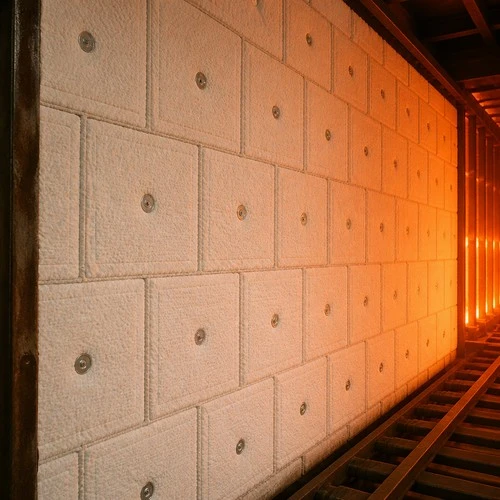
Anchor Metallurgy & Installation Layouts
The longevity of a modular refractory lining depends on matching the anchor alloy to the interface temperature calculated at its embedded depth:
Anchor Material Selection:
SUS304 Stainless Steel: Suitable for backing interface temperatures <= 850°C.
SUS310S (AISI 310) Stainless Steel: The standard choice for high-temperature service, maintaining creep strength up to 1100°C.
Inconel 601 Alloy: Specified for severe operating conditions, high sulfur fuels, or furnace hot faces where interface temperatures exceed 1100°C.
Lining Orientation: Parquet vs. Soldier Course:
Parquet (Checkerboard Pattern): Modules are laid with folding directions alternating 90 degrees between adjacent blocks. This configuration equalizes thermal expansion and contraction stresses in both horizontal and vertical directions, making it the preferred standard for large vertical furnace walls.
Soldier Course (Continuous Alignment): Modules are installed with folds running continuously in one direction. While faster to install on circular ducting, it requires inter-row compensating blanket strips (typically 25 mm thick compressed to 12 mm) between rows to seal joint shrinkage.
For backup insulation behind the modules, engineering designs frequently incorporate dense, rigid ceramic fiber board or calcium silicate layers to prevent hot spot transmission through steel shell anchor points.
Factory Direct Ordering, Custom Fabrication & Lead Times
Direct procurement from our ISO 9001 certified manufacturing plant ensures precise dimensional tolerances and structural integrity:
Quality Control Standards: Every production batch undergoes automated needle density verification, fiber diameter measurement (average 2.5 to 3.5 microns for high tensile strength), and shot content testing (< 12% non-fibrous particles).
Custom Fabrications: In addition to standard 300x300 mm and 600x300 mm blocks, we custom-manufacture L-shaped corner blocks, burner quarl blocks, and curved arch configurations tailored to specific plant furnace blueprints.
Minimum Order Quantity (MOQ): Standard sizes: 50 modules (approximately 4.5 cubic meters). Custom anchor designs or zirconia grades: 100 modules.
Packaging & Delivery: Each module is wrapped in protective plastic shrink wrap, packed into heavy-duty corrugated export cartons (1 to 2 modules per carton), and strapped securely onto fumigated wooden export pallets (ISPM 15 compliant).
Production Lead Time: Standard dimensions dispatch within 7 to 10 working days; custom pre-engineered anchor projects dispatch within 15 to 20 days FOB Qingdao.
To submit furnace drawings, calculate heat transfer lining thicknesses, or receive a direct factory quotation, contact our technical team at inquiry@topower.tech


