


Ceramic fiber module installation is one of the most important steps in furnace relining projects. Correct installation directly affects thermal efficiency, shell temperature, lining service life, and shutdown frequency. For industrial buyers, contractors, and maintenance teams, a clear installation checklist helps reduce errors and ensures the lining performs as designed.
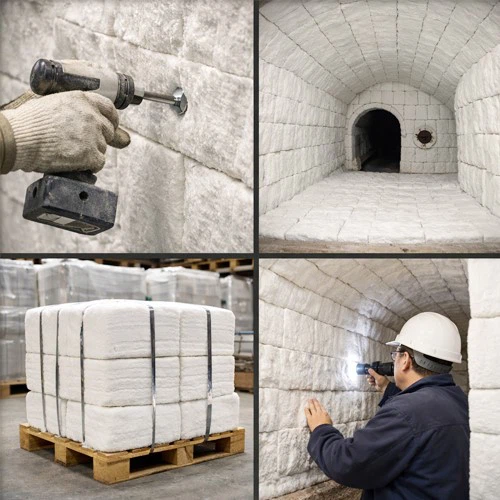
Ceramic fiber modules are widely used in industrial furnace linings because they combine low thermal conductivity, fast installation, and reliable temperature resistance. Compared with traditional refractory brick or castable systems, modules can significantly reduce relining time and lower overall furnace weight. They are commonly used in heat treatment furnaces, forging furnaces, reheating furnaces, petrochemical heaters, ceramic kilns, and other high-temperature equipment. Many buyers also compare modules with ceramic fiber blankets because both are lightweight insulation materials, but modules offer better installation efficiency and more stable lining thickness in large-area projects.
Main Types of Ceramic Fiber Modules
There are several module structures used in furnace relining. Folded modules are among the most common and are designed to provide compressed resilience after release. Veneering modules are often selected where surface appearance and uniform contact are important. Anchored module systems are engineered for stronger holding performance and easier installation in different furnace zones. Buyers can choose standard dimensions for common furnace projects, while custom ceramic fiber modules are often required for curved walls, roof sections, burner blocks, door areas, and other irregular designs.
Before installation starts, the project team should confirm several key points. First, inspect the furnace shell condition carefully and identify any hotspot zones, deformation, corrosion, or welding defects. Second, confirm module density and temperature grade according to the working environment. Third, check the anchor material and finalize the welding plan before lining work begins. Fourth, confirm the expansion allowance and required lining thickness so that the final installed system matches design expectations.
Ceramic Fiber Module Installation Checklist
A successful ceramic fiber module installation starts with anchor layout and spacing. Anchors must be positioned according to the furnace drawing and module design. Inconsistent spacing can cause uneven compression, loose contact, and premature lining failure. For this reason, many buyers prefer working with an experienced ceramic fiber module supplier that can provide installation drawings and anchor layout support.
The compression direction of the module must also be correct. This is one of the most common mistakes during installation. The compression should be oriented to ensure the module expands properly after release and closes joints tightly. Wrong compression direction may create open seams and reduce lining integrity, especially in roof and corner sections.
Joint staggering and edge treatment are equally important. Staggered joints help improve sealing performance and reduce direct heat pathways. At module edges, installers should ensure close contact and use proper trimming or filling treatment where required. Special attention is needed at corners, burner openings, peepholes, and wall-to-roof transitions. These areas often experience higher thermal stress and are more likely to develop gaps if installation is rushed.
After all modules are fixed, a final release and rebound inspection should be carried out. Installers should confirm that each module rebounds evenly, surface alignment is acceptable, and no visible gaps remain between adjacent units. Any loose anchors, damaged edges, or uneven expansion should be corrected before furnace startup.
Common Installation Mistakes
Several installation problems are repeatedly seen in furnace relining projects. One is wrong compression direction, which reduces the self-sealing effect of the modules. Another is inconsistent anchor spacing, which leads to unstable support and irregular surface rebound. Gaps at corners and penetrations are also common if custom shapes are not prepared in advance. In addition, incorrect module grade selection can shorten lining life when the furnace temperature exceeds the module's design limit.
How To Choose a Ceramic Fiber Module Supplier
Choosing the right ceramic fiber modules manufacturers is essential for project success. Buyers should evaluate factory capability, production consistency, and the ability to control module density tolerance. A reliable ceramic fiber module factory should also be able to offer anchor customization, support different attachment systems, and provide packing methods suitable for export handling.
For many international projects, drawing assistance is highly valuable. A qualified supplier should help review furnace layout, recommend suitable module size, and advise on anchor arrangement. Buyers comparing ceramic fiber module price should not focus on unit cost alone. Stable density, correct compression, reliable anchor welding design, and safe export packing are all important parts of the real project value.
What Information Buyers Should Send for Fast Quotation
To receive a faster and more accurate quotation, buyers should prepare the following project details: furnace drawing, working temperature, required lining thickness, preferred module size, anchor type, quantity, destination port, and delivery time. Clear technical information helps the supplier recommend the right temperature grade and structure without delay.
If you are planning a furnace relining project, send us your furnace drawing, working temperature, and lining thickness. Our team can help recommend suitable ceramic fiber module installation layout, anchor type, and module dimensions for faster quotation and smoother project execution.


