


When engineering industrial furnace linings for ethylene cracking furnaces, steel reheat walking beam kilns, or tunnel ceramic kilns, choosing folded or pre-compressed ceramic fiber blocks represents the standard design for minimizing heat loss. However, procurement engineers evaluating commercial quotes frequently encounter wide cost variances-sometimes up to 40% between suppliers for seemingly identical temperature ratings. Understanding the true ceramic fiber module price requires dissecting the three structural cost drivers: blanket density (192 kg/m3 vs 240 kg/m3), internal anchor metallurgy (SS304 vs SS310S alloy hardware), and container-load packing economics. At Topower Refractory, we maintain full pricing and manufacturing transparency, supplying engineered ceramic fiber modules worldwide directly from our factory in Zibo, China.
Key Technical Sourcing Facts
Standard Industrial Product Line: Topower refractory fiber modules spanning STD (1260°C, 44% Al2O3), HP (1350°C, 45% Al2O3), and HZ (1430°C, 15% ZrO2) formulations.
Density Selection Standards: Standard density options of 192 kg/m3 (12 lb/cu.ft), 210 kg/m3, and heavy-duty 240 kg/m3 (15 lb/cu.ft) for high gas velocity zones.
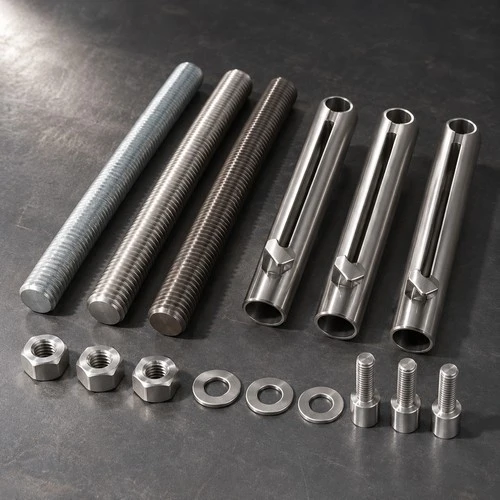
Internal Anchor Systems: Cold-face concealed anchors supplied in 304, 310S (2520 high-nickel chrome), or Inconel 601 alloys including central tubes, guide channels, and weld studs.
FOB Container Optimization: Shipped pre-compressed under plastic strapping with timber or cardboard sideboards. Standard 40HQ container loads accommodate 60 to 65 m3 (2000 to 2200 standard 300x300x300 mm modules, approx. 12 to 14 metric tons). Export lead time 7 to 10 days FOB Qingdao / Tianjin.
What Determines Ceramic Fiber Module Price?
A professional ceramic fiber module is an engineered assembly rather than a raw commodity. The overall unit cost consists of three clear manufacturing elements:
Needled Blanket Mass (Raw Material Cost ~ 60% to 65%): Every module is folded from continuous ceramic fiber blanket strips. Higher bulk densities consume more blanket weight per cubic meter, directly scaling material cost.
Metallic Anchor Hardware (~ 20% to 25%): Because furnace hot-face temperatures range between 1000°C and 1300°C, the metallurgy of internal stainless steel anchor rods and center clamping studs significantly impacts unit pricing.
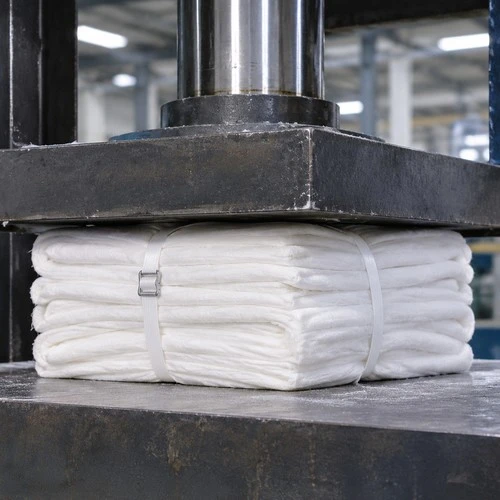
Factory Compression, Strapping & Palletizing (~ 10% to 15%): Pre-compression under hydraulic rams, banding with tensioned straps, and container seaworthy packing ensure modules recover elasticity upon release.
Technical Specifications: Topower Ceramic Fiber Module Formulations
To ensure procurement managers purchase the correct thermal rating, below are verified chemical and physical properties from our production lines:
| Technical Parameter / Property | STD Module (Standard) | HP Module (High-Purity) | HZ Module (Zirconia Grade) | PC Module (Polycrystalline) | Test Standard |
|---|---|---|---|---|---|
| Classification Temperature (°C) | 1260 | 1350 | 1430 | 1600 | ISO 10635 |
| Continuous Working Temp (°C) | 1000 - 1050 | 1100 - 1150 | 1250 - 1300 | 1400 - 1450 | In-House Standard |
| Al2O3 Content (%) | 44.0 - 46.0 | 45.0 - 47.0 | 33.0 - 35.0 | 71.0 - 73.0 | ASTM C114 |
| SiO2 Content (%) | 51.0 - 53.0 | 52.0 - 54.0 | 49.0 - 51.0 | 26.0 - 28.0 | ASTM C114 |
| ZrO2 Content (%) | / | / | 14.0 - 16.0 | / | XRF Analysis |
| Fe2O3 + TiO2 (%) | <= 1.0 | <= 0.50 | <= 0.50 | <= 0.20 | ASTM C114 |
| Bulk Density (kg/m3) | 192 / 210 / 240 | 192 / 210 / 240 | 192 / 210 / 240 | 160 - 200 | ASTM C134 |
| Permanent Linear Shrinkage | <= 2.5% (1000°C) | <= 2.5% (1100°C) | <= 3.0% (1200°C) | <= 1.0% (1400°C) | ASTM C356 |
| Thermal Conductivity @ 600°C | 0.152 W/m·K | 0.148 W/m·K | 0.165 W/m·K | 0.150 W/m·K | ASTM C201 |
Note: Standard modules are manufactured in dimensions of 300 x 300 x 200/250/300 mm and 600 x 300 x 250/300 mm. Custom dimensions are supplied with pre-drilled central anchor tubes.
Density Cost Analysis: 192 kg/m3 vs 240 kg/m3
Specifying module density is a crucial balance between initial procurement spend and operational erosion resistance:
1. Standard 192 kg/m3 Density (Baseline Cost)
Application Profile: Sidewalls, non-turbulent roof sections, and radiant zones of petrochemical cracking furnaces and annealing kilns.
Thermal Efficiency: Offers the lowest thermal conductivity at moderate temperatures (due to optimal trapped air pores).
Cost Advantage: Consumes baseline blanket mass, providing the lowest initial ceramic fiber module price per square meter of furnace lining.
2. High-Density 240 kg/m3 (20% to 25% Cost Premium)
Application Profile: Burner surrounds, flue gas exhaust ports, high-velocity convective zones (gas speeds > 15 m/s), and furnace door jambs.
Mechanical Resilience: Tightly packed fiber needles resist mechanical air scouring and flame vortex abrasion, preventing premature hot-face surface peeling.
Thermal Insulation at Extreme Heat: At temperatures above 1100°C, higher density suppresses radiant thermal transmission across fiber layers, lowering cold-shell skin temperatures.
Anchor Hardware Impact on Module Pricing
The choice of metallic anchor hardware embedded inside the cold face of the module is often the hidden factor causing quote disparities:
| Anchor Alloy Grade | Max Hardware Temp | Recommended Kiln Application | Cost Impact on Module |
|---|---|---|---|
| Carbon Steel / Q235 | < 450°C | Low-temperature ovens (< 700°C hot face) | Baseline hardware cost |
| Stainless Steel 304 | 750°C | Normal heat treatment, ceramic annealing kilns | +8% to 12% over baseline |
| Stainless Steel 310S | 1050°C | Steel reheating, forging, petrochemical furnaces | +18% to 25% over baseline |
| Inconel 601 Alloy | 1200°C | Hazardous waste incineration, glass annealing | +35% to 50% over baseline |
Factory Tip: In budget quotes from unverified vendors, cheaper SS201 or SS304 is sometimes substituted for specified SS310S anchors. In severe steel reheat kilns, premature anchor oxidation causes whole module blocks to dislodge from the furnace roof. At Topower Refractory, all anchor lots include certified 3.1 chemical test mill sheets confirming true 25% Cr and 20% Ni content.
Installation Mechanics and Compensating Strips
Achieving an airtight, low-maintenance furnace lining requires correct installation discipline:
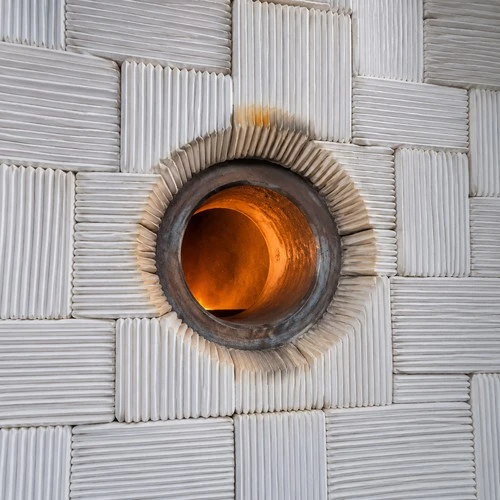
Parquet vs Soldier Layout: Modules are installed in parquet patterns (alternating grain directions) or soldier courses with joint lines perpendicular to gas flow, neutralizing directional shrinkage cracks.
Inter-Module Compensating Strips: Because refractory ceramic fibers shrink between 1.5% and 3.0% along their hot face during continuous firing, technicians must insert single-folded ceramic fiber blanket strips or resilient ceramic fiber textiles between module rows. These pre-compressed gap fillers expand to seal micro-cracks.
Corner and Flange Seals: Complex furnace contours around observation peep-sights and burner nozzles are backed with flexible ceramic fiber paper to eliminate localized air bypass.
Container Packaging and Freight Optimization
Because ceramic fiber modules are lightweight yet bulky, export logistics require volume optimization:
Palletized vs Carton Loading: For overseas container shipping, modules are wrapped with stretch film and stacked on fumigated solid wooden pallets (typically 24 to 36 modules per pallet, pallet dimensions 1100 x 1100 x 2100 mm). A 40HQ container accommodates 20 to 22 standard pallets.
Protection Against Moisture: Each pallet is shrouded with heavy UV-barrier polyethylene bags and desiccant packs to prevent condensation wetting during maritime shipping across tropical trade routes.
Pre-Compressed Packaging: Bundles are tightly banded with high-tensile polypropylene straps. Once mounted onto casing studs, the strapping is cut, allowing immediate three-dimensional expansion against adjacent blocks.
Transparent Sourcing: Pricing & How to Order
Topower Refractory provides direct factory pricing for industrial furnace modules, engineered to project specifications:
Technical RFQ Checklist
To obtain an itemized project quotation within 4 hours, provide:
Operating Temperature & Atmosphere: Working hot-face temperature, fuel type (natural gas, heavy oil, electric), and atmospheric gases (oxidizing, reducing, sulfur-bearing).
Module Specification: Temperature grade (STD 1260°C, HP 1350°C, or HZ 1430°C) and density (192 or 240 kg/m3).
Anchor Hardware Requirements: Anchor design (center-pull, corner-tab, or slide-rail) and alloy grade (SS304 or SS310S).
Order Volume: Required cubic meters or total block count (minimum order 1 pallet / approx. 3 m3; FCL 40HQ container is 60 to 65 m3).
Destination Port: For instant FOB Qingdao/Tianjin or CIF shipping calculations.
Commercial Pricing Reference: Standard STD 1260°C modules (192 kg/m3, SS304 anchors) typically range from 95 to 135 USD per cubic meter FOB China for full container orders. High-purity HP 1350°C modules (240 kg/m3 with SS310S hardware) range from 145 to 195 USD per cubic meter depending on anchor weight and thickness.
Direct Engineering Support: Contact our thermal insulation team directly at inquiry@topower.tech to review lining drawings or request CAD anchor layout calculations.
Frequently Asked Questions
Why does a 240 kg/m3 ceramic fiber module price higher than a 192 kg/m3 module?
A 240 kg/m3 module requires exactly 25% more raw ceramic fiber blanket by mass than a 192 kg/m3 module for the same cubic volume. Since raw aluminosilicate fiber mass represents over 60% of manufacturing costs, this physical material difference directly accounts for the price increase.
Can ceramic fiber modules be installed directly over existing brick refractory?
Yes. Retrofitting older brick kilns with fiber modules (veneer lining) is common. Modules can be cemented directly to existing firebrick hot faces using high-temperature refractory adhesives or anchored through drill-and-anchor studs into the outer steel shell.
What is the advantage of folded modules over edge-stacked modules?
Folded modules feature continuous accordion-style folds with smooth rounded outer surfaces, presenting uniform hot faces with minimal edge fraying. Edge-stacked modules contain cut fiber edges, offering slightly higher resistance to high-velocity airflow but requiring additional compression control during installation.


