


In the design of the inner lining of the white-gray vertical kiln and rotary kiln, increasing the thickness of high alumina bricks is a common technical measure to extend the service life. Thicker bricks can effectively reduce the number of mortar joints, enhance the resistance to wear and erosion, and thereby improve the overall durability of the inner lining. However, the thickening process needs to take into account various factors such as the type of equipment, operating conditions, and economic performance, and should be carried out within a reasonable parameter range to achieve the optimal balance between the service life and production efficiency.
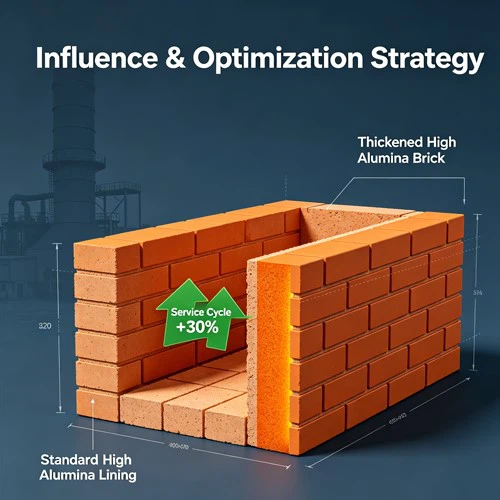
The technical effect of thickening the high-alumina bricks in the white lime rotary kiln
In the white-gray rotary kiln, appropriately increasing the thickness of the high-alumina refractory bricks offers significant technical and economic advantages:
Structural performance optimization
By thickening the brick body, the number of mortar joints is reduced accordingly, thereby decreasing the proportion of weak links. At the same time, the effective resistance thickness in the direction of wear and erosion is increased, significantly enhancing the erosion resistance of the inner lining, prolonging the service life and reducing the frequency of maintenance.
2. Production Efficiency Analysis
Increasing the thickness of the brick body will slightly reduce the inner diameter of the kiln, resulting in a slight decrease in output. However, practical experience shows that the proportion of output loss is relatively limited, while the overall benefits brought about by the extension of the service life and the reduction of maintenance costs are more significant. Therefore, after most manufacturers adopted the thickened brick solution, the overall production cost was effectively controlled, and this measure proved to be feasible.
Special considerations for the thickening technology of the white lime rotary kiln
Unlike the vertical kiln, the thickening of high alumina bricks in a rotary kiln requires strict control within a certain range. This is mainly constrained by the following factors:
1. Dynamic load limit
The rotary kiln operates in a continuous rotating state. An overly thick or long brick will significantly increase the weight of the lining, thereby increasing the load on the cylinder and leading to an increase in operating energy consumption and intensified mechanical wear. Comprehensive calculations show that excessive thickening measures beyond the reasonable range will instead result in a decline in overall efficiency.
2. Dimension Parameter Control
The thickness and length of the refractory bricks used in rotary kilns must be within a reasonable range. Currently, in industry practice, different material configurations are adopted for the high-temperature zone and transition zone. However, regardless of the material used, the adjustment of brick size must follow the principle of moderation.
Typical size specifications and application practices
1. Length specification selection
In practical applications, high-alumina bricks with a length of 345mm are more commonly used, while bricks of 230mm specification are used relatively less frequently. This choice is based on a comprehensive consideration of structural stability and construction convenience.
2. Thickness specification control
The thickness of high-aluminum bricks used in vertical kilns is mostly controlled within the range of 20-25mm for thickening, with a total thickness of around 100mm. For rotary kilns, due to the limitation of rotational conditions, the brick thickness usually adopts the 220mm specification. Further thickening would lead to excessive weight of the kiln lining and an increase in production loss, so it is not advisable to increase it excessively.
Thickening of high-alumina bricks is an effective technical means to extend the service life of the white lime kiln furnace, but its application should follow the principle of rationality. For vertical kilns, moderate thickening can achieve technical and economic optimization; for rotary kilns, the thickening range should be strictly controlled to avoid affecting the operating efficiency of the equipment due to excessive lining weight.
Overall, the adjustment of brick size should be made based on the characteristics of the equipment, working conditions, and comprehensive costs for scientific decision-making. A balance should be sought between improving durability and ensuring production efficiency.


