


The tipping furnace features a tiltable refractory-lined steel shell, enabling continuous operation. Its furnace roof and nozzle are typically lined with cas refractory castable mortar, whereas other structural sections employ precast refractory bricks.
The refractory mortar applied to the furnace roof has a nominal thickness of 80 mm and is anchored using V-shaped ss anchors. Following installation, this castable must undergo a controlled drying and baking schedule prior to commissioning to ensure adequate strength development and thermal stability. In contrast, many operators apply the same mortar formulation directly to the nozzle area without subsequent heat treatment-prioritizing construction speed and operational convenience. While widely adopted, this practice compromises structural integrity and significantly increases the risk of premature spalling.
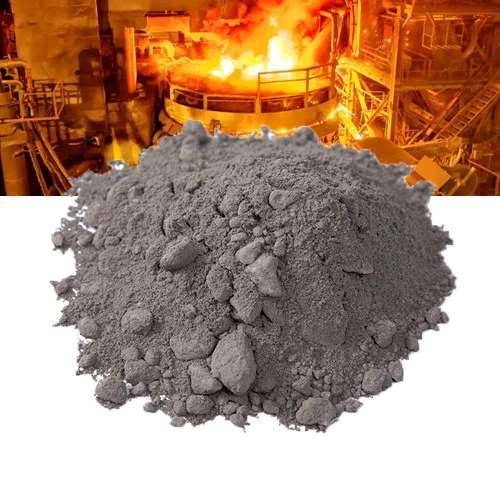
Technical specifications for nozzle applications differ from those for roof linings: the maximum aggregate size in nozzle-grade castable must not exceed 6 mm, whereas roof-grade material permits up to 8 mm. Consequently, substituting roof-grade castable at the nozzle-especially without proper baking-results in inadequate bond strength, poor thermal shock resistance, and accelerated spalling. To mitigate this issue, the following measures are essential:
1. Surface preparation: The substrate around the nozzle must be meticulously cleaned to remove dust, oil, loose particles, and any residual contaminants; insufficient preparation invariably leads to interfacial failure within 3–5 days of service initiation.
2. Binder incorporation and homogeneous mixing: The designated binder must be added in precise proportion and thoroughly mixed to ensure adequate rheology and hydraulic setting. refractory Castables lacking proper binder content exhibit negligible fluidity, incomplete hydration, and insufficient green strength-rendering them structurally nonviable and prone to rapid disintegration.
3. Water dosage control: Excess water addition reduces green strength, prolongs drying time, and exacerbates steam pressure buildup during initial heating-thereby promoting explosive spalling.
The optimal solution is to utilize a purpose-formulated refractory coating material specifically engineered for nozzle applications. Unlike conventional castables, this coating incorporates a tailored binder system that delivers superior flow characteristics, enhanced adhesion, and improved workability under confined geometries. Nevertheless, rigorous surface preparation remains mandatory-even with high-performance coatings-to ensure durable bonding. Furthermore, low-temperature pre-baking (e.g., 110 °C for 24 hours) is strongly recommended prior to service introduction. If immediate use is unavoidable, gradual temperature ramping-starting below 300 °C-is critical to avoid thermal stress-induced failure. When refractory castable must be used at the burner nozzle, strict adherence to particle size grading (≤6 mm), controlled water addition, thorough mixing, and full post-installation thermal treatment are indispensable prerequisites for maximizing service life and reliability.


