


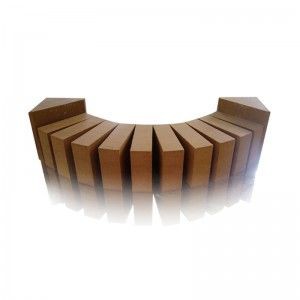
Magnesia bricks mainly include ordinary, mid-range, high-purity, fused bricks. Ordinary fired magnesia bricks, usually referred to as burnt magnesia bricks, are alkaline bricks with more production and applications. my country’s magnesite is of good quality and abundant reserves, and magnesium bricks are of high quality and low price, and enjoy a high reputation in domestic and foreign markets.
Characteristics and performance analysis
The microstructure of magnesium brick is actually a combination of magnesia microstructure. A magnesia brick made of magnesia has the simplest microstructure, but the matrix part is relatively loose and has many pores. The microstructure of magnesium brick made of different grades of magnesia is obviously different. That made of magnesia with high impurity content has many silicate phases, the MgO crystal is round, and the direct bonding rate is low; the raw material has less impurity content, and brick fired at ultra-high temperature has less silicate and is directly bonded In the magnesia brick with a high MgO mass fraction of more than 98%, the MgO crystal is euhedral or semi-hedral. However, it shows the opposite results in terms of high-temperature mechanical properties. For example, the softening temperature of seawater magnesium bricks under load is higher than 1700 °C, and generally sintered this bricks are 1500 to 1600 °C.
1. Ordinary magnesia brick
The magnesia used in the production of this bricks mainly includes natural magnesia and seawater magnesia. The vast majority of this bricks in my country are made by the former. The mass fraction of MgO in magnesia is between 89% and 98%. The limit particle size is generally 3-5mm.
The microstructure characteristics of ordinary calcined magnesia bricks are made of 91 sintered magnesia and 97 high-purity magnesia particles as aggregates, and high-purity magnesia as fine powder. The pore size is large, the main crystal phase is periclase, and the cementation of the silicate phase is the main component in the brick.
2.Mid-range magnesia brick
The microstructural characteristics of mid-grade magnesia bricks are relatively simple .However, the density of the brick body is low and the porosity is high, which is due to the relatively small content of silicate phase in the mid-grade magnesia, resulting in a low degree of cementation.
The bulk density and compressive strength of mid-grade magnesium bricks are lower than those of ordinary burnt magnesium bricks. Obviously, it is unscientific to judge the high temperature performance of products simply by their bulk density and compressive strength at room temperature.
3.High purity magnesia brick
The microstructural characteristics of high-purity magnesia bricks are relatively simple, similar to those of high-purity magnesia. However, the matrix part is relatively loose, and the porosity is relatively high.
The microstructure and morphology of the high-purity brick, the overall structure of the sample is loose, and the porosity is high. Unlike the mid-grade brick, the content of closed pores in the brick is relatively high. The matrix part has higher porosity and lower degree of cementation. It can be seen that the higher the purity of magnesia, the lower the content of silicate phase, the more difficult to sinter, and the higher the required sintering temperature.
4.Fused magnesia brick
Using fused magnesia as raw material, it is the technological basis of fused magnesia bricks. The microstructure characteristics of fused magnesium bricks are basically the same as those of fused magnesia. The degree of direct bonding is high, so the brick has high density and excellent high temperature performance, and its hydration resistance is also better than that of ordinary magnesium bricks. The disadvantage is poor thermal shock stability.
The microstructure characteristics of this bricks are relatively simple, which are close to 98 fused magnesia. The matrix part is loose and the porosity is larger. The microstructure characteristics of 98 fused magnesia, the structure of aggregate and matrix are obviously different, the surface of the aggregate is smooth and the degree of density is high; the matrix part is loose and the amount of pores is large. The partial morphology of the matrix of fused magnesium bricks and the higher porosity in the matrix are due to the higher purity of fused magnesia and less impurity content, which makes it difficult to sinter.


