


Medical waste incineration is harder on refractory than most industrial furnace applications, and not for the reason most people assume. The temperature is moderate - 1000–1200°C, well within high alumina brick territory. The real challenge is the chemical environment.
Medical waste contains chlorinated plastics (PVC, disposable packaging) and biological material. Combustion generates HCl at concentrations of 500–3,000 ppm, SO₂, heavy metal vapors, and dioxin precursors. As these gases move through the system and cool below 400°C, they condense on refractory surfaces and create acidic corrosion that no standard fire brick tolerates.
This guide maps the refractory requirement by zone, specifies the correct material for each position, and covers the maintenance schedule that determines whether a refractory lining lasts 2 years or 8 years.
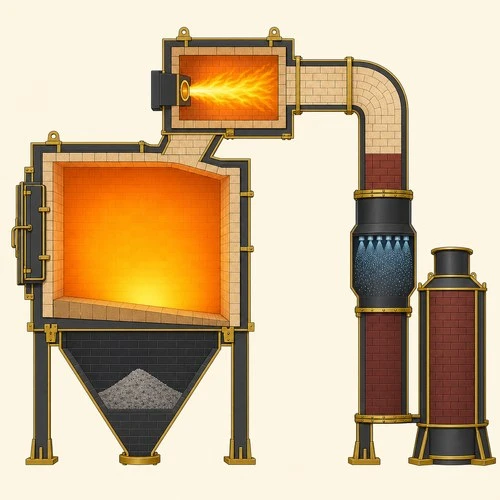
Why Medical Waste Incinerators Are Demanding on Refractory
The failure mechanism in medical waste incinerator refractory is multi-factor:
HCl corrosion. HCl at 500–3,000 ppm reacts with Al₂O₃ and SiO₂ at elevated temperatures: Al₂O₃ + 6HCl → 2AlCl₃ + 3H₂O. AlCl₃ is volatile above 183°C - it leaves the brick as vapor, creating porosity. The result: surface erosion that compounds over time as the porous surface exposes fresh material to the corrosive gas.
Thermal cycling. Unlike continuous-process furnaces, medical waste incinerators typically cycle from ambient to 1000°C+ each operating day and back. Startup/shutdown cycles cause thermal shock. Standard high alumina brick survives this - but the brick-mortar joint system is vulnerable. Open joints become preferential paths for HCl penetration.
Fly ash deposition. Medical waste ash contains heavy metals (lead, zinc, cadmium) that flux at 600–900°C. This flux infiltrates brick pores and reacts with the Al₂O₃-SiO₂ matrix, forming low-melting eutectic phases that weaken the brick structure.
Steam condensation. In the flue duct below 200°C, water vapor condenses carrying dissolved HCl and SO₂. Hydrochloric acid and sulfurous acid attack even relatively resistant materials. This zone requires a completely different material specification from the combustion chamber.
Zone-by-Zone Material Specification Table
| Zone | Temperature | Primary Challenge | Recommended Brick | Alternative |
|---|---|---|---|---|
| Primary chamber walls | 900–1100°C | HCl attack + thermal cycling | High alumina 70% | Dense castable 70% Al₂O₃ |
| Primary chamber floor | 900–1100°C | Waste abrasion + HCl | High alumina 75%, dense grade | SiC brick at grate level |
| Secondary chamber (afterburner) | 1000–1200°C | High temp + HCl | High alumina 80% | Corundum-mullite (if >1150°C) |
| Burner block and throat | 1000–1250°C | Direct flame impingement | 85–90% Al₂O₃ castable | Dense corundum brick |
| Flue gas duct (>400°C) | 400–800°C | HCl attack + fly ash | High alumina 65% or SiC | Castable 65% Al₂O₃ |
| Flue gas duct (<400°C) | 150–400°C | Acid condensate | Acid proof brick + carbon mortar | SiC castable |
| Quench zone | 200–600°C | Thermal shock + acid | SiC brick or acid-resistant castable | - |
| Ash pit and bottom hopper | 400–800°C | Abrasion + acid | SiC brick (high wear) or dense high alumina | - |
| Economizer casing | <200°C | Acid condensate | Red shale acid proof brick | Carbon brick (HCl-rich) |
For standard property comparisons across temperature bands, see our comprehensive guide on high temperature refractory bricks.
Why a single refractory material cannot line an incinerator: Plant operators occasionally ask if a single high-grade refractory can line the entire vessel to simplify procurement. In medical waste incineration, this is physically impossible. The temperature spans 150°C to 1200°C across distinct chemical zones. High alumina brick withstands 1200°C in the combustion chamber but degrades rapidly when liquid acid condenses below 200°C in the ducting. Conversely, acid proof brick withstands concentrated HCl but softens above 350°C. Attempting a single-material lining guarantees catastrophic failure in whichever zone was compromised.
Primary Combustion Chamber: High Alumina Grade Selection
The primary chamber burns waste at 850–1100°C (minimum 850°C is required by most environmental regulations to ensure complete combustion). The lining sees:
Continuous operating temperature 900–1100°C
HCl 500–2,000 ppm in combustion gas
Daily thermal cycling
Occasional waste contact with high ash or slag-forming material
Recommended grade: High alumina brick, 70–75% Al₂O₃
Why 70–75% and not higher? Two reasons:
The HCl attack on Al₂O₃ is non-linear - going from 70% to 90% Al₂O₃ doesn't proportionally improve HCl resistance. The microstructure densification from firing is more important than the composition change for HCl resistance.
Thermal shock resistance is critical in daily-cycling incinerators. Higher-purity alumina brick can have lower thermal shock tolerance than well-fired 70–75% grades. A 75% Al₂O₃ brick with good shot content control and thermal shock resistance (thermal shock cycles >20 at 1100°C) outperforms a nominally higher-purity brick that cracks on daily cycling.
Fe₂O₃ specification: Maximum 1.5% for primary chamber bricks. Higher iron content accelerates the formation of iron-chloride complexes in HCl environments.
Key spec for HCl resistance: Apparent porosity < 16%. Lower porosity means less surface area for HCl to react with, and slower infiltration of acidic condensate during cool-down.
For the primary chamber floor (at grate level where solid waste rests): specify a denser high alumina brick with CCS ≥ 80 MPa or consider SiC brick for the grate zone if waste handling generates significant abrasion.
Secondary Combustion Chamber (Afterburner): Temperature and Chemistry
The secondary chamber (afterburner) ensures complete combustion of dioxins and organics by maintaining 1050–1100°C for minimum 2 seconds retention time - a regulatory requirement in most jurisdictions.
Temperature is higher than the primary chamber, but the chemical environment is cleaner - most HCl has already reacted with base metals or been neutralized by calcium injection. Fly ash concentration is lower.
Recommended grade: High alumina brick, 80% Al₂O₃
Regulatory impact on refractory rating: Environmental standards (including EU Directive 2000/76/EC and related international hazardous waste codes) mandate that clinical waste afterburners sustain at least 1100°C with a 2-second gas retention time for complete dioxin destruction (compared to 850°C for municipal solid waste). This regulatory lower limit establishes a strict performance floor: bricks must handle continuous 1100–1150°C thermal duty without creep, requiring 80% Al₂O₃ brick with a verified refractoriness-under-load (RUL T₀.₅) of ≥1520°C.
At the burner block - where the gas burner flame enters the secondary chamber - the temperature can exceed 1200°C with direct flame impingement. Use 85–90% Al₂O₃ dense high alumina castable refractory at the burner block and throat, backed by 80% Al₂O₃ brick for the general secondary chamber walls.
Flue Gas Duct and Quench Zone: Acid Attack Below 400°C
This is the zone that most incinerator operators under-specify - and it's where most failures occur.
As flue gas cools below 400°C, HCl and SO₂ begin to condense. By 200°C, you have liquid hydrochloric acid and sulfurous acid on the lining surface. By 150°C, the condensate is concentrated enough to attack even standard acid-resistant materials.
Above 400°C in the flue duct: High alumina 65% Al₂O₃ brick or SiC brick. SiC provides better abrasion resistance against fly ash particle impact.
150–400°C flue duct (acid condensation zone): This is a different category entirely. Standard high alumina brick is wrong here - the service is chemical resistance to liquid HCl, not thermal resistance.
Specify: Red shale acid proof brick (Grade A) with furan resin mortar for moderate HCl service, or carbon brick with carbon mortar for environments with HCl >5% or mixed HF content. (Follow our acid proof brick lining design guidelines for joint expansion calculation).
Critical joint specification: Use 3mm joints with furan resin mortar. Zero-gap or over-wide joints both fail - zero-gap causes thermal expansion cracking; over-wide joints leave exposed mortar surface area for acid attack.
Quench zone: The quench section sees the highest thermal shock - gases entering at 700–900°C are rapidly cooled to 200°C by water injection. Specially formulated silicon carbide castable (oxide-bonded, 60% SiC) handles this combination of thermal shock and acid condensation better than alternatives.
Ash Pit and Bottom Hopper: Abrasion and Chemical Combined
The ash collection zones at the bottom of the incinerator receive falling ash at 400–700°C. The wear mode is abrasive - ash particles impacting the refractory at velocity.
SiC brick (oxide-bonded, 40–60% SiC) is the preferred choice for high-abrasion ash pit linings. Hardness advantage over high alumina: Mohs 9–9.5 vs. 8–9. In a direct side-by-side test at a waste-to-energy plant in Vietnam, SiC brick in the ash hopper lasted 28 months vs. 11 months for 75% Al₂O₃ high alumina brick.
For moderate-wear positions, dense 75–80% Al₂O₃ high alumina brick with CCS ≥ 90 MPa is an acceptable cost-performance trade-off.
Castable Options for Irregular Shapes and Corners
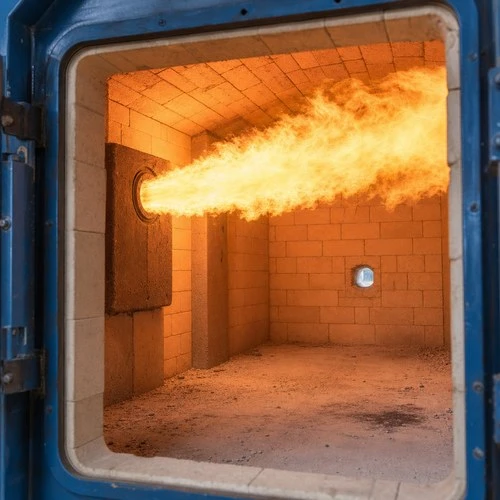
Medical waste incinerators contain complex geometry - burner ports, corners, curved transitions, door frames. Shaped brick doesn't always adapt well to these geometries. Castable refractory is the practical solution for non-standard shapes.
Castable selections by zone:
| Zone | Castable Grade | Minimum CCS |
|---|---|---|
| Primary chamber hot spots | High alumina 70–75% LCC | 80 MPa @ 1000°C |
| Burner throat | High alumina 85–90% dense | 100 MPa @ 1000°C |
| Flue duct above 400°C | Medium alumina 65% | 60 MPa @ 800°C |
| Quench zone | SiC castable 60% | 70 MPa @ 1000°C |
All castable formulations should be vibration-cast, not hand-packed, for applications with thermal cycling. Vibration eliminates internal voids that become crack initiation points.
Maintenance Schedule and Inspection Points
| Interval | Action | Typical Findings |
|---|---|---|
| Every 6 months | Visual inspection of accessible zones | Surface erosion at HCl contact zones, joint opening near thermal cycling points |
| Annually | Thickness measurement at primary chamber walls | Wall thinning rate 5–15mm/year in HCl-exposed zones |
| Every 2–3 years | Full shutdown inspection | Ash pit SiC brick wear, flue duct acid brick condition |
| When shell temperature > 150°C | Investigate immediately | Likely lining thinning or spalling in that zone |
Benchmark campaign lifespans by zone:
Primary combustion chamber (70–75% Al₂O₃): 4–6 years under systematic annual patch maintenance.
Secondary combustion chamber (80% Al₂O₃): 5–7 years due to lower particulate and clean combustion conditions.
Flue duct acid brick (Red shale / Carbon): 5–8 years, provided furan mortar joints receive annual inspection.
Ash pit / hopper (SiC brick): 3–5 years depending on grate discharge abrasive loading.
Risk note: Incorrect zone specification (such as installing porous fire clay in acid condensation areas) degrades linings within 12–18 months.
For the flue gas duct acid proof brick zone: inspect joint integrity every 12 months with a thin probe tool. Failed joints in the acid condensation zone allow acid to penetrate to the structural concrete - repair within 30 days of detection.
Sourcing & Procurement: MOQ, Formats & Lead Time
Commercial Grade Availability (FOB Qingdao / CIF Worldwide)
| Material | Standard Size / Format | MOQ | Production Lead Time |
|---|---|---|---|
| High alumina 70% brick | 230 × 114 × 65mm | 500 pcs | 10–15 days |
| High alumina 80% brick | 230 × 114 × 65mm | 500 pcs | 10–15 days |
| SiC brick 60% (oxide-bonded) | 230 × 114 × 65mm | 300 pcs | 15–20 days |
| Acid proof brick Grade A | 230 × 114 × 65mm | 500 pcs | 10–15 days |
| High alumina castable 75% | 25 kg moisture-proof bag | 1 MT | 7–10 days |
| SiC castable 60% | 25 kg moisture-proof bag | 1 MT | 10–15 days |
Turnkey project packages: For complete incinerator lining builds or scheduled overhauls, we provide consolidated, zone-matched material packages based on your engineering drawings and daily processing capacity (tons/day). Packing conforms to export seaworthy standards (fumigated wooden pallets, stretch wrapping, and corner protectors).
Engineering Consultation & Project RFQ
Zone-matched refractory supply for clinical, hazardous, and municipal incinerator plants.
Provide your incinerator design capacity (tons/day), chamber internal dimensions, and operating fuel type. Our technical sales engineers will prepare a complete material schedule, anchor layout recommendation, and formal quotation.
Email: inquiry@topower.tech - reply within 4 business hours.
Technical datasheets (TDS), XRF chemical analysis, and third-party test certificates available upon request.


