


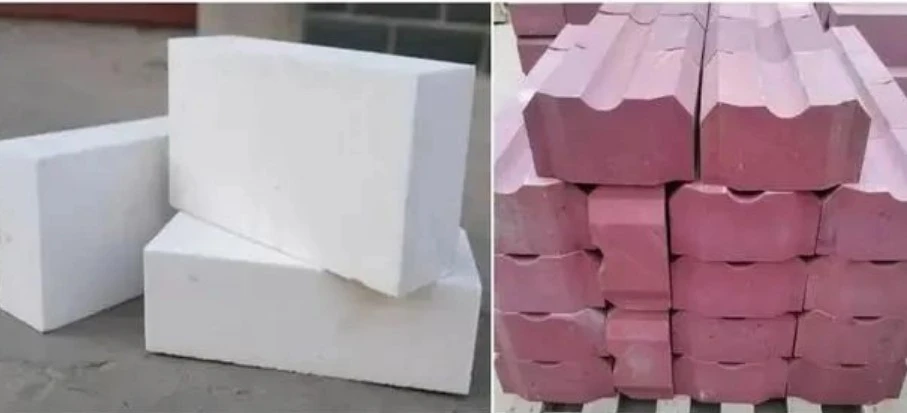
Corundum bricks are refractory bricks with an alumina content of more than 85%. Corundum refractory bricks are divided into sintered and fused corundum fire bricks, while chromium corundum refractory bricks are high-grade refractory bricks made by adding Cr2O3 to corundum, molding at high temperatures, and sintering at high temperatures. Corundum refractory bricks are also divided into fused chromium and sintered chromium corundum refractory bricks.
Different high temperature performance
The refractory resistance of chromium corundum bricks is greater than 1790℃ and the load softening temperature is greater than 1700℃. The service temperature of corundum refractory bricks is 1600℃. The high temperature performance of chromium corundum refractory bricks is better than that of pure corundum fire bricks.
Thermal shock stability performance varies
The compressive strength of corundum refractory bricks is 70-100MPa, and the normal temperature compressive strength of chrome corundum bricks is greater than 150MPa, which is significantly higher than corundum refractory bricks. During the firing process of corundum refractory bricks and chrome corundum fire bricks, Al2O3-Cr2O3 solid solution is formed between particles, between particles and fine powder, and between fine powder and fine powder. The solid solution will connect the particles and fine powder. At the same time, the strength of refractory bricks is greatly improved.
Different resistance to slag erosion
The thermal shock stability of chromium corundum refractory bricks decreases with the increase of Cr2O3 content. That is, the thermal shock stability of chromium corundum bricks with low Cr2O3 content is better than that of bricks with high Cr2O3 content. Generally, the Cr2O3 content of chromium corundum fire bricks is between 12% and 20%; especially the AKZ type chromium corundum refractory bricks produced by adding a small amount of additives that cause phase change have better thermal shock stability.
Different chemical erosion properties
Corundum refractory bricks are seriously eroded by slag, and the slag will completely penetrate into the bricks and penetrate to the surface along the internal pores of the bricks, and the surface of the bricks will turn brown; chrome corundum bricks are almost not eroded by slag, and the edges of the inner holes are clearly demarcated from the slag. Penetration into the brick is minimal. The chemical erosion and permeability of chromium corundum refractory bricks against gasified slag are better than those of corundum refractory bricks.
Chrome corundum bricks are used in glass kiln linings, molten iron pretreatment devices, waste incinerators, gasifier linings, etc. Corundum fire bricks are used in the lining of various high-temperature kilns such as cracking and reforming furnaces in the petrochemical and fertilizer industries, steelmaking furnaces and blast furnaces in the metallurgical industry. Both products have their own advantages, but chrome corundum bricks are more resistant to high temperatures and corrosion than corundum refractory bricks. Corundum refractory bricks are cheaper than chrome corundum refractory bricks. When the temperature is suitable, in order to reduce production costs, it is also a reasonable choice to choose corundum refractory bricks for use in the right location and at the right temperature.


