


The sliding gate slide is a key material for steel casting operations. During use, it must withstand high temperature, thermal shock, erosion and erosion of molten steel, and repeated opening and closing, etc. Based on on-site use experience, the damage factors during the use of slide gate refractory brick are divided into three categories: thermal shock damage, thermal chemical erosion, and improper operation.
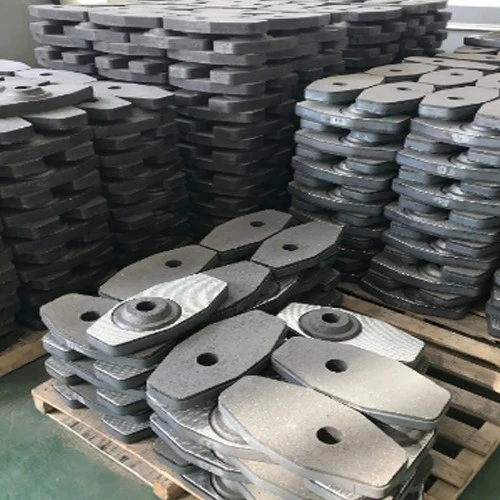
1. Thermal shock damage The temperature of the slide is very low before use. During the casting process, the slide is in contact with high-temperature molten steel for a short time. The huge temperature difference generated will have a strong thermal shock effect on the slide body. At this time, tensile stress is generated outside the casting hole of the slide. Once this stress exceeds the strength of the slide material, radial microcracks will form, as shown in Figure 2. Such cracks are conducive to the diffusion, aggregation, and penetration of foreign molten steel, slag, and oxygen, and become a cause of aggravated chemical erosion.
2. Thermal chemical erosion When the slide contacts high-temperature molten steel and slag during use, a series of chemical reactions will occur, causing thermal chemical erosion. This type of erosion can easily cause the high-temperature wear resistance of the working surface of the slide to deteriorate, the surface layer to fall off, resulting in poor fit of the slide, increased gaps, and further oxidative erosion. After the above processes alternate, serious accidents such as steel leakage from the slide can occur. During the use of the slide, common thermochemical erosion phenomena can be divided into the following categories according to the different steel types and slag compositions.
2.1 Chemical erosion of Ca-treated steel In the process of producing aluminum-killed steel and silicon-aluminum-killed steel, in order to improve the castability of molten steel, Ca-Al wire and Ca-Si wire are fed into the molten steel during the refining process for Ca treatment. When producing this type of steel, the eroded part of the slide presents an obvious "horseshoe" shape. The main reason is that Ca and CaO in the molten steel react with Al2O3 and SiO2 in the slide to form low-melting-point compounds. Especially when the slide is in a pouring state, the molten steel flows in the slide hole and easily forms a negative pressure belt as shown in Figure 3. Under the action of the negative pressure belt, Ca vapor directly reacts with the inhaled oxygen to form CaO, and is enriched in this area, resulting in a "horseshoe" shaped erosion.
2.2 Chemical erosion of high Mn steel When casting high Mn steels such as pipeline steel, the hole expansion of slide gate refractory brick is more serious, and the maximum hole expansion can reach 5mm·furnace-1; in addition, the erosion of the contact surface of the slide plate is also more serious, accompanied by the phenomenon of surface contact surface peeling and crack intensification. This is because the MnO in the high manganese molten steel reacts with the Al2O3 and SiO2 in the slide plate as follows: MnO+SiO2MnO·SiO2, MnO+Al2O3→MnO·Al2O3, resulting in the decomposition of the main materials of corrosion resistance and thermal shock resistance in the slide plate, corundum and zirconium mullite, thereby aggravating the erosion of molten steel and causing abnormal expansion of the aperture. 2.3 Chemical erosion of slag In the later stage of ladle pouring, due to the suction effect of the molten steel flow, part of the slag will be rolled into the water inlet, forming slag erosion on the slide plate. Its main characteristics are hole expansion and plate surface erosion, and there is also the phenomenon of intensified cracks. The composition of steel slag is relatively complex, mainly including CaO, SiO2, Al2O3, MgO, MnO, FeO, Cr2O3, CaF2, etc. Among them, most of the oxides can form low-melting-point compounds with Al2O3 and SiO2 in the slide. In addition, FeO, MnO, etc. may also react with the carbon raw materials in the slide, causing decarburization, making the surface structure of the slide loose and causing damage.
3. Operational factors Through practical summary, the operational factors that cause damage to the slide gate refractory brick can be summarized into three categories: slide installation, pouring flow control, and water nozzle oxygen burning.
(1) Unreasonable installation of the slide. When the slide is not strictly leveled when installed in the sliding mechanism, it will warp, or the slide clamping will be loose, which will generate a lot of external stress during use, resulting in the overall damage of the slide.
(2) Unreasonable pouring flow control in production. If the flow control operation is unreasonable during the pouring process, it is easy to cause peeling, erosion, and steel clamping of the working surface of the slide. Summarizing the flow control operation in production, it is found that the main reason for the damage of the slide plate is that the slide plate movement amplitude is too large or the movement is too frequent, especially the number of slide plate damage caused by manual flow control is more than that caused by computer automatic flow control, indicating that human factors in operation are also an important cause of slide plate damage.
(3) Unreasonable oxygen burning operation. When the ladle is being prepared or there is no downflow during the pouring process, oxygen must be burned at the ladle water inlet. Once the oxygen burning operation is improper, serious oxygen burning erosion will occur. Improper oxygen burning operations that cause slide plate damage include: blowing oxygen when the slide gate refractory brick is not completely aligned, causing oxygen to directly impact the slide plate working surface; blowing oxygen when the drainage sand has not completely flowed out, it is difficult to boil, resulting in too long oxygen blowing time; the oxygen pipe is not parallel to the flow channel, causing the oxygen flow to scour the side wall of the slide plate hole, forming an expanded hole, etc. In addition, other improper operating factors include unreasonable ladle turnover time, which leads to a drop in the overall temperature of the ladle and a large thermal shock when it is used again; improper ratio of fire clay for the slide plate, uneven mixing, impurities, etc. The above-mentioned damage mechanisms interact and promote each other during the preparation and use of the skateboard. It is difficult to attribute the damage of the skateboard to a single reason. Therefore, in order to increase the service life of the skateboard, it is necessary to conduct a comprehensive analysis and come up with a systematic solution.


