


In industrial steam pipelines, petrochemical refining columns, and power plant pipe racks, thermal efficiency and moisture defense are vital engineering priorities. For decades, plant operators relied heavily on conventional ceramic fiber blanket and mineral wool wraps. However, conventional fibrous insulations suffer from two critical limitations: high bulk thickness that overcrowds tight utility chases, and open fibrous capillary networks that absorb ambient moisture, triggering destructive corrosion under insulation (CUI). Installing an advanced aerogel insulation blanket solves both challenges. Combining nanoporous silica aerogel with reinforcing fiberglass or pre-oxidized fiber battings delivers a thermal conductivity as low as 0.020 W/m·K at 25°C and an exceptional 98% hydrophobicity rating. At Topower Refractory, we manufacture and export flexible aerogel blankets that reduce insulation thickness by up to 60% while protecting critical steel piping against moisture ingress.
Key Technical Sourcing Facts
Standard Industrial Product Line: Topower Aerogel Series, standard service grade rated up to 650°C maximum continuous operating temperature.
Exceptional Thermal Conductivity: Tested at 0.020 W/m·K at 25°C and 0.036 W/m·K at 300°C under ASTM C177 guarded hot-plate standards-over two to three times more insulating than traditional fiber blankets.
Hydrophobicity & CUI Defense: 98% water repellency rating; impermeable to liquid water while remaining vapor permeable, eliminating moisture pooling against carbon steel surfaces.
Mechanical & Physical Metrics: Bulk density of 160 to 240 kg/m3; A1 non-combustibility fire rating; 96% compression rebound recovery; tensile strength reaching 1409 kPa (transverse) and 366 kPa (longitudinal). Standard roll width is 1500 mm with thicknesses of 5 mm, 10 mm, and 20 mm (customizable 3 mm and 6 mm). Typical lead time 10 to 15 days FOB Qingdao / Tianjin.
What Is an Aerogel Insulation Blanket?
Silica aerogel represents the world's lightest and lowest-density solid material, comprising over 90% air by volume trapped inside a contiguous nanoporous silicon dioxide skeleton. In its raw monolithic form, aerogel is brittle and fragile.
To create a rugged industrial product, pyrogenic silica aerogel is synthesized into a non-woven reinforcing matrix-such as high-temperature E-glass needle felts or pre-oxidized carbon fibers-via supercritical carbon dioxide drying. The resulting flexible aerogel insulation blanket can be wrapped around complex pipes, curved vessels, and tight valve elbows without shedding or cracking.
Technical Specifications: Topower Aerogel Blanket Series
Evaluating certified laboratory parameters confirms how aerogel outperforms conventional industrial insulation media:
| Technical Parameter / Property | Topower Aerogel Blanket | Standard Ceramic Fiber Blanket | Industrial Rock Wool Wrap | Test Standard |
|---|---|---|---|---|
| Max Service Temperature (°C) | 650 | 1260 - 1430 | 650 | In-House / ASTM C411 |
| Thermal Conductivity @ 25°C | 0.020 W/m·K | 0.045 - 0.055 W/m·K | 0.040 - 0.048 W/m·K | ASTM C177 |
| Thermal Conductivity @ 300°C | 0.036 W/m·K | 0.085 - 0.100 W/m·K | 0.095 - 0.115 W/m·K | ASTM C177 |
| Bulk Density (kg/m3) | 160 - 240 | 96 - 128 | 100 - 140 | ASTM C134 |
| Hydrophobicity Rate (%) | >= 98.0 | Hydrophilic (Absorbs Water) | Hydrophilic / 95% (Temporary) | ASTM C1511 |
| Compression Rebound Rate (%) | 96.0 | 70.0 - 80.0 | <= 60.0 | ASTM C165 |
| Combustion Performance Class | Class A1 (Non-Combustible) | Class A1 (Non-Combustible) | Class A1 (Non-Combustible) | EN 13501-1 |
| Tensile Strength (Transverse) | 1409 kPa | 40 - 75 kPa | 15 - 30 kPa | ASTM D5034 |
| Permanent Linear Shrinkage | -0.3% (650°C x 24h) | <= 2.5% (1000°C x 24h) | <= 2.0% (600°C x 24h) | ASTM C356 |
Note: Supplied in standard roll dimensions of 1500 mm width x 5/10/20 mm thickness. Custom pre-slit strips and removable jacket liners are fabricated on automated CNC tables.
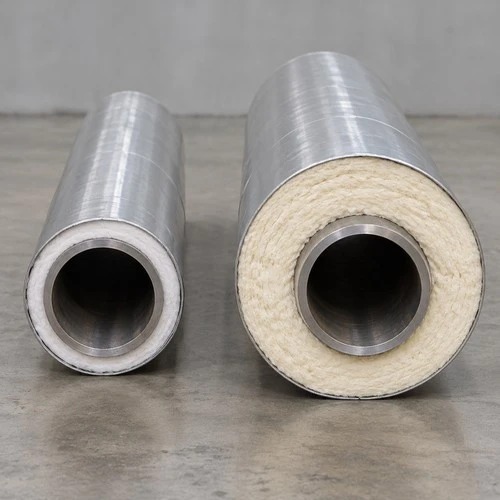
Aerogel vs Ceramic Fiber: Engineering Head-to-Head
Choosing between an aerogel insulation blanket and traditional refractory fiber involves evaluating four critical engineering trade-offs:
1. Thermal Conductivity and Space Savings
Aerogel Advantage: At 300°C operating temperature, an aerogel blanket tests at 0.036 W/m·K versus 0.090 W/m·K for needle-punched ceramic fiber. To maintain an outer surface temperature below 60°C on a 350°C high-pressure steam pipe, a plant needs roughly 30 mm of aerogel versus 80 mm of ceramic fiber.
Clearance Benefit: In congested refinery pipe corridors and offshore oil platforms, reducing insulation thickness frees valuable rack envelope and allows tighter pipe bundling
2. Moisture Defense and CUI Elimination
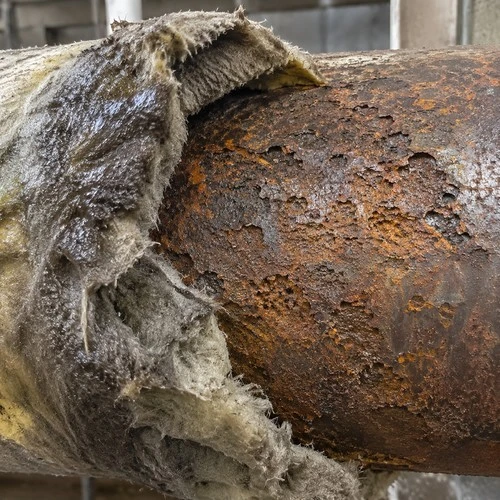
Corrosion Under Insulation: Water penetration is the primary cause of carbon steel pipe failure. Ceramic fiber blankets absorb external water like a sponge; once wet, their thermal conductivity multiplies up to twentyfold while creating an aggressive electrochemical corrosion cell.
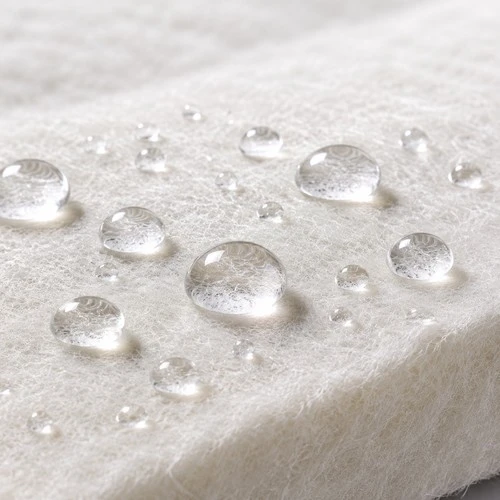
Aerogel Defense: Topower aerogel blankets feature an in-depth 98% hydrophobicity rating. Water droplets bead up and roll off the blanket face without soaking into the aerogel pore structure.
3. Temperature Boundaries (Honest Factory Limitation)
Where Ceramic Fiber Wins: Aerogel is engineered for applications up to 650°C. Above 650°C, the organic hydrophobic surface treatments oxidize, and the silica aerogel framework begins gradual sintering.
Refractory Application: In high-temperature industrial kilns, ethylene cracking furnaces, and steel reheat furnaces operating between 1000°C and 1400°C, ceramic fiber blankets and ceramic fiber board remain the irreplaceable hot-face refractory materials.
Applications: Where Aerogel Delivers Immediate ROI
Implementing a flexible aerogel insulation blanket yields tangible payback across severe operating environments:
High-Pressure District Steam Pipelines: Insulating long-distance overland or underground steam networks with hydrophobic aerogel cuts heat loss by over 35%, ensuring steam arrives at remote processing units with minimal superheat loss.
Removable Thermal Insulation Jackets: Fabricating custom removable blankets for turbine casings, valves, flanges, and injection molding barrels. The 96% compression rebound allows repeated removal and reinstallation during routine inspections without losing loft or shedding dust.
Rigid Furnace Backing Layers: Installing thin aerogel sheets behind dense high alumina brick or backup calcium silicate board layers stops thermal bleeding to furnace steel structures.
Automotive & Rail Exhaust Barriers: Providing ultra-thin, vibration-resistant fire barriers between hot vehicle exhaust downpipes and sensitive electronic sensor harnesses.
Installation Practices and Workmanship
Maximizing thermal barrier integrity requires disciplined jobsite installation:
Staggered Multi-Layer Wrapping: When wrapping pipes with multiple 5 mm or 10 mm layers, offset longitudinal and circumferential seams by at least 100 mm to eliminate thermal bridging through joint gaps.
Securing Hardware: Secure blankets using high-tensile stainless steel banding wire or glass fiber tie tape spaced every 200 mm to 300 mm along pipe runs.
Clean Cutting: Cut blankets cleanly with rotary textile cutters, heavy utility shears, or CNC water-jet cutters. Wear standard dust masks and safety glasses during dry indoor cutting.
Packaging, Roll Dimensions & Export Logistics
Topower Refractory ships aerogel rolls worldwide with multi-layer moisture and impact protection:
Roll Packaging: Master rolls are rolled around heavy cardboard cores, sealed inside poly-tubing, and packed in heavy reinforced export cartons.
Palletizing: Cartons are stacked on ISPM-15 compliant heat-treated wooden pallets (pallet dimensions 1100 x 1100 x 1650 mm) and vacuum-wrapped with waterproof polyethylene stretch wrap.
Container Loading: A standard 40HQ container accommodates approximately 35 to 40 m3 of aerogel blankets (approx. 500 to 650 rolls depending on thickness). Lead time is 10 to 15 days FOB Qingdao / Tianjin.
Transparent Sourcing: Pricing & How to Order
Topower Refractory supplies engineered aerogel blankets directly to piping contractors, energy service companies (ESCOs), and mechanical insulation distributors:
Technical RFQ Checklist
To receive an engineered heat-loss calculation and formal quotation within 4 hours, provide:
Operating Temperature & Pipe Diameter: Maximum pipe temperature, steel pipe diameter (NPS), and ambient environmental conditions (indoor, outdoor, or buried).
Target Surface Temperature: Desired outer touch temperature (typically <= 50°C to 60°C for personnel protection).
Roll Dimensions Required: Thickness (5 mm, 10 mm, or 20 mm) and total square meters required.
Facing Preference: Standard bare aerogel felt or pre-laminated aluminum foil backing.
Destination Port: For instant FOB Qingdao/Tianjin or CIF shipping calculations.
Commercial Pricing Reference: Prevailing commercial pricing for standard 650°C aerogel blankets typically ranges from 12 to 24 USD per square meter FOB China depending on thickness (5 mm to 20 mm) and fiber carrier matrix.
Direct Engineering Support: Contact our technical thermal insulation team directly at inquiry@topower.tech to request certified test reports, ASTM C177 thermal conductivity curves, or sample test swatches.
Frequently Asked Questions
Why does an aerogel insulation blanket cost more per square meter than ceramic fiber?
Producing silica aerogel requires high-purity chemical alkoxide precursors and energy-intensive supercritical CO2 drying autoclaves to extract solvent without collapsing the delicate nanoporous structure. However, because aerogel lasts over 15 years without settling and eliminates CUI pipeline replacement costs, the total lifecycle cost is significantly lower.
Does an aerogel blanket shed hazardous inhalable dust?
No. High-quality industrial aerogel blankets encapsulate aerogel particles inside long-staple glass fibers or pre-oxidized fiber needle mats. Dust generation during handling is minimal and consists of non-crystalline amorphous silica, which is non-hazardous and carries no OSHA carcinogen classification.
Can aerogel thermal blankets be reused after pipeline maintenance?
Yes. Unlike mineral wool or calcium silicate which crumb and crack upon removal, the 96% compression rebound of aerogel allows blankets to be unstrapped, inspected, and reinstalled repeatedly without loss of thermal insulation performance.


