


In high-efficiency industrial kilns-including ceramic roller kilns, petrochemical ethylene crackers, metallurgical reheating furnaces, and specialty laboratory furnaces-lining design has shifted toward lightweight refractory solutions. Among hot-face backup and direct-exposure insulations, lightweight mullite refractories represent the industry standard for combining high operating refractoriness with ultra-low thermal conductivity. However, procurement managers and installation contractors frequently encounter jobsite challenges: irregular brick dimensions causing thick mortar joints, edge crumbling during transit, or spalling under rapid thermal cycles. Achieving gas-tight, long-lasting furnace insulation requires precision six-face CNC grinding tolerances within +/- 0.5 mm, correct grade selection across ASTM/ISO standards (JM23 to JM30), and disciplined jobsite bricklaying. At Topower Refractory, we manufacture engineered mullite insulating fire brick products utilizing high-purity synthetic mullite and micro-porosity burnout technologies to ensure exceptional dimensional accuracy and thermal insulation for industrial buyers worldwide.
Key Technical Sourcing Facts
Standard Industrial Product Lines: Topower JM Series, spanning standard international classifications: JM-23 (1300°C), JM-26 (1400°C), JM-28 (1500°C), and JM-30 (1550°C).
Controlled Bulk Density & Strength: Ultra-lightweight structures with bulk densities ranging from 0.60 g/cm3 (JM-23) to 1.00 g/cm3 (JM-30); cold crushing strength engineered from 1.2 MPa to 3.3 MPa to resist mechanical stacking loads.
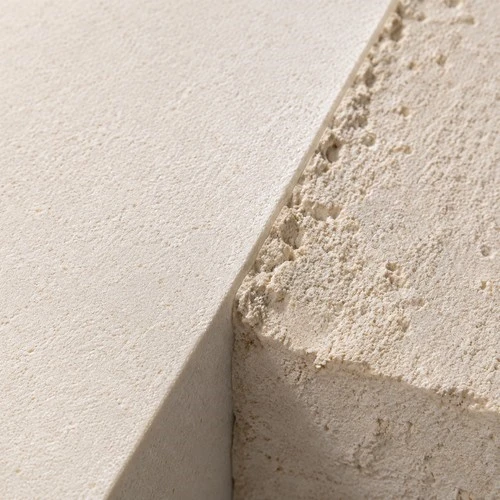
Six-Face Precision Grinding: Every fired block undergoes automated CNC mechanical calibration across all six faces, guaranteeing sharp 90-degree edges and dimensional tolerances held strictly within +/- 0.5 mm.
Low Thermal Conductivity & Reheat Shrinkage: Thermal conductivity held between 0.18 and 0.42 W/m·K at 350°C to 600°C; permanent linear change (CT°C x 24h) tightly restricted below 0.6% to 0.9%.
Why Six-Face Factory Machining Matters
Traditional insulating firebricks produced with rough wire-cut or manual mold-release methods exhibit thickness variations of +/- 2.0 mm or more. In high-temperature industrial kilns, dimensional irregularity leads to severe structural failures:
Thick Joint Vulnerability: When bricks vary in dimension, masons are forced to apply thick mortar beds (3.0 mm to 5.0 mm) to level brick courses. As water evaporates and heat sinters the mortar, thick joints shrink, creating thermal gas channels that overheat outer kiln steel shells.
Stress Concentrations and Corner Crushing: Bricks with uneven faces exert uneven point-loading under thermal expansion thrust. Point contact crushes brittle porous corners, causing brick spalling.
The Topower CNC Solution: Fired mullite blocks are fed through automated diamond-wheel grinding lines. Every single mullite insulating fire brick is calibrated to +/- 0.5 mm tolerance on all six faces, enabling masons to maintain razor-thin mortar joints under 1.5 mm.
Technical Specifications: Topower JM Mullite Series Data Sheet
Evaluating verified physical and chemical parameters from our production lines ensures process engineers choose the exact thermal classification required:
| Technical Parameter / Property | JM-23 (1300°C Grade) | JM-26 (1400°C Grade) | JM-28 (1500°C Grade) | JM-30 (1550°C Grade) | Test Standard |
|---|---|---|---|---|---|
| Classification Temperature (°C) | 1300 | 1400 | 1500 | 1550 | ISO 2245 |
| Bulk Density (g/cm3) | 0.60 | 0.80 | 0.90 | 1.00 | ASTM C134 |
| Cold Crushing Strength (MPa) | 1.2 | 1.8 | 2.5 | 3.3 | ISO 10059 |
| Modulus of Rupture (MPa) | 1.0 | 1.7 | 2.3 | 3.1 | ASTM C133 |
| Permanent Linear Change (%) | 0.6 (1300°C x 24h) | 0.6 (1400°C x 24h) | 0.8 (1500°C x 24h) | 0.9 (1550°C x 24h) | ASTM C210 |
| Thermal Expansion @ 1100°C (%) | 0.50 | 0.52 | 0.52 | 0.53 | Dilatometry |
| Thermal Conductivity @ 350°C | 0.18 W/m·K | 0.27 W/m·K | 0.32 W/m·K | 0.38 W/m·K | ASTM C182 |
| Thermal Conductivity @ 400°C | 0.20 W/m·K | 0.29 W/m·K | 0.34 W/m·K | 0.40 W/m·K | ASTM C182 |
| Thermal Conductivity @ 600°C | 0.24 W/m·K | 0.32 W/m·K | 0.36 W/m·K | 0.42 W/m·K | ASTM C182 |
| Al2O3 Content (%) | 40.0 | 56.0 | 67.0 | 73.0 | ASTM C114 |
| Fe2O3 Content (%) | 1.0 | 0.8 | 0.7 | 0.7 | XRF Analysis |
Thermal Spalling Resistance: Micro-Porosity Architecture
A high-performance mullite insulating fire brick achieves high thermal shock stability through specialized microstructure control:
1. Synthetic Mullite Needle Network
Unlike clay insulating bricks that rely on low-melting quartz and glass phases, JM series bricks are synthesized from high-purity mullite grains (3Al2O3·2SiO2). The interlaced acicular mullite crystal needles form a rigid micro-skeleton that resists high-temperature plastic deformation up to its classification limit.
2. Uniform Spherical Burnout Pores
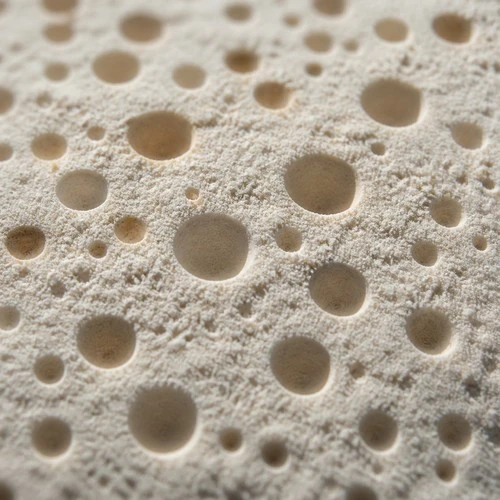
Porosity is generated by blending calibrated organic polymer beads and refined sawdust into the raw slurry. During firing in tunnel kilns, the organic inclusions burn out cleanly, leaving uniformly distributed, isolated spherical micro-pores. This avoids interconnected capillary fissures, suppressing thermal radiation across pores while preventing micro-crack propagation under thermal cycling.
Kiln System Integration: Complete Lining Configurations
Optimizing industrial kiln thermal efficiency requires coordinating lightweight insulating firebrick masonry with complementary refractory layers:
Direct Hot-Face Exposure: In ceramic roller kilns, shuttle kilns, and heat-treatment furnaces fired with clean natural gas, JM-26 and JM-28 bricks serve directly as hot-face linings, minimizing kiln thermal mass and reducing gas consumption during fast firing cycles.
Secondary Thermal Backing: In severe steel ladles, glass tank regenerators, and waste incinerators where molten slag or liquid metal attacks the hot face, dense high alumina brick or corundum castable serves as the working lining, backed by lightweight JM-23 bricks to contain thermal bleeding.
Veneer and Expansion Sealing: In kiln roof corners and burner sleeve collars, flexible ceramic fiber paper absorbs localized expansion stresses, while specialized refractory mortar holds brick courses in rigid alignment.
Jobsite Installation & Bricklaying Best Practices
Because insulating firebricks are lightweight and porous, masons must observe dedicated installation rules:
Mortar Compatibility & Air-Setting Slurry: Never lay insulating firebricks with thick coarse mortar. Always specify high-alumina chemical air-setting mortar (Topower MI or MA series) formulated with ultra-fine powder (-0.074 mm passing >= 45%).
Thin-Joint Dipping Method: Bricks should be buttered or face-dipped in fluid mortar slurry and pressed firmly into position with a sliding motion, maintaining finished joint thicknesses between 1.0 mm and 1.5 mm.
Moisture Absorption Control: Because porous bricks rapidly draw water out of mortar, masons should dip bricks quickly in clean water or use high-retention chemical mortars to prevent premature drying before full joint bonding occurs.
Joint Fullness Standards: Inspect every brick course to ensure joint mortar fullness exceeds 95%. Incomplete mortar beds create localized thermal bypass channels that overheat exterior steel structures.
Thermal Expansion Allowance: In continuous hot-face walls, install dedicated expansion joints every 2.0 to 3.0 meters using combustible cardboard strips or ceramic fiber felt to absorb reversible linear thermal expansion without crushing brick edges.
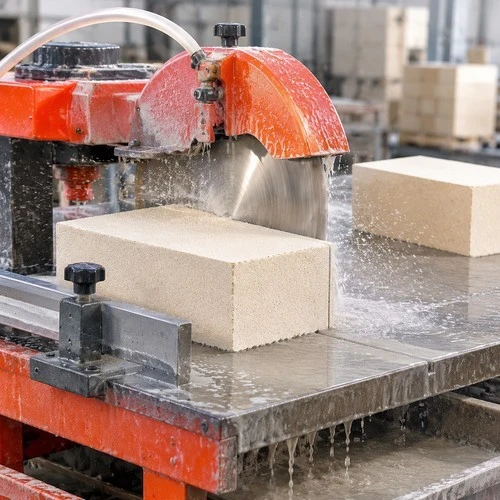
Clean Jobsite Cutting: Precision field adjustments should be executed using carbide-tipped hand saws or portable masonry wet saws to preserve sharp, unchipped edges.
Packaging, Palletizing & Export Logistics
Topower Refractory ships fragile insulating materials with multi-stage impact and weather protection:
Reinforced Carton Packing: Bricks are packed in heavy-duty corrugated export cartons (typically 10 to 12 standard straights per box, 230 x 114 x 65 mm), interlaid with foam dividers to prevent face rubbing.
Palletized Shrink Hooding: Cartons are stacked on ISPM-15 compliant heat-treated wooden pallets, edged with high-impact cardboard corner protectors, and vacuum-wrapped in UV-resistant polyethylene stretch hoods.
Container Loading: A standard 40HQ container carries approximately 55 to 60 m3 of insulating bricks (approx. 14,000 to 16,000 standard straight bricks, weighing 18 to 22 metric tons depending on JM23 vs JM28 density). Lead time is 10 to 15 days FOB Qingdao / Tianjin.
Transparent Sourcing: Pricing & How to Order
Topower Refractory supplies engineered mullite insulating fire brick shapes directly to furnace builders, petrochemical operators, and international refractory distributors:
Technical RFQ Checklist
To obtain an engineered proposal and formal quotation within 4 hours, provide:
Operating Temperature & Atmosphere: Maximum continuous temperature, fuel source (natural gas, hydrogen, fuel oil, or electric), and atmospheric gases (oxidizing or reducing).
Grade Required: JM-23 (1300°C), JM-26 (1400°C), JM-28 (1500°C), or JM-30 (1550°C).
Shape List & Dimensions: Standard straight bricks (230x114x65 mm, 230x114x75 mm) or custom arch/wedge shapes (side arch, end arch, wedge, feather edge).
Order Volume: Required piece count or cubic meters (minimum trial order 1 pallet / approx. 400 pieces; full container load is 14,000 to 16,000 pieces).
Destination Port: For instant FOB Qingdao/Tianjin or CIF maritime logistics calculations.
Commercial Pricing Reference: Standard JM-23 insulating firebricks typically range from 0.85 to 1.35 USD per standard piece FOB China for container volumes, while high-temperature JM-28 and JM-30 grades range from 1.60 to 2.80 USD per piece depending on Al2O3 purity, custom wedge taper cutting, and carton packaging specifications.
Direct Engineering Support: Contact our thermal insulation team directly at inquiry@topower.tech to review furnace lining blueprints or request certified chemical and thermal conductivity test sheets.


