


In flat glass float tanks, container glass melting furnaces, and modern tall coke oven batteries, the superstructure crown and carbonization walls endure continuous temperatures exceeding 1550°C to 1600°C under severe acid vapor attack. For glass furnace engineers, the silica crown represents the single most critical structural asset-a premature refractory failure or localized roof sag compromises the entire multi-million-dollar production campaign. Yet, when surveying suppliers, procurement managers observe significant variances in commercial quotations. Understanding the underlying silica refractory price structure requires looking past raw tonnage rates to evaluate raw quartzite selection, SiO2 mineral purity, true density phase transformation, and high-temperature creep resistance. At Topower Refractory, we manufacture and export premium silica bricks and fused silica zero-expansion refractories formulated to provide structural stability and extended campaign life for glassmakers worldwide.
Key Technical Sourcing Facts
Standard Industrial Product Line: Topower JGZ series, including JGZ96 (Glass tank crowns & hot-blast stoves), JGZ95 (Coke ovens & regenerators), JGZ94 (General industrial acid chambers), and JSG98 (Zero-expansion fused silica).
Mineral Purity & High Refractoriness: High SiO2 content from 94.0% to 98.5%; minimal fluxing oxides with Al2O3 strictly held <= 0.3% to 0.5%; refractoriness under load (0.2 MPa) up to 1660°C to 1680°C.
Phase Transformation Guarantee: Low true density tightly controlled between 2.33 and 2.34 g/cm3, ensuring maximum tridymite and cristobalite inversion with near-zero residual quartz.
Packaging & Export Logistics: Fully moisture-sealed export packaging with desiccant bags, plastic stretch hoods, and ISPM-15 fumigated timber pallets. Export dispatch within 10 to 15 days FOB Qingdao / Tianjin.
What Determines Silica Refractory Price?
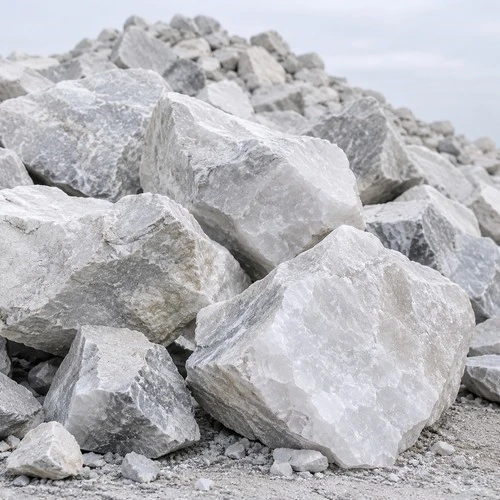
Commercial buyers often ask why silica brick quotations range between 380 and 850 USD per metric ton for standard grades, and up to 1200 USD or more for specialized zero-expansion or low-flux glass crown blocks. The true market cost breaks down into four essential manufacturing drivers:
Quartzite Feedstock Quality (~ 40% of Cost): Producing glass-grade silica bricks requires dense crystalline quartz rocks with exceptionally low alumina (Al2O3 < 0.2%) and low titania. Impure bauxite-contaminated quartz ruins high-temperature load capacity.
Tunnel Kiln Firing Cycle & Gas Consumption (~ 30% of Cost): Silica bricks undergo complex crystal phase conversions between 100°C and 1450°C (quartz -> tridymite -> cristobalite), involving significant volumetric expansion. Sintering requires a slow firing schedule lasting 20 to 28 days to prevent micro-cracking, representing massive thermal fuel input.
Dimensional Machining & Sorting Tolerances (~ 15% of Cost): Large crown wedge bricks and inverted arch blocks for 10-meter-span glass crowns require diamond-wheel pre-assembly and precision taper grinding with tolerances <= +/- 0.5 mm.
Moisture-Proof Export Palletizing (~ 10% to 15% of Cost): Unprotected silica bricks absorb maritime atmospheric humidity, leading to destructive hydration or explosive steam-spalling during initial kiln commissioning.
Technical Specifications: Topower JGZ & Fused Silica Series
Evaluating technical data sheets enables buyers to ensure they are paying for verified mineral performance rather than substandard masonry:
| Technical Parameter / Property | JGZ96 (Glass Crown Grade) | JGZ95 (Coke Oven Grade) | JGZ94 (General Industrial) | JSG98 (Fused Silica Block) | Test Standard |
|---|---|---|---|---|---|
| SiO2 Content (%) | >= 96.0 | >= 95.0 | >= 94.0 | >= 98.5 | ASTM C114 |
| Al2O3 Content (%) | <= 0.35 | <= 0.60 | <= 0.90 | <= 0.15 | ASTM C114 |
| Fe2O3 Content (%) | <= 1.0 | <= 1.2 | <= 1.4 | <= 0.10 | XRF Analysis |
| True Density (g/cm3) | <= 2.34 | <= 2.35 | <= 2.35 | <= 2.31 | ASTM C135 |
| Bulk Density (g/cm3) | >= 1.85 | >= 1.83 | >= 1.81 | >= 1.85 | ASTM C134 |
| Apparent Porosity (%) | <= 22.0 | <= 22.0 | <= 22.0 | <= 16.0 | ASTM C20 |
| Cold Crushing Strength (MPa) | >= 30.0 | >= 30.0 | >= 30.0 | >= 40.0 | ISO 10059 |
| Refractoriness Under Load (°C) | >= 1660 | >= 1650 | >= 1640 | >= 1680 | ASTM C583 |
| Thermal Shock (1100°C Water) | / | / | / | >= 30 cycles | DIN 51068 |
Note: For glass melting furnace crowns, our JGZ96 bricks undergo mandatory 50-hour creep testing at 1550°C, ensuring deformation rates <= 0.2% across full service campaigns.
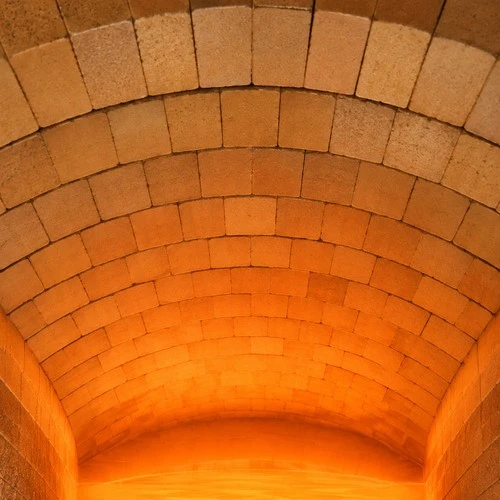
Glass Crown Quality: Why True Density and Alumina Matter
Understanding how chemical purity and mineral conversion govern field performance separates reliable manufacturers from cheap imitators:
1. The Critical Role of True Density

Raw natural quartz has a true density of 2.65 g/cm3. Upon full conversion into stable tridymite and cristobalite, its true density drops to 2.28 to 2.33 g/cm3.
Under-Fired Incomplete Conversion (Density > 2.35 g/cm3): Indicates unreacted residual quartz. When exposed to 1550°C in an operating glass tank, residual quartz continues to expand unpredictably, causing crown arch upheaval, joint dislocation, and sudden roof collapse.
Fully Transformed Grade (Density <= 2.34 g/cm3): Guarantees full volume stability, ensuring crown arches settle into continuous compression without shifting.
2. The Alumina Contamination Threat
Alumina is the most dangerous impurity in silica refractories. An increase of just 0.5% in Al2O3 forms low-melting liquid aluminosilicate eutectics at 1545°C. In high-temperature glass melting crowns, excess Al2O3 causes localized "sweating", dripping acidic liquid glass back into the molten glass bath and forming refractory defect stones.
Comparing Silica Brick Costs vs Alternative Refractories
When evaluating furnace superstructure investments, understanding the comparative silica refractory price against alternative lining solutions provides clear financial and engineering guidance for project managers:
Silica Bricks vs High Alumina Brick: High-alumina refractories suffer progressive high-temperature plastic creep under compressive arch loads above 1400°C. In contrast, high-purity silica maintains full structural rigidity within 20°C of its ultimate melting point (1710°C), making it the only economical material for wide-span glass crowns.
Standard Silica vs Fused Cast AZS Block: While fused AZS blocks dominate molten glass contact lines, their high bulk density (3.8 to 4.0 g/cm3) and costly fusion process make them prohibitively heavy and expensive for upper superstructure crowns. Silica provides an optimal cost-to-performance ratio for upper furnace crowns.
Silica Bricks vs Refractory Castable: Monolithic castables cannot accommodate the severe non-linear 0°C to 600°C volumetric expansion of silica without catastrophic cracking, making pre-fired modular silica shapes irreplaceable.
Heating-Up Schedule and Thermal Expansion Control
Because silica refractory exhibits dramatic non-linear thermal expansion between 100°C and 300°C (driven by alpha-to-beta cristobalite and tridymite inversions), executing a precise heat-up curve is paramount:
Slow Low-Temperature Heating: Maintain a very gentle ramp rate (no faster than 5°C to 10°C per hour between 100°C and 300°C). Over 70% of total expansion occurs in this critical window.
Expansion Tie-Rod Adjustment: Furnace structural steel tie-rods must be progressively loosened by mechanical crews as the crown expands upwards, maintaining uniform compressive arch thrust without crushing brick faces.
High-Temperature Stability: Once temperatures exceed 600°C, silica expansion flattens to near zero. Above this threshold, silica refractories exhibit superior volume stability up to 1600°C.
Moisture Protection & Container Sourcing Logistics
Due to its open microporous network (porosity 20% to 22%), silica refractory is vulnerable to ambient water absorption:
Triple-Layer Packaging: Each pallet is packed on solid fumigated wooden skids, interlaid with shock-absorbing foam or corrugated sheets, bundled with high-tensile steel straps, and heat-shrunk inside UV-stabilized heavy polyethylene bags with internal silica gel desiccant packs.
Container Loading: A standard 20GP container accommodates 22 to 24 metric tons of silica bricks (approx. 12,000 standard straight equivalents). Dunnage air bags secure pallet rows to prevent impact chipping during rough ocean voyages.
Transparent Sourcing: Pricing & How to Order
Topower Refractory provides direct factory transparency on every commercial silica refractory price, supplying engineered refractories directly to glass producers, coke battery constructors, and industrial engineering contractors:
Technical RFQ Checklist
To obtain an engineered proposal and formal quote within 4 hours, provide:
Application & Zone: Glass melting furnace crown, regenerator checker wall, coke oven combustion chamber, or hot-blast stove dome.
Quality Grade Required: High-purity glass-grade JGZ96 (SiO2 >= 96%, Al2O3 <= 0.35%) or standard industrial grade JGZ95.
Shape List & Drawings: Standard straights, arch wedges, key bricks, or custom pre-machined crown skewbacks with dimensional tolerances.
Order Volume: Required metric tons or piece count (minimum order 10 metric tons / partial container; FCL is 22 to 25 metric tons per 20GP container).
Destination Port: For instant FOB Qingdao/Tianjin or CIF shipping calculations.
Commercial Pricing Reference: The prevailing silica refractory price for standard industrial JGZ95 bricks typically ranges from 420 to 650 USD per metric ton FOB China for container volumes, while high-purity glass crown JGZ96 grades (low alumina, low true density <= 2.34 g/cm3) range from 680 to 920 USD per metric ton depending on pre-assembly and precision grinding specifications.
Direct Engineering Support: Contact our high-temperature furnace engineering team at inquiry@topower.tech to review crown lining blueprints or request certified chemical and creep analysis reports.
Frequently Asked Questions
Why does the silica refractory price vary significantly between suppliers?
Pricing is primarily dictated by raw quartzite selection, alumina impurity limits, and tunnel kiln firing cycles. Producing low-alumina (< 0.35%) bricks with full tridymite conversion (true density <= 2.34 g/cm3) requires premium low-impurity quartz rock and prolonged high-temperature sintering, whereas cheaper bricks contain high residual quartz that risks furnace roof failure.
What is the maximum operating temperature for a silica glass crown?
A high-purity silica brick crown safely operates continuously between 1580°C and 1620°C in clean oxidizing atmospheres. Above 1650°C, or in the presence of heavy alkali dust contamination, liquid silicate formation accelerates rapidly.
Can silica bricks be used in cyclic or intermittent furnaces?
No. Silica bricks have poor thermal shock resistance below 600°C due to reversible alpha-beta crystal phase inversions. They are strictly recommended for continuous, uninterrupted high-temperature furnaces like glass float tanks and coke ovens that remain at elevated temperatures for years.


