


In heavy thermal processing industries-from steelmaking transfer ladles and aluminum holding furnaces to cement preheaters and petrochemical cracking coils-engineers face a constant structural conflict between thermal insulation and interior working volume. Traditional insulation systems relying on thick layers of insulating firebrick or calcium silicate boards occupy significant cross-sectional space. To achieve an acceptable outer steel shell temperature below 250°C to 300°C, furnace designers often sacrifice 100 mm to 150 mm of radial thickness on refractory backing. Implementing an engineered nano insulation board breaks this physical bottleneck. By leveraging microporous fumed silica technology delivering an ultra-low thermal conductivity of 0.020 W/m·K at 200°C, plants can reduce backing insulation thickness by half while lowering outer steel casing temperatures. At Topower Refractory, we engineer and supply customized thermal nano insulation boards that unlock furnace capacity and improve energy retention across industrial furnaces globally.
Key Technical Sourcing Facts
Standard Industrial Product Line: Topower JC Series, including JC950 (standard density 280 to 350 kg/m3 for ultra-low thermal conductivity) and heavy-duty grades JC1000 and JC1100 (density 550 to 650 kg/m3 with elevated 0.8 to 1.2 MPa compressive strength).
Thermal Conductivity Performance: Tested under ASTM C177 / C201 protocols: 0.016 W/m·K at 200°C, 0.021 W/m·K at 400°C, 0.026 W/m·K at 600°C, and 0.035 W/m·K at 800°C for JC950.
Knudsen Effect Pore Structure: Formed from amorphous fumed silica chains with nanoscale pores (20 to 50 nm) smaller than the mean free path of air molecules (68 nm), practically eliminating internal gas convection and molecular conduction.
Facing and Encapsulation Options: Supplied with impermeable aluminum foil, glass cloth encapsulation, or water-repellent silane coatings to shield the microporous core from jobsite moisture and mortar contact. Shipped globally from Zibo, China within 10 to 15 days FOB Qingdao / Tianjin.
How Nanoscale Microporous Insulation Functions
A high-performance nano insulation board achieves thermal barrier values three to five times lower than conventional fiber boards through three distinct micro-mechanisms:
Knudsen Effect (Gaseous Conduction Suppression): In conventional porous refractories, air molecules collide continuously inside pores larger than 1 micron, transporting heat across the wall. In a microporous silica panel, pores are engineered between 20 and 50 nanometers. Because this diameter is narrower than the mean free path of gas molecules (68 nm at atmospheric pressure), gas molecules collide with pore boundaries rather than with each other, virtually extinguishing internal gaseous heat transfer.
Solid-State Contact Minimization: The solid matrix consists of point-contact agglomerations of amorphous pyrogenic silica nanoparticles, creating an exceptionally tortuous, elongated thermal conduction pathway.
Infrared Radiation Opacification: High temperatures (above 600°C) drive heat transfer primarily through infrared radiative waves. Blending optical opacifiers-such as silicon carbide and titanium dioxide minerals-scatters and absorbs infrared radiation across hot zones.
Technical Specifications: Topower JC Nano Board Series
Evaluating verified laboratory physical parameters enables procurement and process engineers to select the exact density and strength rating required:
| Technical Parameter / Property | JC950 (Ultra-Low Conductivity) | JC1000 (Medium-Duty Grade) | JC1100 (High-Strength Grade) | Test Standard |
|---|---|---|---|---|
| Max Operating Temperature (°C) | 950 | 1000 | 1100 | In-House Standard |
| Melting Point (°C) | >= 1200 | >= 1200 | >= 1200 | ASTM C24 |
| Bulk Density (kg/m3) | 280 - 350 | 550 - 650 | 550 - 650 | ASTM C134 |
| Compressive Strength (MPa) | >= 0.50 | 0.80 - 1.20 | 0.80 - 1.20 | ASTM C165 |
| Linear Shrinkage @ 800°C x 24h | <= 1.9% | <= 1.9% | <= 1.9% | ASTM C356 |
| Thermal Conductivity @ 200°C | 0.016 W/m·K | / | / | ASTM C177 |
| Thermal Conductivity @ 400°C | 0.021 W/m·K | 0.043 W/m·K | 0.047 W/m·K | ASTM C177 |
| Thermal Conductivity @ 600°C | 0.026 W/m·K | 0.057 W/m·K | 0.058 W/m·K | ASTM C177 |
| Thermal Conductivity @ 800°C | 0.035 W/m·K | 0.063 W/m·K | 0.069 W/m·K | ASTM C177 |
Note: Standard panel dimensions are 1000 x 600 mm, 600 x 500 mm, and 500 x 250 mm with precision thicknesses from 5 mm to 50 mm. Custom water-jet cut geometries are supplied with pre-punched anchor cutouts.
Thickness Optimization: Steel Ladle Lining Case Study
In modern continuous casting steel mills, steel transfer ladles represent the primary proving ground for microporous fumed silica technology.
The Problem with Traditional Ladle Backing
A conventional 120-ton steel ladle typically incorporates 50 mm to 65 mm of calcium silicate board or insulating fire brick behind its safety and working brick linings. Despite this thickness, high thermal conductivity (0.12 to 0.18 W/m·K at 600°C) leads to:
Shell temperatures routinely reaching 320°C to 380°C, causing steel shell ovalization and weld fatigue.
Molten steel heat loss rates between 1.8°C and 2.5°C per minute during ladle furnace treatment.
The Nano Insulation Board Retrofit Solution
Replacing 50 mm of conventional calcium silicate with just 15 mm to 20 mm of JC1000 nano board produces measurable engineering benefits based on plant trial records:
Ladle Steel Volume Expansion: Reclaiming 30 mm to 35 mm of radial lining space increases the effective internal molten metal capacity by approximately 2% to 4%, allowing mills to tap an additional 2 to 4 tons of steel per heat without enlarging crane hook capacities.
Lower Outer Shell Temperatures: Steel casing temperatures consistently drop by 40°C to 65°C, preserving shell mechanical integrity and reducing thermal radiation toward operating personnel.
Tapping Temperature Reductions: Reducing liquid steel temperature loss allows steelmakers to reduce electric arc furnace or converter tapping temperatures by 5°C to 10°C, yielding direct savings in electrical power and refractory consumption.
Industrial Kiln Shell Optimization: Tunnel & Rotary Kilns
Beyond steel ladles, applying a compact nano insulation board transforms industrial furnace thermal balances:
Petrochemical Cracking Furnaces: Backing hot-face refractory castable layers with 10 mm of nano board suppresses external furnace skin temperatures while preventing heat loss between burner ports.
Cement Preheater Ducts & Cyclones: Thin microporous panels fit smoothly behind wear-resistant high alumina brick linings, maintaining high gas temperatures required for raw meal calcination without adding excessive dead weight to tall suspension towers.
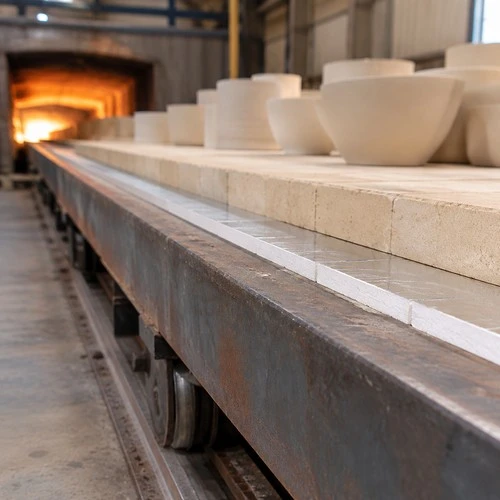
Ceramic Tunnel Kiln Cars: Installing high-density JC1100 boards in kiln car perimeter borders reduces heat soak into lower track mechanisms, protecting wheel bearings and reducing cyclic firing fuel consumption.
Critical Installation Rules: Moisture Protection
While microporous silica provides unmatched thermal insulation, engineers must observe one non-negotiable operational boundary during installation:
The Absolute Water Hazard
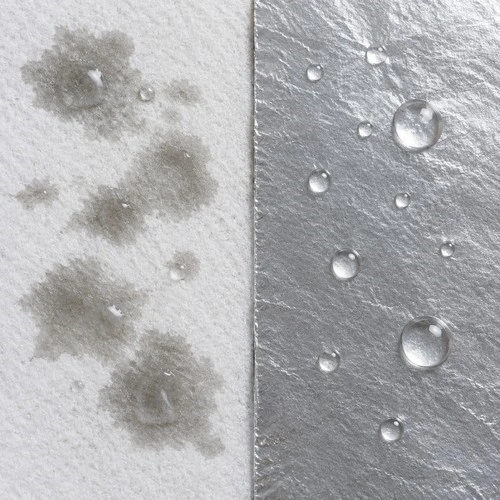
Unprotected fumed silica nanoparticles exhibit extreme hydrophilicity. If wet refractory castable, chemical mortar slurry, or rainwater directly contacts an unsealed microporous silica board, capillary suction draws liquid into the microscopic pores. Liquid water collapses the delicate 20-nanometer silica matrix. Upon drying, the board densifies irreversibly, losing its Knudsen microporosity and increasing thermal conductivity by up to 300%.
Standard Protection Measures
Factory Encapsulation: Topower panels are supplied wrapped in sealed aluminum foil jackets or heat-bonded woven glass fabric.
Impermeable Vapor Barriers: When casting monolithic refractories over nano boards, installers must lay an overlapping polyethylene plastic sheet (minimum 0.2 mm thickness) over all board seams before pouring wet concrete.
Dry Storage Discipline: Pallets must remain stored in climate-controlled indoor warehouses with moisture-barrier stretch wrap intact until the hour of installation.
Packaging, Dimensions & Export Logistics
Topower Refractory delivers fragile microporous materials fully protected for multi-modal international shipping:
Protective Box Packaging: Standard panels are packed in rigid corrugated cartons with shock-absorbing corner pads.
Palletized Seaworthy Crates: Cartons are stacked on ISPM-15 heat-treated fumigated wooden pallets, wrapped in vacuum-sealed plastic stretch film, and strapped with high-tensile plastic bands.
Container Loading: A 20GP container carries approximately 25 to 30 m3 (approx. 8 to 11 metric tons depending on JC950 vs JC1000 density). Lead time is 10 to 15 days FOB Qingdao / Tianjin.
Transparent Sourcing: Pricing & How to Order
Topower Refractory supplies engineered nano insulation boards directly to engineering contractors, furnace builders, and steel manufacturing groups:
Technical RFQ Checklist
To obtain an itemized project proposal within 4 hours, provide:
Target Operating Temperature: Cold-face and hot-face exposure limits (950°C, 1000°C, or 1100°C).
Mechanical Loading: Free-standing backup wall or compressive load-bearing bottom zone (determining JC950 vs JC1000/JC1100 selection).
Required Thickness & Dimensions: Specified sheet thickness (5, 10, 15, 20, 25, or 50 mm) and panel size (standard 1000x600 mm or custom shapes).
Facing Specification: Bare panel, single-sided foil, double-sided foil, or fully sealed fiberglass textile jacket.
Project Volume & Destination: Required square meters or cubic meters (minimum order 1 pallet / approx. 2 m3).
Commercial Pricing Reference: The prevailing commercial price for standard JC950 microporous nano boards typically ranges from 1200 to 1800 USD per cubic meter FOB China for container orders, while high-temperature encapsulated JC1100 panels range from 1900 to 2600 USD per cubic meter depending on foil barrier grade and precision cutting requirements.
Direct Engineering Support: Contact our thermal calculation specialists directly at inquiry@topower.tech to obtain 1D/2D thermal gradient simulations and lining thickness reduction assessments.
Frequently Asked Questions
How does a nano insulation board compare to traditional ceramic fiber board?
At 600°C, a standard ceramic fiber board has a thermal conductivity of roughly 0.120 to 0.140 W/m·K. A JC950 microporous panel tests at just 0.026 W/m·K-nearly five times lower. This allows engineers to achieve identical or superior insulation performance with roughly 20% to 25% of the physical thickness.
Can microporous nano boards be used as a furnace hot-face lining?
No. Microporous nano boards are designed strictly as backup insulation. They lack the mechanical erosion resistance and slag durability required to withstand direct flame impingement, turbulent flue gas scrubbing, or liquid metal slag contact. They must be installed behind dense bricks, castables, or ceramic fiber modules.
How are thermal microporous insulation panels cut on site?
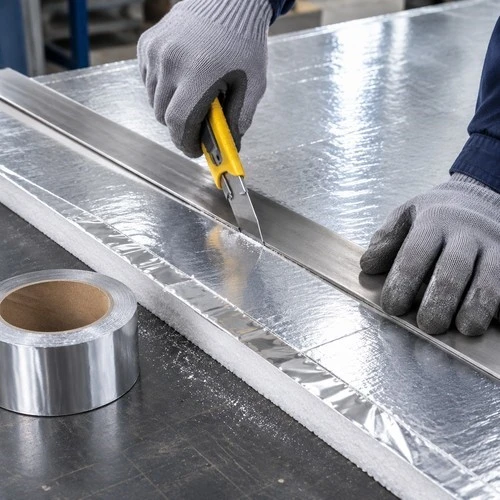
Panels can be cut smoothly using a standard serrated utility knife, fine-toothed hand saw, or high-speed band saw. When field-cutting foil-encapsulated panels, technicians should immediately reseal the cut edge with high-temperature aluminum foil tape to preserve moisture protection.


