


In extreme thermal processing-including coal-water slurry gasifiers, carbon black reaction furnaces, hydrogen reforming reactors, and aerospace vacuum metallurgy-furnace linings endure continuous temperatures exceeding 1600°C to 1750°C under severe chemical reduction. In these severe operational zones, conventional lightweight refractory options fail rapidly: standard clay insulating bricks soften and undergo catastrophic compressive creep, while high-temperature silica-bearing refractories decompose under dry hydrogen atmospheres. Conversely, dense corundum bricks provide chemical immunity but exhibit high thermal conductivities between 3.8 and 4.5 W/m·K, allowing massive thermal loss and driving outer kiln steel shell temperatures past safe engineering thresholds. Resolving this engineering conflict requires an advanced alumina bubble insulating brick. Built from hollow electro-fused corundum spheres bonded by a sub-micron alpha-Al2O3 crystalline matrix, this specialty refractory delivers 1800°C structural refractoriness alongside less than one-third the thermal conductivity of heavy dense corundum. At Topower Refractory, we engineer high-purity hollow sphere corundum bricks holding over 98% Al2O3, purpose-built to eliminate gasifier heat bypass and resist aggressive reducing gases in heavy chemical installations worldwide.
The Hollow Sphere Architecture: Microstructural Genesis and Thermal Damping
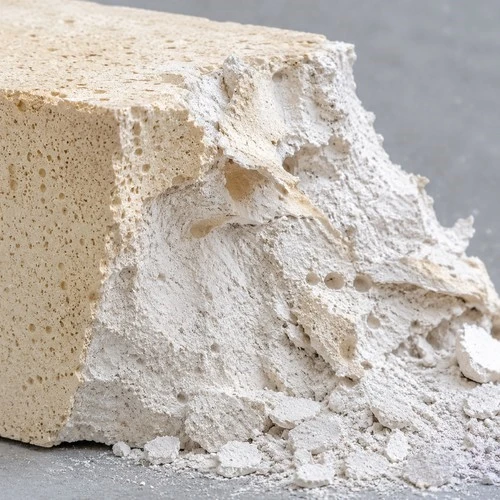
The physical performance of an alumina bubble insulating brick originates from its internal microscopic geometry-a network of sealed, spherical ceramic bubbles bonded within a sintered corundum skeleton:

1. High-Energy Electric Arc Fusion and Aerodynamic Atomization
Industrial-grade calcined Bayer alumina is loaded into an electric arc tilting furnace and fused into a homogenous liquid melt at temperatures exceeding 2200°C. As the superheated molten corundum stream exits the pour spout, a high-velocity stream of compressed air (0.6 to 0.8 MPa) intercepts the liquid stream perpendicularly. The intense aerodynamic shear force atomizes the molten stream into micro-droplets. During free flight, high liquid surface tension pulls each molten droplet into a spherical envelope, while thermal expansion of entrained air hollows the core before instantaneous surface chilling freezes the alpha-corundum shell.
2. Micro-Porosity and Sintering Kinetics
The resulting hollow spheres (graded from 0.2 mm to 5.0 mm with wall thicknesses between 50 and 200 microns) are classified via multi-deck vibrating sieves. Classified bubbles are blended with ultra-fine reactive alpha-alumina micro-powders and molded under calibrated hydraulic pressing (30 to 50 MPa) designed to achieve close particle packing without crushing the hollow sphere shells. During subsequent firing in high-temperature shuttle kilns at 1700°C to 1750°C, the fine matrix powders sinter directly onto the bubble surfaces, forming solid ceramic necks that lock the spheres into a rigid, load-bearing framework.
Technical Specifications: Topower AB Alumina Bubble Brick Series
Matching furnace thermal zones with verified physical and chemical parameters ensures structural reliability under intense thermodynamic stress:
| Technical Parameter / Property | Grade AB-12 (Lightweight Thermal Barrier) | Grade AB-14 (Standard Workhorse Grade) | Grade AB-16 (High-Strength Structural Grade)| Test Standard | | :--- | :--- | :--- | :--- | :--- | :--- | | Al2O3 Content (%) | >= 98.5 | >= 98.5 | >= 98.0 | ASTM C114 | | SiO2 Content (%) | <= 0.30 | <= 0.40 | <= 0.50 | ASTM C114 | | Fe2O3 Content (%) | <= 0.20 | <= 0.20 | <= 0.25 | XRF Analysis | | Na2O + K2O Content (%) | <= 0.30 | <= 0.30 | <= 0.35 | ASTM C114 | | Bulk Density (g/cm3) | 1.20 - 1.30 | 1.35 - 1.45 | 1.50 - 1.65 | ASTM C134 | | Apparent Porosity (%) | 65.0 - 70.0 | 60.0 - 65.0 | 55.0 - 60.0 | ASTM C20 | | Cold Crushing Strength (MPa)| >= 12.0 | >= 18.0 | >= 25.0 | ISO 10059 | | Refractoriness Under Load (°C)| >= 1680 | >= 1720 | >= 1750 | ASTM C16 (0.1 MPa) | | Linear Change (1650°C x 3h) | +/- 0.3% | +/- 0.2% | +/- 0.2% | ASTM C210 | | Thermal Conductivity @ 400°C | 0.65 W/m·K | 0.75 W/m·K | 0.85 W/m·K | ASTM C182 | | Thermal Conductivity @ 1000°C| 0.95 W/m·K | 1.10 W/m·K | 1.30 W/m·K | ASTM C182 | | Thermal Conductivity @ 1400°C| 1.25 W/m·K | 1.45 W/m·K | 1.70 W/m·K | ASTM C182 |
Thermodynamic Stability in High-Temperature Reducing Atmospheres
In synthetic gasification and pure hydrogen annealing processes, furnace atmospheres contain between 70% and 99% dry H2 alongside concentrated carbon monoxide (CO) at temperatures past 1400°C:
The Destructive Chemistry of Silica Reduction
In conventional insulating refractories containing silicates or free silica (such as mullite insulating fire brick or fireclay), silica readily reduces in the presence of hot hydrogen gas:
SiO2 + H2 -> SiO(gas) + H2O
The resulting volatile silicon monoxide (SiO) gas migrates outward toward cooler furnace zones, condensing as destructive glassy deposits on boiler tubes, heat exchangers, and catalyst beds. Simultaneously, the depletion of silica leaves the refractory lining porous, chalky, and structurally brittle.
Chemical Immunity of Ultra-Low Silica Bubble Bricks
By maintaining total SiO2 strictly below 0.30% to 0.50% and Fe2O3 below 0.20%, this engineered hollow corundum refractory contains almost zero reducible oxides. The corundum crystal structure maintains chemical equilibrium in dry hydrogen, pure carbon monoxide, and volatile hydrocarbon gas streams up to 1800°C, completely eliminating volatile outgassing and preserving brick structural strength across multi-year operating campaigns.
Multi-Layer Lining Design: Gasifiers & Petrochemical Reactors
In industrial gasification and extreme thermal reactors, refractory linings operate as integrated multi-tier systems where each layer performs a specialized thermodynamic role:
Direct Hot-Face Liquid Slag Barrier: In coal-water slurry gasifiers, molten acidic or basic coal slag attacks the working face. Dense chrome-corundum or fused-cast blocks serve as the sacrificial hot face to resist turbulent liquid slag erosion and physical wash.
Intermediate High-Temperature Insulation Layer: Directly behind the dense hot face, Grade AB-14 alumina bubble bricks form a 150 mm to 230 mm thick thermal barrier. This layer withstands the 1400°C to 1550°C interface temperature while dropping thermal conductivity by more than 60%, drastically blunting heat flow toward the shell.
External Cold-Face Conservation Layer: Behind the bubble brick course, a combined backing of calcium silicate board or high-density ceramic fiber blanket reduces the exterior steel vessel temperature below 180°C to 220°C, protecting the pressure vessel from thermal stress fatigue.
Carbon Black Crackers & Ultra-High Vacuum Metallurgy
Beyond synthesis gasifiers, high-purity hollow sphere bricks solve distinct failure modes across specialized processing vessels:
1. Carbon Deposition Resistance in Hydrocarbon Crackers
In oil-furnace carbon black reactors operating at 1700°C to 1850°C, high-velocity feedstock oils crack into turbulent gaseous carbon streams. Standard refractories suffer from catalytic carbon disintegration: traces of free metallic iron (Fe) or iron oxides catalyze the Boudouard reaction (2CO -> C + CO2), forcing elemental carbon crystals to grow inside open micro-pores. This internal crystalline expansion fractures brick matrices from within. With Fe2O3 controlled under 0.20% and open porosities isolated by closed spherical envelopes, Grade AB-14 bricks completely halt internal carbon whisker growth, maintaining lining integrity in high-shear reactor throats.
2. Zero-Outgassing Stability in Vacuum Induction Melting (VIM)
In aerospace vacuum induction furnaces producing single-crystal nickel superalloys and reactive titanium aluminides, furnace chambers maintain vacuum levels between 10^-2 and 10^-4 mbar at 1600°C. Standard refractories exhibit high volatile outgassing-releasing alkali vapors and silicon sub-oxides that contaminate superalloy melts. Pure alpha-corundum exhibits an exceptionally low equilibrium vapor pressure at elevated temperatures, ensuring zero alloy melt contamination while supporting high-frequency induction coil electrical insulation.
Jobsite Masonry Standards & Mortar Engineering
Because hollow sphere refractories feature high open porosities (55% to 70%), jobsite installation requires specialized masonry procedures:
High-Purity Corundum Mortar Compatibility: Never lay bubble bricks with fireclay or aluminosilicate mortars containing high silica. Masons must exclusively utilize chemical air-setting refractory mortar formulated with Al2O3 >= 90% and SiO2 <= 4.0% to prevent low-melting eutectic formations at brick joints.
Precision Thin-Joint Execution: Every alumina bubble insulating brick must be dipped in fluid mortar slurry and pressed firmly into position with a sliding motion, maintaining finished joint thicknesses strictly between 1.0 mm and 1.5 mm. Thicker joints represent weak thermal pathways susceptible to gas bypass.
Moisture Protection and Dry Storage: Hollow sphere bricks absorb environmental humidity rapidly due to capillary draw. All palletized materials must be stored in climate-controlled indoor warehouses; bricks with absorbed moisture subjected to rapid kiln heat-up will experience internal steam pressurization and explosive spalling.
Diamond-Blade Wet Machining: Field adjustments around burner sleeves and thermocouple ports must be executed with high-speed diamond-tipped masonry saws. Dry chopping or impact chiseling crushes the delicate internal hollow spheres, destroying localized compressive strength.
Technical Sourcing, Sampling & Engineering Collaboration
Topower Refractory manufactures precision alumina bubble insulating brick shapes in standard straights (230 x 114 x 65 mm, 230 x 114 x 75 mm) as well as custom-machined arch, wedge, and feather-edge blocks for radial furnace arches:
Export Packaging Protection: Bricks are packed in heavy multi-wall export cartons with dense foam dividers, stacked on ISPM-15 compliant heat-treated wooden pallets, and sealed within UV-resistant polyethylene shrink hoods. A standard 20GP container carries 18.0 to 22.0 metric tons.
Laboratory Sample Verification: Qualified engineering firms and petrochemical operators can request 1 to 4 full-sized brick samples alongside complete 3.1 chemical inspection certificates for laboratory thermal conductivity and hot crushing verification.
Direct Engineering Support: To review lining blueprints, evaluate gas composition limits, or calculate 1D steady-state kiln shell heat loss, consult our high-temperature refractory engineering team directly at inquiry@topower.tech.


