


In the global production of shaped and monolithic refractories-spanning high alumina firebricks, low-cement castables, steel ladle safety linings, and anti-skid road surfacing-calcined bauxite represents the industry's primary workhorse aggregate. Sourced predominantly from mineral deposits calcined at 1600°C to 1750°C, this high-alumina clinker balances high structural refractoriness with cost-efficient availability compared to synthetic tabular alumina. However, international refractory producers and foundry procurement directors frequently face technical setbacks: unexpected secondary expansion during product firing, elevated water demand in castable formulations, or premature wear from high internal porosity and unburned mineral cores. Sourcing high-yield, chemically stable calcined bauxite requires evaluating bulk density thresholds (from 2.80 g/cm3 up to 3.25 g/cm3), understanding the kiln firing process (rotary kiln versus shaft kiln), and controlling volatile impurities such as iron and titania across standard 75% to 88% Al2O3 grades.
Mineralogical Genesis: Diaspore Transformation & Secondary Mullitization
The thermal performance of calcined bauxite is forged through sequential phase changes that take place inside the calcining kiln:
1. Thermal Decomposition of Natural Diaspore
Raw bauxite consists primarily of diaspore (alpha-Al2O3·H2O) accompanied by kaolinite clay impurities (Al2O3·2SiO2·2H2O). Between 450°C and 600°C, crystal chemically combined water evaporates rapidly. As the kiln temperature surpasses 1100°C to 1250°C, the dehydroxylated lattice restructures into fine corundum (alpha-Al2O3) micro-crystals, while associated clay minerals liberate reactive amorphous silica.
2. The Secondary Mullitization Window
Between 1200°C and 1400°C, the newly liberated silica reacts with adjacent alumina grains to form synthetic secondary mullite (3Al2O3·2SiO2). This solid-state reaction is accompanied by a volumetric expansion of roughly 8% to 10%. If raw bauxite is under-calcined (a frequent flaw in low-cost shaft kilns), this mullitization reaction remains incomplete. When refractory bricks manufactured from under-calcined grog are subsequently fired, the residual mullite synthesis triggers secondary swelling, creating internal micro-fissures, warping, and dimensional rejection.
3. Influence of Fe2O3 and TiO2 Fluxes
Natural bauxites carry 1.5% to 3.5% titanium dioxide (TiO2) and 1.2% to 2.5% iron oxide (Fe2O3). During sintering, TiO2 enters solid solution within corundum crystals and reacts with alumina to synthesize tialite (Al2TiO5), which acts as a sintering aid to accelerate grain densification. However, if iron and alkali impurities (Na2O + K2O) exceed critical limits, low-viscosity liquid aluminosilicate phases develop at grain boundaries above 1300°C, causing high creep rates under mechanical kiln load.
Technical Specifications: Topower Industrial Calcined Bauxite Series
Evaluating verified physical and chemical specifications from our calcining rotary kilns enables procurement engineers to select the exact aggregate grade for their formulations:
| Technical Property / Parameter | Grade 75# (Standard Grade) | Grade 80# (Intermediate Grade) | Grade 85# (High-Duty Grade) | Grade 88# (Super Premium Grade) | Test Standard |
|---|---|---|---|---|---|
| Al2O3 Content (%) | >= 75.0 | >= 80.0 | >= 85.0 | >= 88.0 | ASTM C573 |
| SiO2 Content (%) | <= 12.0 | <= 9.50 | <= 7.00 | <= 5.50 | ASTM C573 |
| Fe2O3 Content (%) | <= 2.50 | <= 2.20 | <= 2.00 | <= 1.80 | XRF Analysis |
| TiO2 Content (%) | <= 4.00 | <= 4.00 | <= 3.80 | <= 3.50 | XRF Analysis |
| CaO + MgO Content (%) | <= 0.80 | <= 0.70 | <= 0.60 | <= 0.50 | ASTM C573 |
| Bulk Density (g/cm3) | >= 2.75 | >= 2.85 | >= 3.00 | >= 3.20 - 3.25 | ASTM C357 |
| Water Absorption (%) | <= 5.0 | <= 4.0 | <= 3.5 | <= 3.0 | ASTM C20 |
| Refractoriness (°C) | >= 1770 | >= 1780 | >= 1790 | >= 1800 | ISO 528 |
| Loss on Ignition - LOI (%) | <= 0.35 | <= 0.30 | <= 0.25 | <= 0.20 | ASTM C573 |
| Standard Sizing Fractions | 0-1 mm, 1-3 mm, 3-5 mm, 5-8 mm, -200 mesh, -325 mesh | Precision Screening |
Rotary Kiln vs Shaft Kiln Bauxite: Sourcing Economics & Homogeneity
In the global raw material market, calcined bauxite is manufactured using two distinct thermal processing technologies, each producing noticeable differences in batch consistency:
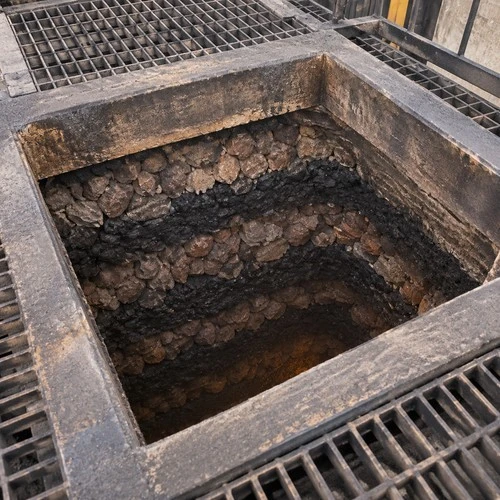
Continuous Rotary Kiln Bauxite: Raw ore is crushed into uniform feed and rotated continuously through a refractory-lined cylindrical kiln fired with natural gas or pulverized coal at 1650°C to 1750°C. Continuous tumbling ensures that every individual clinker lump experiences identical thermal heat-soak. The resulting aggregate features high bulk density (exceeding 3.20 g/cm3 for Grade 88#), uniform phase distribution, and near-zero under-burned cores. This consistency makes rotary bauxite mandatory for low-cement refractory castable products where erratic water absorption ruins workability.
Vertical Shaft Kiln Bauxite: Raw lumpy ore is layered with coke or coal inside a vertical shaft kiln. Heat distribution is inherently non-uniform: aggregate along the kiln perimeter reaches sintering temperatures, while the inner core often suffers from localized under-burning (spotted white clinker with densities below 2.70 g/cm3). While shaft kiln clinker is typically 12% to 18% cheaper, it requires intensive post-calcination optical sorting and magnetic separation to remove high-iron inclusions.
Formulation Economics: In standard high alumina brick production, blending 70% rotary kiln coarse aggregates with 30% sorted shaft kiln fines allows brickworks to maintain high hot crushing strength while containing raw material expenditure. Conversely, when comparing bauxite with high-purity synthetic tabular alumina, calcined bauxite delivers over 80% of tabular alumina's hot strength at approximately half the aggregate cost.
Grain Fractionation & Andreasen Packing in Monolithics
To optimize mechanical strength and minimize porosity in refractory mortars, gunning mixes, and precast shapes, formulators structure calcined bauxite into engineered particle size distributions:
1. Matrix Densification via Continuous Grading
Applying an Andreasen continuous packing distribution (modulus q = 0.26 to 0.30) achieves optimum packing densities:
Coarse Skeleton Aggregate (3-5 mm and 5-8 mm): 35% to 40% by weight, establishing a rigid, interlocking structural lattice that arrests propagating cracks.
Intermediate Stress-Relief Grain (1-3 mm and 0-1 mm): 25% to 30% by weight, nested tightly into the void spaces between coarse clinker grains.
Reactive Matrix Fines (-200 mesh and -325 mesh): 30% to 35% by weight, providing abundant reactive surface area that combines with calcium aluminate binders to form strong ceramic bonds at 1000°C to 1350°C.
2. Controlling Water Addition
Because open porosity in lower-density bauxite absorbs mixing water, utilizing Grade 88# rotary bauxite with low water absorption (under 3.0%) limits the water-to-cement ratio in castables below 4.5% to 5.2%. Minimizing mixing water prevents capillary bleeding channels, lowering dried permeability and enhancing molten metal corrosion resistance.
Ocean Shipping Logistics, Moisture Defense & Packaging Standards
Calcined bauxite is shipped globally in dry bulk vessel holds or ocean container loads. Topower Refractory enforces strict quality controls across export shipments:
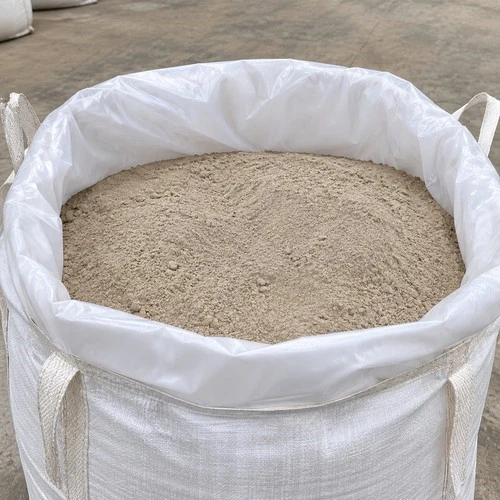
Moisture-Proof Jumbo Bag Packaging: Granular and milled fractions are packed in 1.0 MT, 1.25 MT, or 1.5 MT heavy-duty UV-stabilized woven polypropylene bags. To protect milled fines (-200 mesh) from oceanic humidity, bags are fitted with 80-micron sealed polyethylene inner liners.
Container Weight Optimization: High mineral bulk density allows maximum container utilization. A standard 20GP container accommodates 20 to 22 jumbo bags (20.0 to 22.0 metric tons net weight). All container floors are lined with corrugated cardboard, and bags are secured with heavy-duty polyester strapping.
Lead Times & Maritime Dispatch: Shipments depart from our central warehousing hubs in Tianjin and Qingdao within 7 to 12 working days from purchase order confirmation.
Buyer's Field Quality Verification Protocol
To verify that delivered shipments conform to commercial purchase orders and prevent production contamination, receiving plants should execute three standard acceptance checks:
Hydrostatic Bulk Density Verification (ASTM C357): Perform density testing on sampled 3-5 mm coarse grains. Reject lots if bulk density falls below 3.15 g/cm3 for Grade 88# or 2.95 g/cm3 for Grade 85#, as low density indicates under-calcining and high porosity.
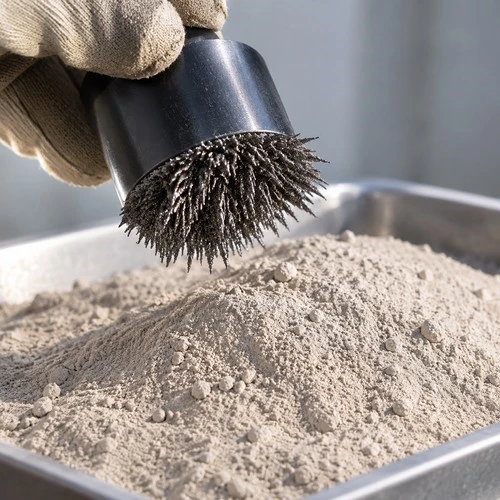
Magnetic Separation & Iron Screening: Pass 1.0 kg of milled bauxite fines across a high-intensity neodymium bench magnet. Free metallic iron pick-up from crushing rolls must be held under 0.05% to prevent iron-spot carbon disintegration in service.
Loss on Ignition (LOI) Test: Ignite a 10 g pulverized sample at 1000°C for 60 minutes. An LOI exceeding 0.35% reveals moisture pickup or residual carbonate and hydroxide uncalcined matter.
Sieve Analysis & Particle Distribution (ISO 3310-1): Execute dry mechanical screening on 500 g representative aggregate samples. Ensure cumulative oversize and undersize deviations remain strictly within +/- 5.0% of purchase contracts. Uncontrolled fines in coarse fractions increase matrix liquid demand, while oversized grains weaken pressed shapes compared to precision-machined mullite insulating fire brick masonry.
Technical Inquiries, Sourcing & Certified Sampling
Topower Refractory maintains large-scale crushing, sieving, and air-classifying facilities in Shandong and Shanxi, supplying raw and sized calcined bauxite to refractory manufacturers, abrasives producers, and industrial foundries worldwide:
Custom Aggregate Processing: We produce bespoke size fractions according to customer-specific sieve curves, including customized fractions such as 0.5-2 mm, 1-4 mm, and high-purity milled flours down to -325 mesh (44 microns).
Sample Testing & Technical Data: Industrial laboratories can request 2 kg to 10 kg evaluation samples for particle sizing confirmation and pilot castable trials. Full 3.1 chemical inspection certificates and sieve curves are available on request.
Direct Engineering Support: To discuss raw material formulations, container freight rates, or custom size grading schedules, contact our mineral sourcing engineers directly at inquiry@topower.tech


